The family is the primary agent of socialization, playing a crucial role in shaping an individual’s values, attitudes, and career choices. In Indian society, where familial influence is deeply rooted, the occupational roles individuals assume are often guided by the socialization processes they undergo at home. This blog explores how socialization in the family influences occupational roles, integrating sociological theories with real-world phenomena.
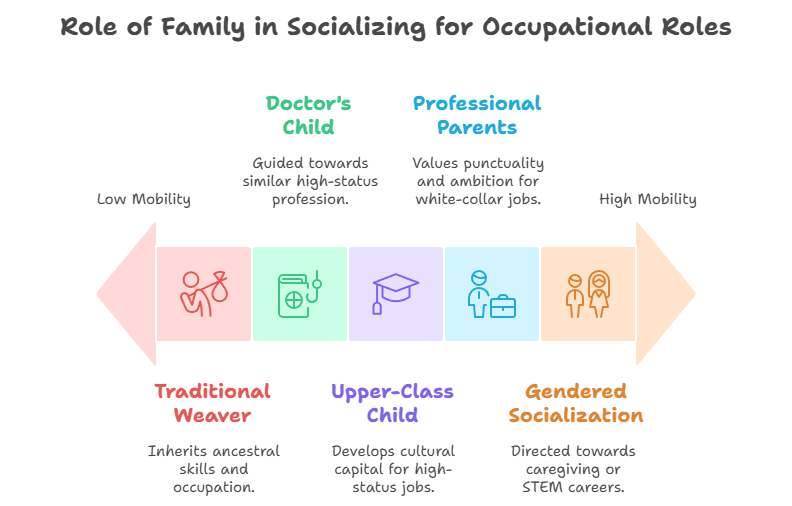
Role of Family in Socializing for Occupational Roles
Primary Socialization and Work Ethic: Children learn the value of work, discipline, and responsibility from their parents. In nuclear families with professional parents, values like punctuality, ambition, and planning are emphasized—gearing children toward white-collar occupations.
Parental Occupation and Aspirations: Family influences occupational aspirations. For instance, children of doctors or lawyers are often nudged toward similar professions, owing to exposure, resources, and role models. This sustains occupational inheritance in Indian society.
Caste and Traditional Occupations: In rural India, caste-based occupational socialization is still prevalent. A weaver’s child is socialized into the art of weaving, reflecting Louis Dumont’s theory of hierarchy and the link between caste and profession in traditional society.
Gender Socialization: Families socialize boys and girls differently. Girls may be directed toward caregiving roles (e.g., nursing, teaching), while boys are often encouraged to pursue STEM or managerial careers. This reinforces gendered division of labor, a concept discussed by Ann Oakley.
Cultural Capital and Class-Based Occupation: Pierre Bourdieu emphasized that middle and upper-class families provide children with “cultural capital”—skills, language, and dispositions—which align with high-status occupations. This perpetuates class reproduction through family socialization.
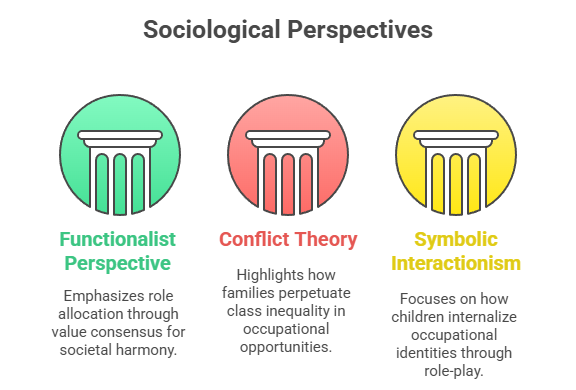
Sociological Perspectives
Functionalist Perspective: Families play a key role in role allocation through value consensus. Individuals internalize roles suitable for the smooth functioning of society. This supports occupational role differentiation.
Conflict Theory: The family perpetuates class inequality. Bourgeois families transmit advantages that secure better occupations for their children, while proletarian families often lack access to resources needed for social mobility.
Symbolic Interactionism: Through role-taking and imitation, children internalize occupational identities. A child pretending to be a teacher or engineer is developing a self-concept aligned with those occupations.
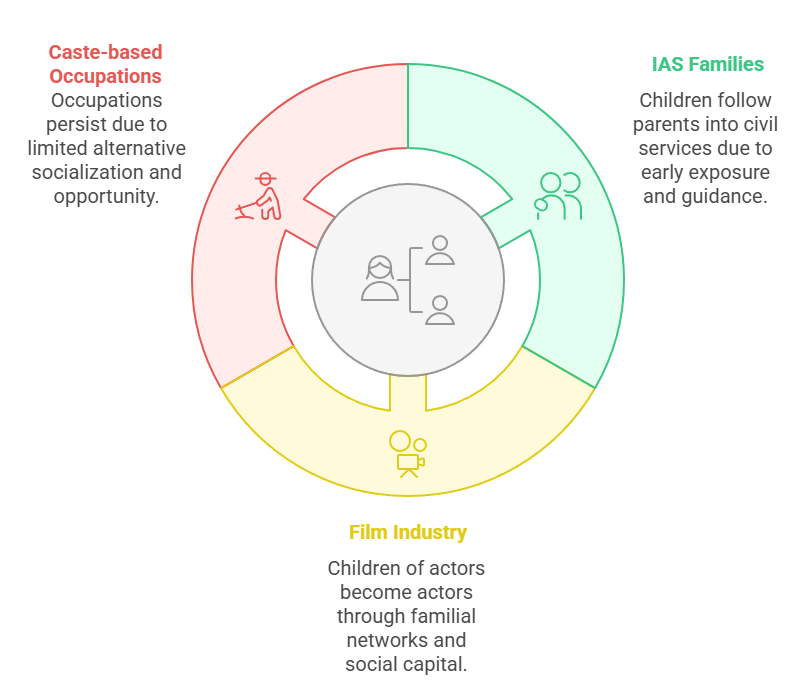
Real-life Examples from Indian Society
IAS Families: In India, families with members in civil services often produce future bureaucrats, supported by early exposure, guidance, and value inculcation.
Film Industry: Children of actors often become actors, revealing how familial networks and social capital define career paths.
Caste-based Occupational Continuity: Among Many Scheduled Castes, occupations such as manual scavenging persist due to limited alternative socialization and opportunity.
Conclusion
Family is not just a unit of emotional bonding but a critical site of occupational conditioning. The process of socialization in the family shapes how individuals view work, their ambitions, and their place in society. Understanding this dynamic is crucial for UPSC aspirants, especially those pursuing sociology, as it bridges theoretical knowledge with practical realities in the Indian context.
PYQs
Paper I
How do different agencies of socialization influence the formation of self in individuals? (2016)
Explain the process of anticipatory socialization and its significance in occupational mobility. (2017)
Examine the functional and conflict perspectives of the family in shaping occupational roles. (2018)
Discuss the role of family in the reproduction of social inequality. (2022)
Paper II
Discuss the persistence of caste in professional and white-collar occupations in India. (2015)
How has the urban middle-class family in India adapted to dual-career demands? (2016)
Discuss the effect of economic liberalization on occupational aspirations among middle-class families. (2017)
Do you think that traditional family values continue to influence occupational mobility in India? Discuss. (2018)
Examine how modernization has transformed occupational patterns and family expectations in India. (2021)
Examine the impact of changing family structures on the career aspirations of youth in urban India. (2022)
Critically examine the influence of family background on the success of children in competitive exams like UPSC. (2023)











One comment