


Female Labour Force Participation in India: A Sociological Critique Beyond Numbers
(Relevant for Sociology Paper 2: Rural and Agrarian Transformation in India)
|
India’s recent surge in Female Labour Force Participation Rate (FLFPR) — from 23.3% in 2017-18 to 41.7% in 2023-24 — has been widely hailed as a sign of economic progress. But from a sociological lens, particularly within the context of Indian society, this numeric increase belies a deeper structural crisis in gendered labour. This blog critically engages with the qualitative aspects of female labour in India using frameworks from Marxist, Feminist, and Structural-Functionalist perspectives Deconstructing the “Participation” Narrative: From Numbers to Power
The FLFPR, by design, is a quantitative economic indicator. But as sociologists like Amartya Sen argue, empowerment is not just about participation, but capability. Merely shifting women from unpaid domestic labour to unpaid or poorly paid self-employment (as the data shows) does not represent emancipation — it reflects reproductive exploitation in a new guise. “Participation in labour does not always translate into autonomy or empowerment.” — Naila Kabeer (Feminist Economist) Women Work: The Invisible Labour Force
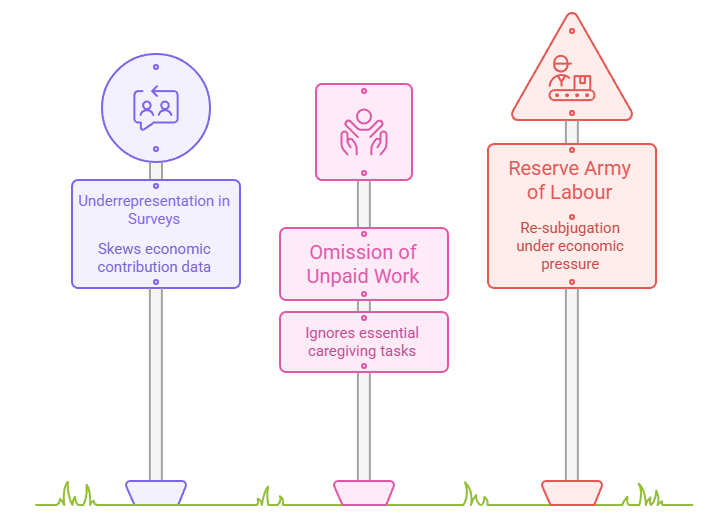
The FLFPR often underrepresents or misrepresents women’s actual contribution. The Time Use Survey of the NSO, aligning with Ann Oakley’s arguments, reveals how much of women’s labour remains invisible. Cooking, caregiving, and subsistence farming are often omitted from the definition of ‘economic work’. Sociological Insight: The Indian woman is not entering the labour market; she has always been there — but invisibly. The state has only recently begun to count her.
From a Marxist-feminist lens (e.g., Silvia Federici), the re-entry of rural women into agriculture and informal sectors can be seen as a response to capitalist crisis. Women act as a “reserve army of labour”, absorbed into low-wage or unpaid work when the economy needs to absorb shocks (rural distress, inflation). This is not liberation — it is a re-subjugation under new economic conditions. Structural Constraints and Social Institutions
Sociologist Parsons and Bales’ structural-functional model explains how societies assign instrumental roles to men and expressive roles to women. In India, this division is still culturally and religiously sanctioned, reinforced by caste endogamy, family honour, and mobility restrictions. Thus, even when women work, they are constrained to gendered, caste-appropriate, low-paid tasks (e.g., bidi-making, tailoring, or unpaid farm labour).
Borrowing from B.R. Ambedkar and Gail Omvedt, any study of women’s work in India must account for caste-class intersections. Dalit and Adivasi women have always worked — but in degrading and devalued forms of labour. The recent rise in FLFPR is not about Brahminical women entering the workforce. It is largely about lower-caste rural women being pushed into informal work due to economic precarity. This is not gender empowerment; it is gendered exploitation through the prism of caste capitalism. Labour and Agency: Beyond Economic Definitions
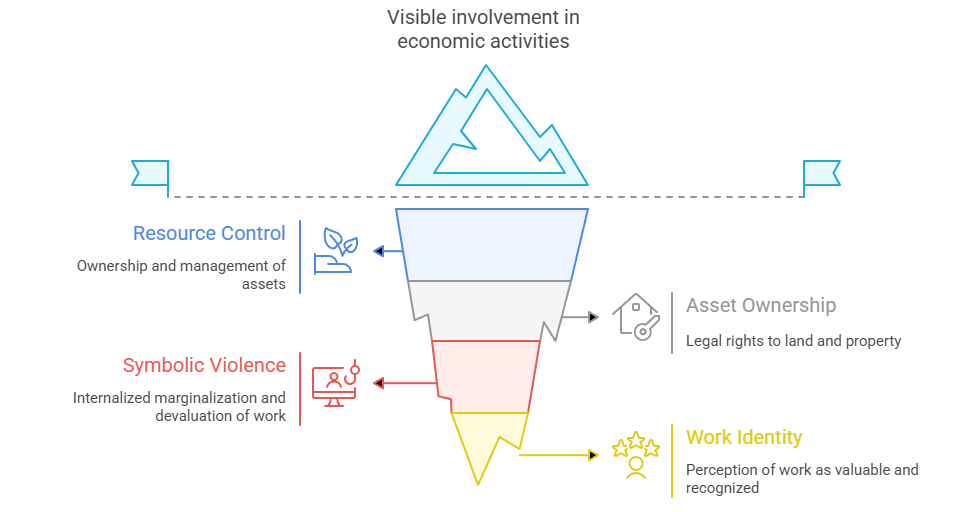
As per Bina Agarwal’s work on land rights, economic participation only leads to empowerment if it results in resource control. Most rural women in agriculture do not own the land they till. The lack of asset ownership reinforces their marginality, both within the household and in the market.
Borrowing from Pierre Bourdieu, many women internalize their marginalisation. Work done at home or in fields is not considered “real work,” even by themselves. This is symbolic violence, where domination is naturalised and goes unchallenged. The Way Forward: Sociological Reimagining of WorkRedefining Labour Sociologists must push for a redefinition of ‘labour’ that includes social reproduction — not just production. This means valuing care work, domestic work, and emotional labour, especially in Indian contexts where the family is the primary economic unit. Building Gender-Just Structures Policies must move from targeting individuals to transforming institutions:
Conclusion: From Labour to LiberationIndia’s rising FLFPR tells us little about freedom, power, or choice. Sociological analysis reveals that women’s work remains structurally constrained, culturally devalued, and economically exploited. True transformation lies not in making women participate more in the current system, but in radically restructuring the system itself — one that recognises unpaid labour, challenges patriarchal social norms, and redistributes both work and power. |


To Read more topics, visit: www.triumphias.com/blogs
Read more Blogs:
Firecracker Ban in India: Environmental Protection and Social Justice
One comment