


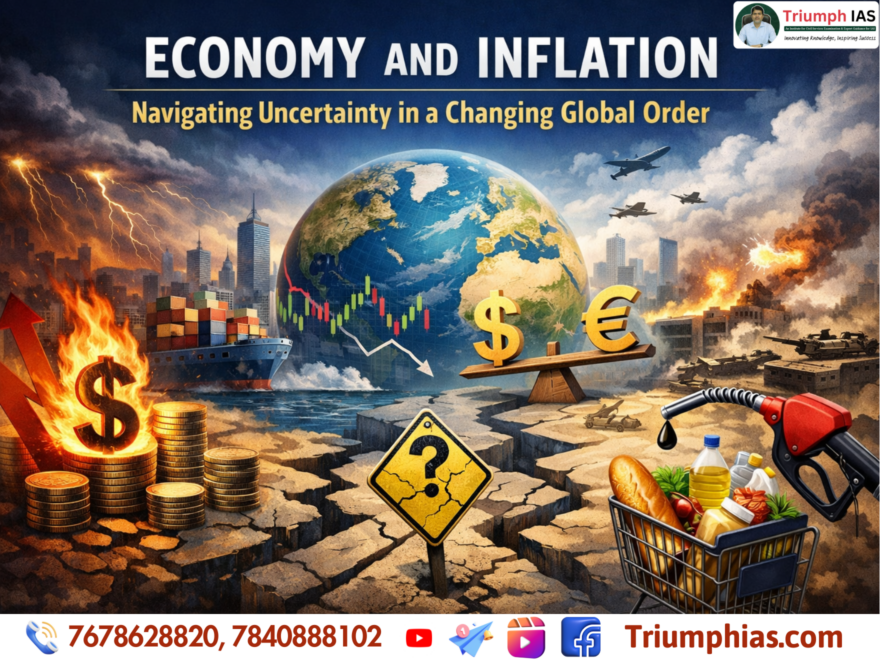
Economy and Inflation: Navigating Uncertainty in a Changing Global Order
(Relevant for Sociology Paper II)
Economy and InflationInflation has once again become a defining feature of contemporary economic discourse. After the disruptions caused by the pandemic, global supply chain breakdowns, geopolitical conflicts, and aggressive monetary tightening, economies across the world are struggling to strike a balance between controlling prices and sustaining growth. As we move through the current phase of global recovery, inflation is no longer a temporary concern but a structural challenge shaping policymaking, social stability, and everyday life. This blog examines the current state of the global and Indian economy, the evolving nature of inflation, its social and political implications, and the possible paths forward in an era marked by uncertainty. Understanding Inflation in the Current ContextInflation refers to the sustained rise in the general price level of goods and services over time. While moderate inflation is often seen as a sign of a growing economy, high or unpredictable inflation erodes purchasing power, widens inequality, and creates economic instability. In recent years, inflation has been driven by a complex interaction of factors:
Unlike earlier inflationary episodes, today’s inflation is not uniform across countries or sectors, making policy responses particularly challenging. Global Economic Landscape: Slow Growth, Persistent PressuresThe global economy is currently experiencing moderate but uneven growth. While a full-scale recession has been avoided in most regions, growth remains below historical averages. Advanced economies are witnessing slowing demand, while emerging economies face the dual challenge of external shocks and domestic vulnerabilities. Advanced EconomiesDeveloped countries have managed to bring down inflation from post-pandemic peaks, but price pressures persist, especially in services such as housing, healthcare, and transportation. Central banks remain cautious about cutting interest rates too quickly, fearing a resurgence of inflation. Developing and Emerging EconomiesMany developing economies continue to struggle with currency depreciation, food inflation, and rising debt burdens. Inflation in these regions disproportionately affects poorer households, where food and fuel constitute a large share of expenditure. Fragile and Conflict-Affected StatesIn countries facing sanctions, political instability, or conflict, inflation has reached crisis levels. Hyperinflation and currency collapse have translated into social unrest, migration, and declining living standards. India’s Economic Position: A Relative Bright SpotIndia stands out in the current global scenario due to its combination of strong growth and relatively low inflation. While challenges remain, the Indian economy has demonstrated resilience amid global headwinds. Inflation Trends in IndiaConsumer price inflation in India has remained largely within the tolerance band of the central bank. A decline in food inflation, especially in vegetables and cereals, has played a key role in moderating headline inflation. This has provided relief to households and created room for policy flexibility. However, inflation is not evenly distributed:
Economic GrowthIndia continues to be one of the fastest-growing major economies. Domestic demand, public investment, infrastructure spending, and a relatively stable financial system have supported growth. Manufacturing and services have shown resilience, even as global trade remains uncertain. This combination of growth and price stability places India in a relatively strong position compared to many global peers. Monetary Policy and Inflation ControlCentral banks play a crucial role in managing inflation through interest rate adjustments and liquidity management. Global Monetary TighteningIn response to high inflation, many central banks aggressively raised interest rates in recent years. While this helped cool inflation, it also increased borrowing costs, slowed investment, and strained financial markets. India’s Monetary ApproachIndia’s central bank has adopted a cautious and calibrated approach. The focus remains on maintaining inflation close to the medium-term target while ensuring that growth is not compromised. Policymakers have emphasized that extremely low inflation can be as problematic as high inflation, as it may signal weak demand. Inflation and Inequality: A Social PerspectiveInflation is not just an economic phenomenon; it has deep social consequences. Impact on the PoorInflation disproportionately affects low-income households because:
Even moderate inflation can push vulnerable households into poverty. Middle-Class AnxietyRising costs of housing, education, healthcare, and transportation have increased financial stress among the middle class. This has social and political implications, including changing consumption patterns and growing dissatisfaction. Gendered ImpactInflation often affects women more severely, especially in developing countries, as they are more likely to manage household budgets and work in informal sectors with unstable incomes. Inflation, Politics, and Public SentimentHistorically, inflation has been one of the most politically sensitive economic issues. Rising prices influence voting behaviour, public trust in institutions, and social stability.
In democracies, controlling inflation is not just an economic goal but a political necessity. Sectoral Dimensions of InflationInflation does not affect all sectors equally.
Food prices are highly sensitive to weather patterns, supply disruptions, and global commodity markets. Climate change has made food inflation more volatile, especially in agrarian economies.
Energy prices influence transportation, manufacturing, and household costs. Geopolitical tensions often lead to sudden spikes, with cascading effects across the economy.
Services inflation tends to be more persistent due to wage pressures and structural factors. This is increasingly becoming a concern in both advanced and emerging economies. Globalisation, Deglobalisation, and InflationThe current inflationary environment is closely linked to changes in the global economic order.
While these changes may enhance long-term security, they also contribute to higher structural inflation. The Role of Fiscal PolicyGovernments worldwide have used fiscal measures to cushion the impact of inflation.
While these measures provide short-term relief, they also increase fiscal deficits and public debt, raising concerns about long-term sustainability. Inflation Expectations and Economic BehaviourOne of the most critical aspects of inflation is how people expect prices to behave in the future.
Managing inflation expectations is therefore as important as controlling actual inflation. Looking Ahead: Risks and OpportunitiesKey Risks
Opportunities
For countries like India, sustaining growth while keeping inflation under control will be critical for long-term development. Conclusion: Inflation as a Test of Economic GovernanceThe current phase of the global economy highlights a fundamental truth: inflation is not merely a technical issue but a test of governance, institutional credibility, and social cohesion. While the worst inflationary pressures may have eased in some regions, the underlying causes—geopolitical uncertainty, climate change, inequality, and structural transformation—remain. India’s relative stability offers valuable lessons, but complacency would be misplaced. The challenge ahead lies in ensuring that growth remains inclusive, inflation remains predictable, and economic policy remains responsive to the needs of society. As economies navigate this uncertain terrain, the ability to manage inflation without sacrificing growth will define the success of governments and institutions in the years to come. |
To Read more topics, visit: www.triumphias.com/blogs
Read more Blogs:
Urban Protests, Civil Resistance, and the Sociology of Dissent
2 comments