


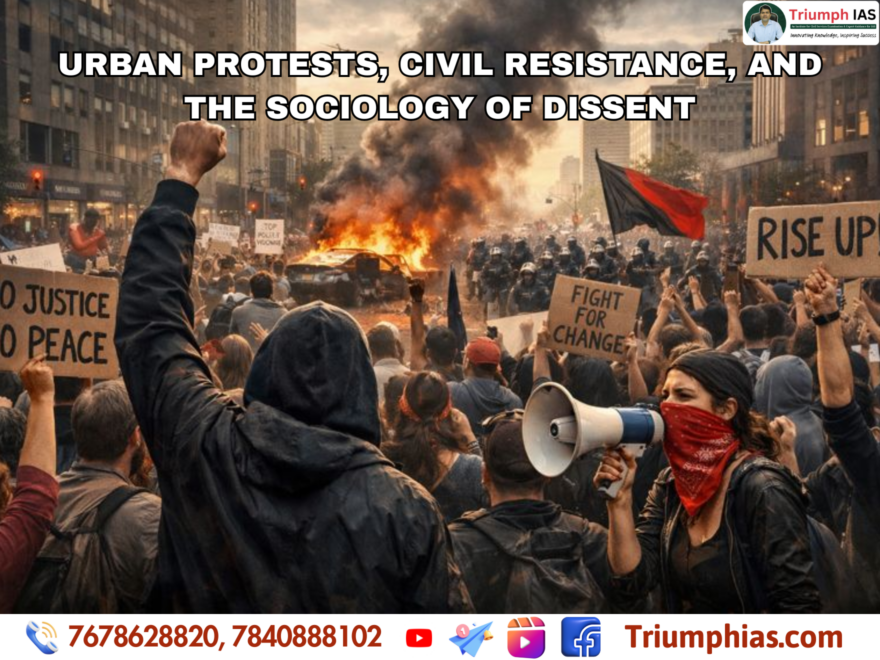
Urban Protests, Civil Resistance, and the Sociology of Dissent
(Relevant for Sociology Paper I and II)
Introduction: Why Urban Protests Politics Is Back at the Centre StageOne of the striking features of today’s news landscape in 2026 is the renewed visibility of mass protests, walkouts, and civil resistance movements across democracies and semi-democracies alike. From coordinated walkouts in advanced economies to issue-based mobilisations in developing societies, dissent has re-emerged as a powerful social force. These movements are not isolated events. They reflect deeper structural tensions arising from economic insecurity, political polarisation, digital surveillance, erosion of trust in institutions, and generational anxieties. Protest in 2026 is not merely about specific demands; it is about reclaiming voice, visibility, and agency in rapidly changing societies. This blog analyses the sociology of protests and civil resistance in contemporary times, with a focus on urban movements, digital mobilisation, and their implications for democracy and social order. Understanding Protest as a Social PhenomenonProtest Beyond Law and OrderSociology views protest not as disorder, but as a form of collective action arising when institutional channels fail to address grievances. Protests occur when:
In this sense, protests are symptoms of social strain, not anomalies. From Class Struggle to Issue-Based MovementsEarlier protest movements were largely class-based—workers, peasants, or colonial subjects. Contemporary protests are more fragmented and issue-driven, focusing on:
This shift reflects changing social structures under late capitalism. Urban Spaces as the Epicentre of DissentWhy Cities Become Protest HubsUrban centres dominate protest politics in 2026 because cities concentrate:
Urban life intensifies visibility of inequality—luxury alongside precarity—creating fertile ground for mobilisation. The Urban Precariat and ProtestA new social class—the urban precariat—has become central to protest politics. This group includes:
Lacking job security and social protection, the precariat experiences chronic uncertainty, translating into political frustration and mobilisation. Digital Media and the New Grammar of ProtestFrom Streets to ScreensIn 2026, protests are organised as much online as offline. Digital platforms enable:
However, digital mobilisation also creates leaderless movements, which can be powerful but fragile. Surveillance and Counter-MobilisationWhile digital tools empower protesters, they also enable state surveillance. Governments monitor social media, map networks, and pre-empt mobilisations. State Responses: Control, Co-option, and CriminalisationPolicing Protest in the 21st CenturyStates increasingly manage protests through:
This reflects a shift from consensus-based governance to security-oriented governance. The Criminalisation of DissentIn many societies, protestors are portrayed as:
This delegitimisation weakens democratic dialogue and narrows the space for lawful dissent. Protest, Democracy, and LegitimacyIs Protest a Democratic Failure or Strength?Contrary to popular narratives, sociologists argue that protests often indicate:
Where protests disappear entirely, it may signal political apathy or repression, not stability. Protests and the Crisis of RepresentationContemporary protests reveal a crisis of representative institutions:
Citizens increasingly rely on direct action to express demands. Identity, Emotion, and Collective ActionThe Emotional Foundations of ProtestProtests are driven not only by material grievances but also by emotions:
These emotions bind individuals into moral communities of resistance. Identity-Based MobilisationMany protests today mobilise around identity—gender, ethnicity, language, generation. While identity politics empowers marginalised voices, it can also fragment movements if not integrated with broader structural demands. Indian Context: Protest and Social ChangeIndia’s Long Tradition of DissentIndia’s social history is deeply shaped by protest:
Contemporary protests continue this legacy but operate within a digital and globalised environment. Changing Nature of Indian ProtestsRecent years show:
Indian protests today reflect tensions between developmental aspirations and democratic rights. Theoretical Perspectives in Sociology1. Marxist Perspective
2. Weberian Perspective
3. Durkheimian Perspective
4. New Social Movement Theory
Limitations of Contemporary Protest MovementsDespite their visibility, modern protests face challenges:
Without institutional follow-up, protests risk symbolic success but limited structural change. Future of Protest PoliticsFrom Resistance to ReconstructionThe future challenge is transforming protest energy into:
Protests must evolve from moments of resistance to processes of reconstruction. Conclusion: Protest as a Mirror of SocietyThe resurgence of protests in 2026 is not accidental. It reflects deeper transformations in economy, politics, and culture. Dissent today is shaped by digital connectivity, urban precarity, identity struggles, and democratic anxieties. Rather than viewing protests as disruptions, sociology urges us to see them as diagnostic tools—revealing fault lines within society. How states respond to dissent will determine whether protests become engines of democratic renewal or symptoms of democratic decay. In a rapidly changing world, the right to protest remains one of the last safeguards of collective voice. |
To Read more topics, visit: www.triumphias.com/blogs
Read more Blogs:
Non-Positivist Methodologies with References from Contemporary Society
One comment