Introduction: Economic Growth and Strategic Competition with China
India’s complex relationship with China is marked by both economic engagement and strategic rivalry. As two of the largest Asian economies and populous nations, India and China share a competitive relationship with overlapping interests and points of contention. The balancing act between economic growth and geopolitical rivalry has emerged as a defining feature of India’s foreign policy and developmental strategies in recent years, especially after the 2020 Galwan Valley clash.
Historical Background
India and China have shared civilizational ties dating back millennia, but their modern relationship is shaped by the 1962 border war, unresolved territorial disputes, and growing competition in global affairs. The Line of Actual Control (LAC), a disputed boundary, remains a constant flashpoint. Since the 2020 Galwan incident, where 20 Indian soldiers were martyred, bilateral ties have been under unprecedented strain.
Trade and Economic Engagement
Trade Growth:
Despite political tensions, bilateral trade between India and China crossed $136 billion in 2023, according to China’s General Administration of Customs.
China remains India’s largest import partner, contribting over 13% of total imports. Imports primarily consist of electronics, machinery, active pharmaceutical ingredients (APIs), and chemicals.
India’s exports to China, mainly iron ore, aluminum, and agricultural products, stood at approximately $16 billion in 2023.
Trade Deficit:
The trade deficit reached a record high of $101 billion in 2023, posing serious concerns for India’s economic policymakers.
To address this, India has implemented measures to promote domestic manufacturing under the ‘Aatmanirbhar Bharat’ initiative and incentivize import substitution in sectors like electronics, solar modules, and APIs.
Strategic Rivalry
Border Disputes:
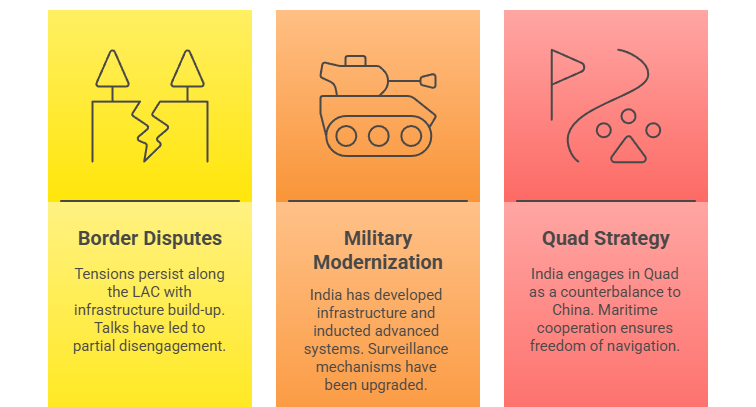
The border tensions persist along the LAC in Eastern Ladakh and Arunachal Pradesh, with recent reports (2024-25) of continued Chinese infrastructure build-up, including new bridges and airfields.
As of July 2025, 19 rounds of Corps Commander-level talks have been held, with partial disengagement in some areas but no full resolution.
Military Modernization:
India has ramped up infrastructure development along border areas, with 295 projects worth ₹11,000 crore completed under the Border Roads Organisation (BRO) since 2022.
The Indian Army has inducted advanced systems like Light Combat Helicopters (Prachand), K-9 Vajra howitzers, and upgraded surveillance mechanisms along the LAC.
Quad and Indo-Pacific Strategy:
India’s engagement in the Quadrilateral Security Dialogue (Quad), along with the US, Japan, and Australia, is viewed as a counterbalance to China’s growing assertiveness in the Indo-Pacific.
India has also signed logistics agreements and deepened maritime cooperation with regional partners to ensure freedom of navigation and rule-based order in the Indo-Pacific.
Technology and Supply Chain Decoupling
Curtailing Chinese Technology Influence:
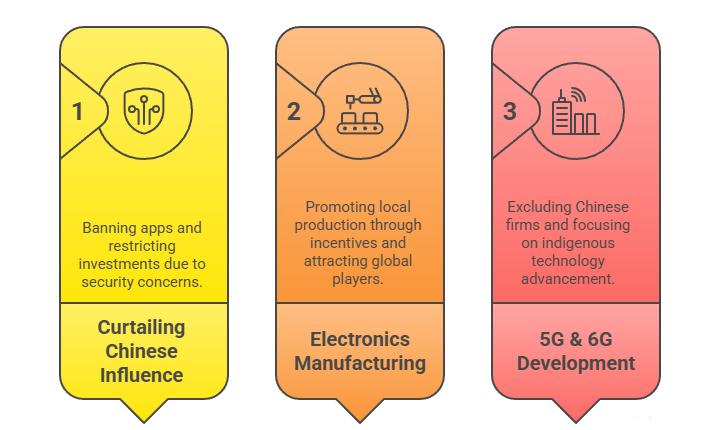
India has banned over 300 Chinese apps, including TikTok and WeChat, since 2020 citing national security concerns.
Restrictions have been placed on Chinese investments in sensitive sectors, especially under Press Note 3 (April 2020), requiring government approval for FDI from countries sharing land borders with India.
Electronics Manufacturing:
Through schemes like the Production Linked Incentive (PLI), India has emerged as an alternative electronics hub. Apple has shifted around 7% of its global iPhone production to India by 2024.
Semiconductor development is being promoted through India’s Semiconductor Mission, with the recent ₹91,000 crore Micron project in Gujarat highlighting diversification efforts.
5G & 6G Developments:
India has excluded Chinese telecom giants like Huawei and ZTE from its 5G networks and is progressing towards indigenous 6G development, with Bharat 6G Vision released in 2023.
Energy and Connectivity Competition
Connectivity Rivalry:
China’s Belt and Road Initiative (BRI) and the China-Pakistan Economic Corridor (CPEC), passing through Pakistan-occupied Kashmir, remain key security concerns for India.
In response, India is promoting alternative connectivity like the India-Middle East-Europe Economic Corridor (IMEC), signed during the G20 Summit 2023, and the Chabahar Port in Iran.
Renewable Energy and Critical Minerals:
China dominates global solar and battery supply chains. India is working towards reducing dependency by increasing domestic solar manufacturing capacity (targeting 100 GW by 2030) and securing critical minerals through partnerships with Australia and Latin American countries.
Diplomatic Balance and Global Engagement
Multilateral Forums:
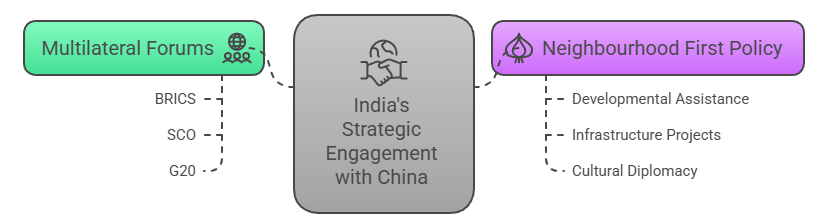
India continues to engage China through BRICS, SCO, and G20 forums, balancing competition with cooperation on global issues like climate change and counter-terrorism.
India assumed the G20 Presidency in 2023, emphasizing inclusive growth and voiced concerns about coercive economic practices without directly naming China.
Neighbourhood First Policy:
India is countering Chinese influence in South Asia through developmental assistance, infrastructure projects, and cultural diplomacy in Bhutan, Nepal, Bangladesh, and the Maldives.
Conclusion
Balancing economic growth and strategic rivalry with China remains one of India’s most significant geopolitical challenges. While India recognizes the necessity of engaging with China economically, it has taken a firm stance on issues of sovereignty and national security. By boosting domestic capabilities, strengthening partnerships in the Indo-Pacific, diversifying trade, and modernizing defence, India is charting a path of strategic autonomy and resilience. This calibrated approach will be critical in safeguarding national interests while ensuring sustained economic progress.







One comment