In India, weddings are elaborate social events, symbolizing union, status, and family pride. But in several villages of India, weddings have transformed into battlegrounds forsocial dignity and caste assertion—particularly for Dalit communities. Recent incidents reveal how Dalit families celebrating weddings face violent backlash from dominant caste groups. This blog explores the sociological dimensions of caste resistance through Dalit weddings, drawing on key concepts and theories.
Understanding the Caste Backlash against Dalit Weddings
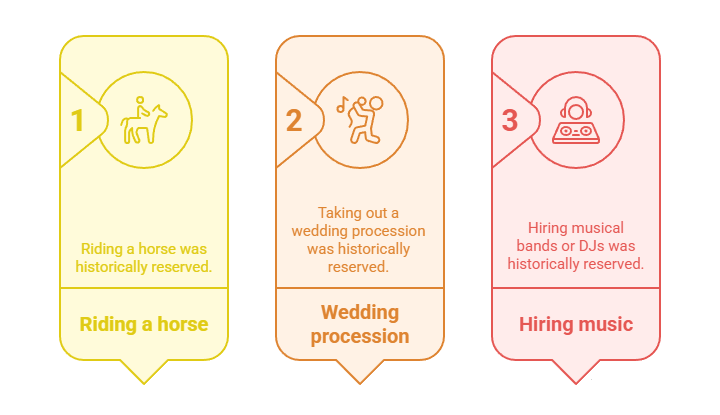
In India’s hierarchical caste order, rituals and symbols are closely guarded markers of status. Practices like:
Riding a horse,
Taking out a wedding procession (baraat),
Hiring musical bands or DJs, were historically reserved for dominant castes.
When Dalits assert these rights, it is seen as a challenge to caste norms and the symbolic power of upper castes. Such assertions invite resistance, often violently, as dominant groups attempt to “discipline” the transgression.
Sociological Analysis
Rituals as Tools of Resistance:
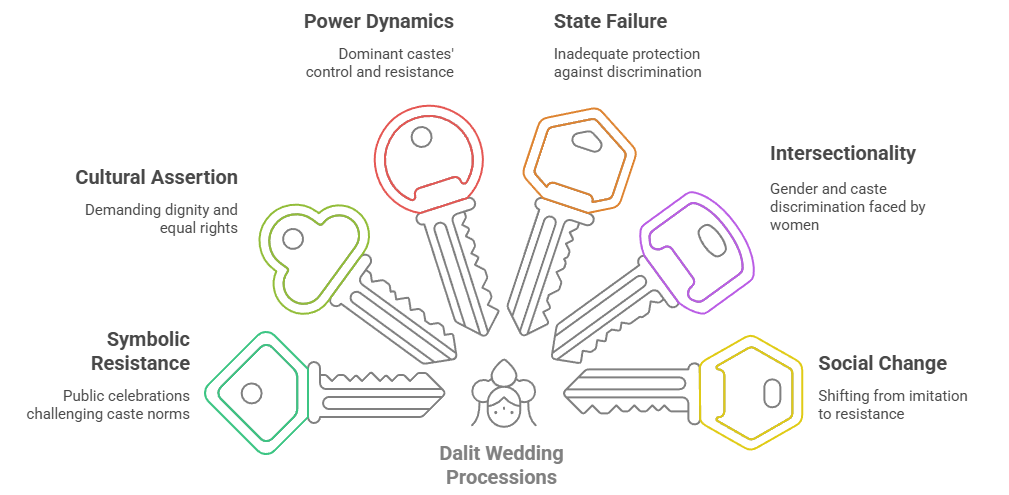
Symbolic Resistance: A wedding procession is no longer just a cultural event—it has become a political act. When Dalits celebrate in public spaces and emulate rituals traditionally denied to them, they are making a symbolic claim to equality.
This aligns with Victor Turner’s concept of ritual as rebellion—where public ceremonies invert or challenge the established social order.
Cultural Assertion and Dignity: Borrowing from B.R. Ambedkar, these acts represent a rejection of ritual purity-pollution hierarchy. Dalit assertion through weddings is a demand for human dignity and equal rights, beyond token constitutional guarantees. In Ambedkarite thought, caste is not merely a division of labor but a division of people that dictates every aspect of life—including marriage, food, and public behavior.
Caste, Power, and Control Over Public Space
Dominant Caste Theory – According to M.N. Srinivas, in many villages of U.P., dominant castes like Jats exercise ritual, economic, and political control. They see Dalit assertion as a threat to their entrenched power, reacting with social boycotts, intimidation, and violence.
Public Space as Political Space: Dalit wedding processions challenge spatial segregation. Marching through village lanes traditionally dominated by upper castes asserts the right to space—a concept explored by Henri Lefebvre in urban sociology. The ability to move freely, celebrate publicly, and occupy central village spaces is deeply political in caste-based rural India.
The Role of the State and Police Protection:
Ironically, the Indian Constitution abolishes untouchability and protects against caste-based discrimination. Yet, Dalits need police protection to celebrate weddings, highlighting:
The state’s failure to dismantle caste-based hierarchies, and
The persistence of extra-constitutional caste authority in villages.
Despite legal frameworks like the SC/ST (Prevention of Atrocities) Act, enforcement is weak, and police often act under local dominant caste pressure, failing to uphold Dalits’ rights.
Intersectionality:
Gender and Caste in Dalit Weddings: While the groom riding a horse often becomes the flashpoint, Dalit women face an intersectional burden. Weddings are traumatic for them when accompanied by threats, humiliation, or violence.
Using Kimberlé Crenshaw’s theory of intersectionality, we understand that Dalit women experience caste and gender discrimination simultaneously—through emotional distress, societal shame, and denial of their right to celebrate.
Social Change and Resistance Through Culture
From Sanskritization to Assertion: In the past, M.N. Srinivas’s concept of Sanskritization described lower castes adopting upper-caste rituals to gain status. But Dalit assertion today is not imitation—it is resistance. It’s about saying, “We too deserve joy, ritual, and respect.”
This shift is critical—from seeking inclusion within caste hierarchy to challenging its very basis.
Dalit Cultural Renaissance: Dalit weddings now feature Ambedkar portraits, blue flags, Bhim songs, and assertive slogans—redefining cultural expression as a form of political resistance. Weddings have thus become mini public spheres where Dalit identity is asserted and celebrated.
What Needs to Change?
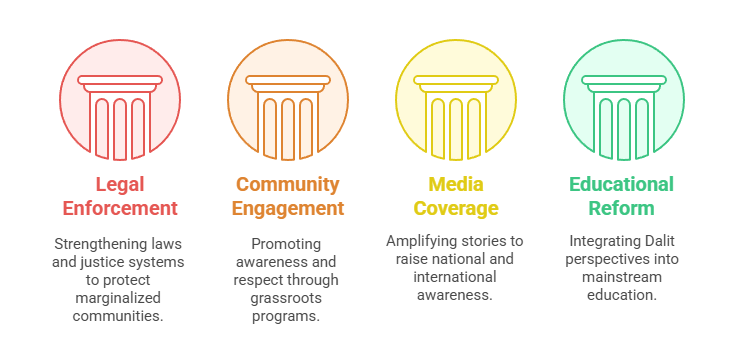
Legal Enforcement: Stronger implementation of SC/ST Atrocities Act and fast-track justice in caste-violence cases.
Community Engagement: Grassroots awareness programs on caste equality, inter-caste respect, and legal rights.
Media Coverage and Documentation: Highlighting these stories beyond local press to national conscience and international human rights forums.
Educational Reform: Dalit assertion and Ambedkarite thought must become a part of mainstream social science education.
Conclusion
What should be a day of joy becomes a struggle for dignity in many Dalit households. Yet, these weddings stand tall—not just as personal victories—but as symbols of collective resistance. Each groom who rides a horse, each family that celebrates openly, reclaims a space denied for generations. These acts remind us that real change is not just legislative but cultural—and that rituals too can be revolutionary. These everyday acts of resistance offer critical insights into India’s deeply layered social fabric.
PYQs
Paper I:
Discuss the features of caste as a form of social stratification. How is it different from class? (2016)
Discuss the relationship between caste, class and power. How do they interact in rural India? (2020)
What is the role of rituals in maintaining social order and hierarchy? Explain with reference to caste society. (2022)
Paper II:
What are the structural and cultural constraints in the eradication of caste in India? (2014)
Examine the impact of caste-based mobilization in Indian politics. (2016)
Explain the dynamics of dominant caste in rural India with suitable examples. (2017)
Explain the concept of Dalit assertion in contemporary India. (2018)
Caste continues to be a determinant of social reality in India. Discuss with suitable examples. (2019)
What are the changing patterns of Dalit identity in contemporary India? (2020)
Discuss the forms and causes of caste-based violence in rural India. (2021)
How far have Dalit movements been successful in changing the socio-political status of Dalits in India? (2022)
Examine the role of state and civil society in empowering Scheduled Castes in India. (2023)
Discuss the sociological significance of rituals in Indian society. (2015)
Explain how symbolic practices reinforce or challenge social hierarchies. Illustrate with examples. (2018)
To what extent is cultural assertion by marginalized communities a form of resistance? (2020)
Analyze how rituals and festivals are used to assert identity in Indian society. (2023)
Explain the concept of dominant caste and its influence on local power structure in rural India. (2015)
How has rural violence shaped inter-caste relations in India? (2018)
Examine the assertion of Dalit rights in the context of rural social stratification. (2022)







One comment