


Relevant for Sociology Optional Paper 1, Paper 2, and GS Paper I (Indian Society)
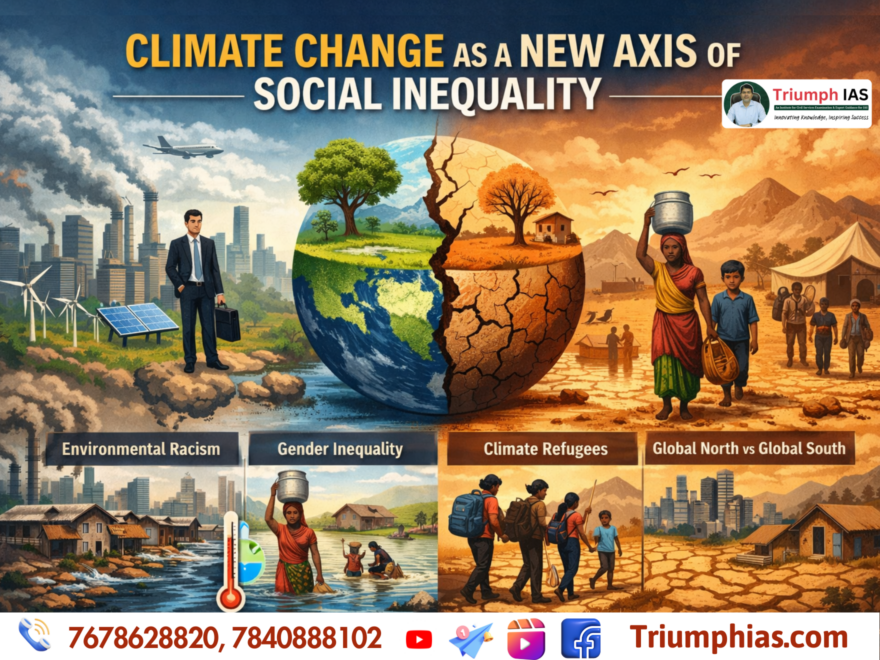
IntroductionClimate change is no longer merely an environmental concern; it has emerged as a profound sociological issue that is reshaping patterns of inequality across the globe. Traditionally, social inequality has been examined through axes such as class, caste, gender, and race. However, in the 21st century, climate change has introduced a new dimension—one that intersects with and intensifies existing inequalities while creating new forms of marginalization. DimensionAt its core, climate change operates unevenly. Its causes are disproportionately linked to industrialized and affluent societies, yet its consequences are borne most heavily by vulnerable populations. This asymmetry reflects what sociologists describe as “climate injustice”—a condition where those least responsible for environmental degradation suffer the most severe impacts. For instance, low-income communities, indigenous populations, and developing nations face heightened exposure to climate risks such as floods, droughts, and heatwaves, despite contributing minimally to greenhouse gas emissions. From a sociological perspective, climate change can be understood through the lens of structural inequality. The distribution of resources, power, and opportunities determines both vulnerability and resilience. Wealthier individuals and nations possess adaptive capacities—such as access to technology, insurance, and infrastructure—that allow them to mitigate or recover from climate shocks. In contrast, marginalized groups often lack these buffers, making them more susceptible to displacement, livelihood loss, and health crises. The concept of environmental racism further illustrates how climate change reinforces inequality. Marginalized communities are frequently located in ecologically vulnerable areas—such as floodplains, drought-prone regions, or polluted industrial zones—due to historical patterns of exclusion and discrimination. This spatial dimension of inequality reveals how environmental risks are socially organized rather than randomly distributed. Climate change also intersects with gender inequality. Women, particularly in rural and agrarian societies, are disproportionately affected due to their dependence on natural resources and limited access to decision-making structures. For example, water scarcity increases the burden of unpaid labor on women, while extreme weather events heighten risks of displacement and exploitation. Thus, climate change amplifies existing gendered divisions of labor and power. Moreover, climate-induced migration is emerging as a significant sociological phenomenon. As environmental degradation renders certain regions uninhabitable, populations are forced to migrate, leading to what is termed “climate refugees.” This displacement often exacerbates social tensions, strains urban infrastructure, and creates new forms of exclusion in host communities. Migration, therefore, becomes both a consequence and a driver of social inequality. The global governance of climate change further reflects unequal power relations. International negotiations often reveal a divide between developed and developing countries, commonly framed as the Global North–South divide. While developed nations advocate for emission reductions, developing countries emphasize historical responsibility and the need for climate finance and technology transfer. This tension underscores how climate change is embedded within broader geopolitical and economic inequalities. Importantly, climate change is not only a driver of inequality but also a potential catalyst for social transformation. Grassroots movements, youth activism, and indigenous resistance have brought attention to issues of environmental justice and sustainability. These collective actions challenge dominant development paradigms and advocate for more equitable and inclusive climate policies. ConclusionIn conclusion, climate change represents a new axis of social inequality that intersects with existing structures of power and privilege. It exposes the deeply embedded inequities in our social systems while demanding a rethinking of development, governance, and justice. Addressing climate change, therefore, requires not only technological solutions but also sociological insight into the distribution of vulnerability and resilience. Only through an integrated approach that prioritizes equity and justice can sustainable and inclusive futures be realized. |
UPSC Civil Services (Mains) Question
Q. “Climate change has emerged as a significant axis of social inequality in contemporary society.” Discuss with suitable examples. (20 Marks)
To Read more topics, visit: www.triumphias.com/blogs
Read more Blogs:



2 comments