


Relevant for Sociology Optional Paper 1, Paper 2, and GS Paper I (Indian Society)
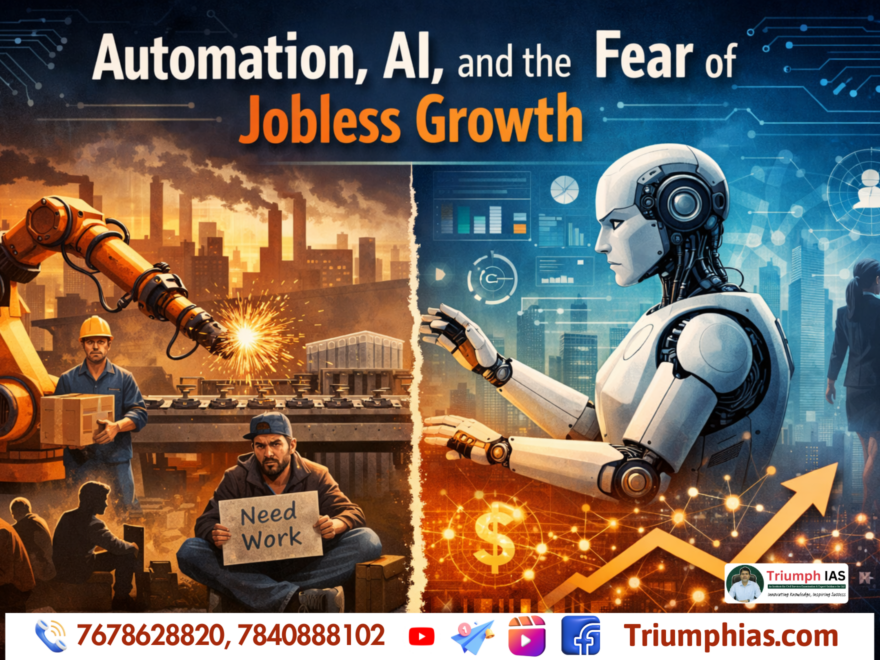
IntroductionThe rapid advancement of automation and Artificial Intelligence (AI) is transforming economies across the world. While technological innovation has historically driven economic growth, the contemporary phase of digital transformation has raised concerns about “jobless growth”—a situation where economic output increases without a proportional expansion in employment opportunities. From a sociological perspective, this phenomenon raises critical questions about the future of labour, social inequality, and the structure of modern societies.
DimensionTechnological change has always been intertwined with social transformation. During the Industrial Revolution, mechanization displaced certain forms of labour but simultaneously created new industries and employment opportunities. However, the current wave of AI-driven automation differs in both scale and speed. Machines are no longer confined to routine manual tasks; they increasingly perform cognitive functions such as data analysis, decision-making, and even creative work. This has intensified fears that technology might replace not only low-skilled labour but also sections of the middle class. Sociologists interpret this transformation through several theoretical frameworks. Karl Marx’s theory of technological unemployment highlighted how capitalist production constantly seeks to replace labour with machines to increase productivity and profit. In Marx’s view, technological innovation under capitalism could create a “reserve army of labour,” where surplus workers remain unemployed or underemployed, exerting downward pressure on wages. Contemporary automation reflects similar dynamics, where firms adopt AI systems to reduce labour costs and enhance efficiency. At the same time, Max Weber’s concept of rationalization helps explain the expansion of automated systems. Weber argued that modern societies increasingly prioritize efficiency, predictability, and calculability. Automation embodies this rationalizing tendency by replacing human discretion with algorithmic decision-making. However, such rationalization may lead to what Weber described as the “iron cage”—a social order where human creativity and autonomy are constrained by technological systems. The rise of automation has also contributed to the informalization and gigification of labour markets. Many workers who lose stable employment due to automation migrate toward precarious forms of work in the gig economy. Sociologists argue that this shift reflects broader structural changes in capitalism, where labour flexibility is prioritized over employment security. Workers increasingly face unstable incomes, lack of social protection, and limited bargaining power. From the perspective of social stratification, automation risks widening inequalities. High-skilled professionals involved in designing, managing, or complementing AI technologies often benefit from technological change. In contrast, workers performing routine tasks—particularly in manufacturing, retail, and clerical occupations—face higher risks of displacement. This divergence may intensify existing divides based on class, education, and digital access, reinforcing what sociologists describe as the digital divide.
The implications of jobless growth are particularly significant in countries like India, where a large proportion of the population depends on labour-intensive sectors. The adoption of automation in manufacturing, banking, and service industries could limit employment absorption despite economic growth. For a country with a vast young workforce, this raises concerns about demographic dividend turning into demographic distress if sufficient employment opportunities are not generated. Nevertheless, sociologists caution against viewing automation purely as a threat. Technology can also create new forms of work, improve productivity, and enhance quality of life. The key challenge lies in ensuring that the benefits of technological progress are socially distributed. This requires proactive public policies focusing on skill development, education, and social security mechanisms. Sociologists also emphasize the importance of strengthening labour institutions and regulating technological transitions to prevent large-scale social dislocation. ConclusionIn conclusion, automation and AI represent not merely technological developments but profound social transformations. The fear of jobless growth reflects deeper anxieties about inequality, labour displacement, and the changing nature of work in the digital age. A sociological perspective reminds us that technology is not socially neutral; its impact depends on how societies choose to organize production, distribute opportunities, and protect vulnerable populations. |

UPSC Civil Services (Mains) Question
Q. “Automation and Artificial Intelligence may lead to economic growth without corresponding employment generation.” Examine this statement from a sociological perspective.(250 words)
To Read more topics, visit: www.triumphias.com/blogs
Read more Blogs:
Great insights shared in this blog! The content is clear, informative, and very helpful for beginners. Looking forward to more such posts!
https://www.gradsiren.co.in/state-cities/Telangana-state-TS?type=Fresher%20Jobs