


Relevant for Sociology Optional Paper 1, Paper 2, and GS Paper I (Indian Society)
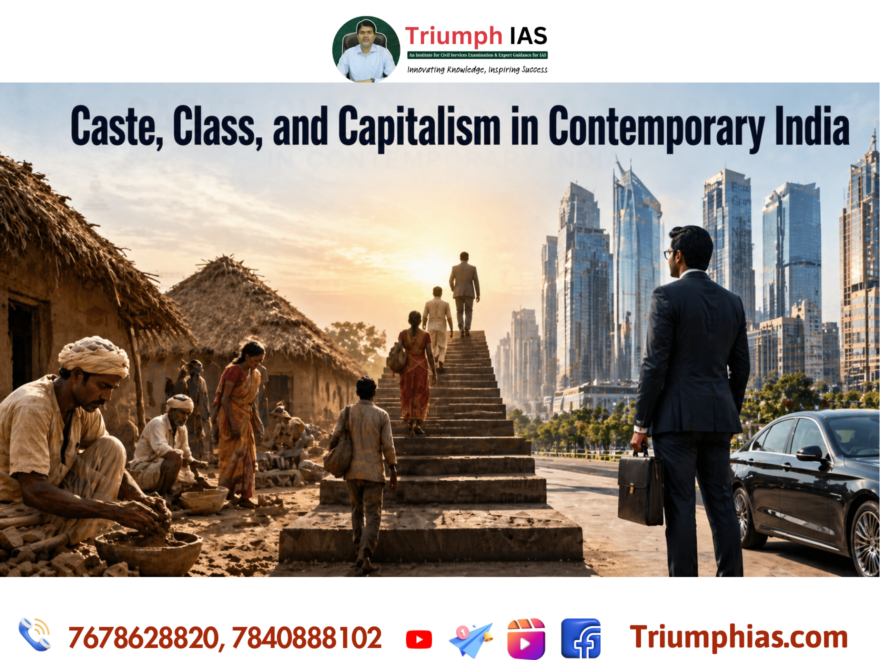
IntroductionThe relationship between caste, class, and capitalism in contemporary India represents one of the most dynamic and debated areas in sociology. While classical sociological theories often treated caste and class as distinct systems—caste as a closed, hereditary hierarchy and class as an open, economic stratification—modern India reveals a complex overlap between the two. The expansion of capitalism has not dismantled caste; rather, it has reconfigured its expression in new economic and social contexts. Historically, caste was understood as a rigid system based on birth, occupation, and ritual status, as elaborated by scholars like G. S. Ghurye and later critiqued by B. R. Ambedkar. Class, on the other hand, is rooted in economic relations, particularly ownership and control over the means of production, following the ideas of Karl Marx. However, in India, caste and class are deeply intertwined, creating what sociologists describe as a “caste-class nexus.” DimensionThe advent of capitalism—especially after the 1991 economic liberalization—has introduced new opportunities for mobility, urbanization, and market participation. Yet, this transformation has not erased caste-based inequalities. Instead, caste has adapted to capitalist structures. For instance, access to education, capital, and networks often remains caste-mediated, influencing who benefits from economic growth. Upper castes continue to dominate corporate sectors, elite institutions, and high-paying professions, while historically marginalized communities remain concentrated in informal and precarious labor markets. Sociologists like M. N. Srinivas argued that processes such as Sanskritization and Westernization enabled some degree of mobility within the caste system. However, these processes have limited impact in a capitalist economy where structural inequalities persist. Similarly, Andre Beteille highlighted how caste, class, and power intersect in shaping social stratification in India, suggesting that neither caste nor class alone can fully explain inequality. In contemporary India, capitalism has also led to the emergence of a new middle class, including individuals from lower castes who have benefited from affirmative action policies and educational opportunities. This has given rise to what some scholars call the “Dalit bourgeoisie.” However, their upward mobility does not necessarily translate into the complete erosion of caste-based discrimination. Social exclusion, prejudice, and symbolic violence continue to persist, particularly in rural areas and even within urban spaces. Moreover, capitalism has commodified caste in unexpected ways. Caste networks are often used in business, politics, and employment, reinforcing social capital within caste groups. Matrimonial markets, for example, continue to prioritize caste endogamy despite modernization. This indicates that capitalism does not operate in isolation but is embedded within existing social structures. At the same time, new forms of resistance and assertion have emerged. Dalit movements, identity politics, and digital activism challenge traditional hierarchies and demand greater equality and representation. These developments suggest that while capitalism may reproduce inequalities, it also creates spaces for contestation and transformation. ConclusionIn conclusion, the interplay of caste, class, and capitalism in contemporary India is characterized by both continuity and change. Capitalism has not abolished caste but has reshaped its functioning, making it less visible yet deeply embedded in economic and social processes. A nuanced sociological understanding requires moving beyond binary frameworks and recognizing the hybrid nature of inequality in India today. |
UPSC Civil Services (Mains) Question
Q. “Discuss how capitalism has transformed but not eradicated caste-based inequalities in contemporary India.” (250 words)
To Read more topics, visit: www.triumphias.com/blogs
Read more Blogs:
Understanding Caste Today: Ghurye, Srinivas, Dumont, and Beteille in Dialogue
A smile is the chosen vehicle for all ambiguities – Triumph IAS & Vikash Ranjan Sir



2 comments