Émile Durkheim (1858-1917) Often called the “father of modern sociology,” Durkheim’s fundamental mission was to establish sociology as a legitimate, scientific discipline distinct from philosophy or psychology. He argued that society was a reality sui generis (of its own kind), a force that existed externally to and coerced the individual. His concepts form the very bedrock of the sociological imagination, providing timeless tools to analyze everything from traditional villages to modern metropolises.
The Core of Durkheim Sociology: Society as the Supreme Reality
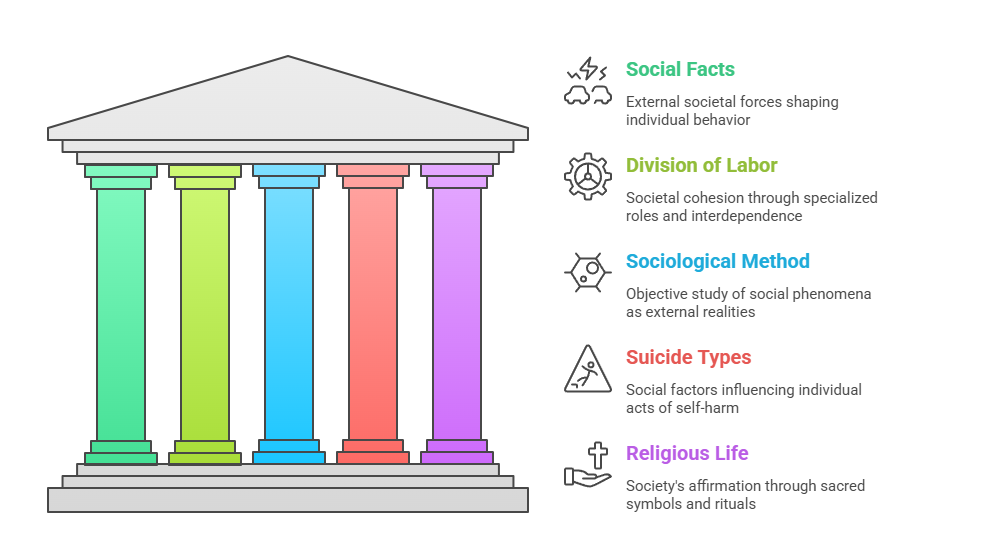
Durkheim’s entire theoretical edifice rests on a few foundational pillars:
Social Facts:This is his most central concept. Social facts are “ways of acting, thinking, and feeling that are external to the individual and endowed with a power of coercion by reason of which they control him.” They are not personal or psychological; they are societal.
Examples:Laws, moral obligations, religious doctrines, language, currency, and even fashion trends. You cannot choose to ignore the rules of grammar or the value of money without facing social consequences.
Types:He distinguished between:
Material Social Facts:Tangible, institutionalized forms like legal codes, architectural forms, and the state.
Non-Material Social Facts:The more pervasive and crucial ones, including morality, collective conscience, collective representations, and social currents.
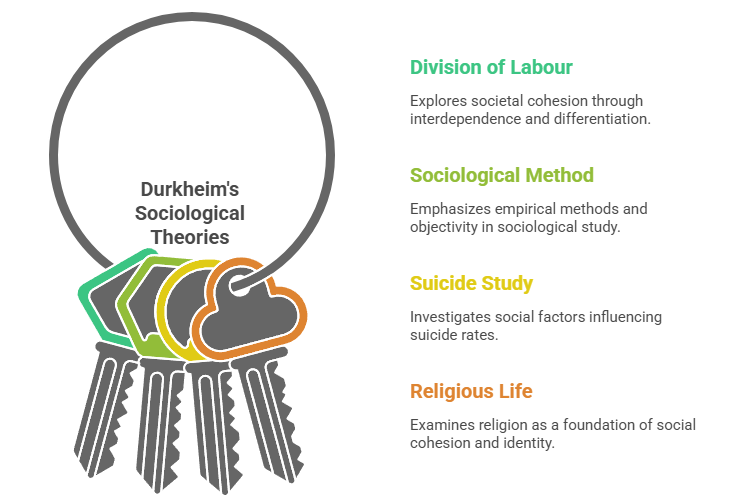
The Division of Labour in Society (1893):Durkheim’s doctoral thesis was a revolutionary take on why societies hold together. He moved beyond economic explanations to a sociological one, identifying two types of social solidarity:
Mechanical Solidarity:Found in simple, traditional societies. Here, social cohesion is based on the similarity of its members. People are united because they all do similar work, hold the same beliefs (strong Collective Conscience), and are governed by Repressive Law (punitive justice for violations of the collective norms).
Organic Solidarity:Found in complex, modern societies. Cohesion is based on difference and interdependence. Just as organs in a body have specialized functions, individuals in society perform specialized roles. This interdependence creates a new form of social bond, governed by Restitutive Law (law that aims to restore normal activity, like contract law).
The Rules of Sociological Method (1895):This was Durkheim’s manifesto for a new science. He insisted that social facts must be treated as “things”—that is, as objective, external realities to be studied empirically, not through introspection. The sociologist must rid themselves of preconceived notions and systematically observe social facts from the outside, primarily through social statistics (like suicide rates).
Suicide (1897):A masterstroke of sociological reasoning. Durkheim took the most personal, seemingly psychological act—suicide—and demonstrated its social By analyzing suicide rates across different European countries, he proved they varied predictably based on social integration and regulation. He identified four types:
Egoistic Suicide:Caused by too little social integration. Individuals who are isolated and lack strong bonds to family, religious groups, or community (e.g., Protestants vs. Catholics; unmarried vs. married).
Altruistic Suicide:Caused by too much social integration. The individual’s life is so subordinated to the group that they willingly sacrifice it (e.g., sati, kamikaze pilots).
Anomic Suicide:Caused by too little social regulation. This occurs during periods of sudden disruption or normlessness (anomie), such as an economic boom or bust, when old rules break down and desires are no longer kept in check.
Fatalistic Suicide:Caused by too much The individual’s future is pitilessly blocked, and passions are choked by oppressive discipline (e.g., the slave, the childless wife). Durkheim mentioned this only in a footnote.
The Elementary Forms of Religious Life (1912):In his final major work, Durkheim argued that the fundamental essence of religion is not God, but society itself. Studying the totemism of Australian Aboriginal clans, he concluded that:
The Sacred and the Profane:All religions divide the world into these two distinct realms. The sacred is set apart, forbidden, and inspires awe; the profane is the realm of the everyday.
Totemism as Collective Representation:The totem, a symbol worshipped by the clan, is in reality a symbol of the clan itself. By worshipping the totem, people are unconsciously worshipping the power of society.
Collective Effervescence:The intense energy and sense of unity generated during religious rituals, protests, or even a massive sports event. This is the moment when society is literally “re-created,” reinforcing social bonds and revitalizing the collective conscience.
Function of Religion:Religion is the symbolic language through which society affirms its own existence. It creates and maintains social solidarity.
Key Conceptual Toolkit for the Aspirant
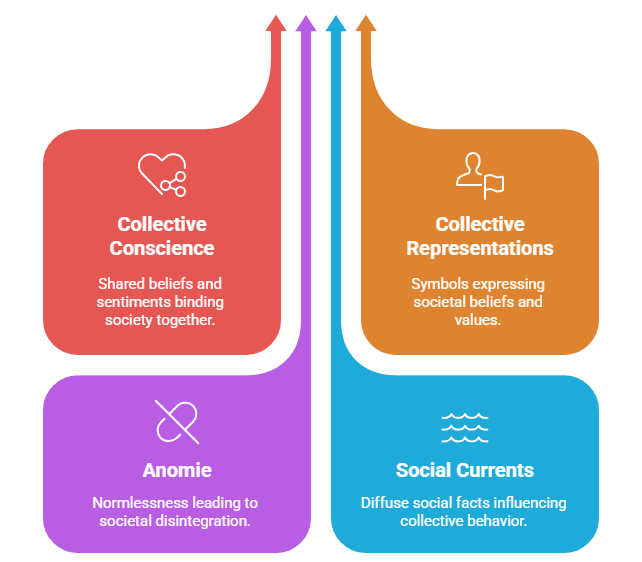
Collective Conscience:The totality of beliefs and sentiments common to the average members of a society. It is the “glue” of mechanical solidarity.
Collective Representations:The symbols, images, and concepts that express the collective conscience (e.g., a national flag, a religious cross).
Anomie:A state of normlessness, where societal norms are weak, conflicting, or absent. It is a major pathology of modern organic solidarity, where the division of labour fails to create genuine integration.
Social Currents:Diffuse, less crystallized social facts that can sweep through a crowd or society, like waves of enthusiasm, indignation, or pity.
Durkheim’s Vision of the Ideal Society and Modernity’s Pathologies
Durkheim was no mere observer; he was a moralist concerned with the health of modern society. He identified several “pathologies” of the division of labour that could lead to anomie:
Forced Division of Labour:When roles are allocated not by talent but by birth or class (e.g., the caste system). This prevents the natural development of organic solidarity.
Anomic Division of Labour:When economic crises or rapid industrialization break down the rules governing economic relations, leading to a state of anomie.
Poor Coordination:When the functions of different institutions are not well-integrated.
His solution was not a return to mechanical solidarity but the creation of new moral foundations for organic solidarity. He advocated for:
Occupational Associations (Corporations):Modern versions of medieval guilds that would regulate economic life, provide a sense of community for workers and employers, and act as a moral force against anomie.
Civic Morality and Education:The state, through secular education, must instill a new, rational civic morality that emphasizes the rights and duties of the individual within the collective.
A Critical Appraisal: Strengths and Limitations
Strengths:
Scientific Foundation:He successfully established sociology as an empirical science.
Macro Perspective:His focus on social structures and institutions corrects the individualistic bias of other disciplines.
Enduring Relevance:Concepts like anomie and social integration are brilliantly applicable to understanding modern issues like student suicides, farmer distress, and the mental health crisis in urban, atomized lives.
Criticisms:
Overemphasis on Consensus:He is often criticized for ignoring conflict, power, and inequality. Marxists argue he downplays class struggle.
Circular Logic:His definition of social facts (identified by their constraint, and constraint is proof they are social facts) can be seen as circular.
Functionalist Bias:His explanations can be overly functionalist, assuming everything exists to maintain social order.
Reliability of Data:His use of suicide statistics has been questioned for its accuracy and his interpretations.
Durkheim’s Major Works: A Book-wise Summary
A separate, consolidated overview of his key texts is crucial for a holistic understanding.
The Division of Labour in Society (1893)
Central Problem:What holds complex modern societies together?
Key Concepts:Mechanical and Organic Solidarity, Collective Conscience, Repressive vs. Restitutive Law, Anomie.
Thesis:Society evolves from solidarity based on likeness to solidarity based on difference and interdependence. The transition, however, can be pathological if not managed properly.
The Rules of Sociological Method (1895)
Central Problem:How can sociology be a science?
Key Concepts:Social Facts, treating social facts as “things,” Normal vs. Pathological.
Thesis:Sociology has a distinct subject matter (social facts) and must employ objective, empirical methods to study it, distinguishing between normal (functional) and pathological (dysfunctional) social phenomena.
Suicide: A Study in Sociology (1897)
Central Problem:Is a highly individual act like suicide socially determined?
Key Concepts:Social Integration, Social Regulation, Egoistic, Altruistic, Anomic, and Fatalistic Suicide.
Thesis:Suicide rates are social facts that vary inversely with the degree of integration and regulation in social groups. It is a powerful demonstration of sociology’s explanatory power.
The Elementary Forms of Religious Life (1912)
Central Problem:What is the origin and fundamental function of religion?
Key Concepts:The Sacred and the Profane, Totemism, Collective Effervescence, Collective Representations.
Thesis:Religion is a symbolic system through which society worships itself. It is the foundation of social cohesion, and its core elements are present in all societies, including secular ones (e.g., civil religion).
Conclusion: Why Durkheim Endures for the UPSC Aspirant
For the UPSC candidate, Durkheim is not just a theorist to be memorized. He provides a foundational lens—a structural-functionalist perspective—that is indispensable. His concepts offer powerful analytical tools for Paper-I (thinkers) and for critically analyzing Indian society in Paper-II. You can use:
Anomieto discuss farmer suicides or the crisis of urban youth.
Mechanical and Organic Solidarityto analyze the transition from traditional caste-based villages to modern, market-driven cities.
Collective Conscience and Effervescence to understand nationalistic movements, religious festivals, or even the “Jai Shri Ram” chant as a modern political totem.
His method of using statistics to understand social phenomena is a model for evidence-based policy analysis.
By internalizing Durkheim, you equip yourself not just with a set of ideas, but with a rigorous, scientific way of thinking about the social world—a skill that is at the very heart of the civil services examination.
I appreciated the breakdown of Durkheim’s works and his focus on social facts. It’s interesting how he saw these ‘external’ social forces shaping human behavior. Do you think his theories on anomie still hold relevance in today’s hyper-connected, globalized world?






I appreciated the breakdown of Durkheim’s works and his focus on social facts. It’s interesting how he saw these ‘external’ social forces shaping human behavior. Do you think his theories on anomie still hold relevance in today’s hyper-connected, globalized world?