(Relevant for Sociology Paper I: Social Change in Modern Society and Sociology Paper II: Industrialization and Urbanization in India; Challenges of Social Transformation)
Status anxiety refers to the fear of being perceived as unsuccessful or socially inferior in the eyes of others. In modern, competitive societies, individuals constantly compare themselves to others, leading to feelings of inadequacy, low self-worth, and chronic stress. Unlike traditional societies where roles and positions were more stable, modern capitalist systems foster competition, ambition, and social comparison — fueling status anxiety.
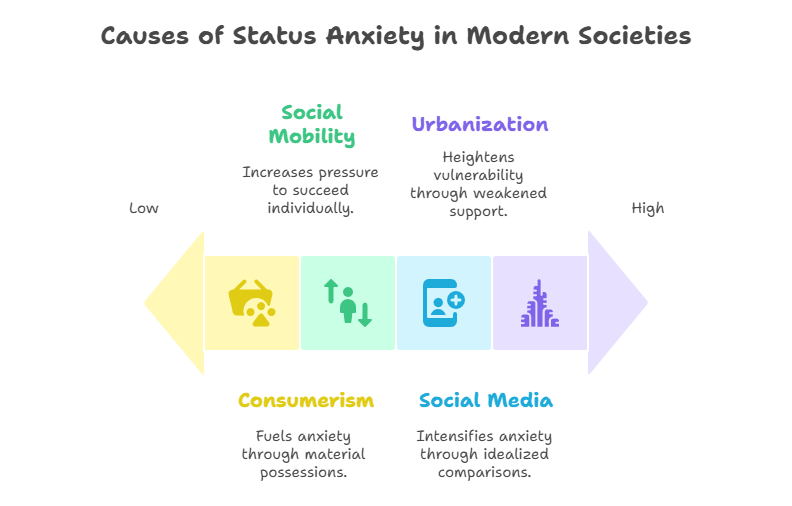
Causes of Status Anxiety in Modern Societies
Consumerism and Capitalism: The rise of consumer culture equates success with material possessions. People judge their worth based on what they own — cars, gadgets, brands — creating a cycle of conspicuous consumption and anxiety.
Increased Social Mobility: With greater opportunities comes increased pressure to “succeed.” The myth of meritocracy makes people feel solely responsible for their failure or stagnation, increasing psychological distress.
Social Media and Digital Comparison: Platforms like Instagram and LinkedIn create an idealized version of success. Individuals, especially youth, experience FOMO (Fear of Missing Out) and relative deprivation, intensifying status-based anxiety.
Urbanization and Individualism: Modern urban life promotes individual achievement over collective welfare. The weakening of traditional support systems, like extended families or caste communities, leaves people more vulnerable to social comparison.
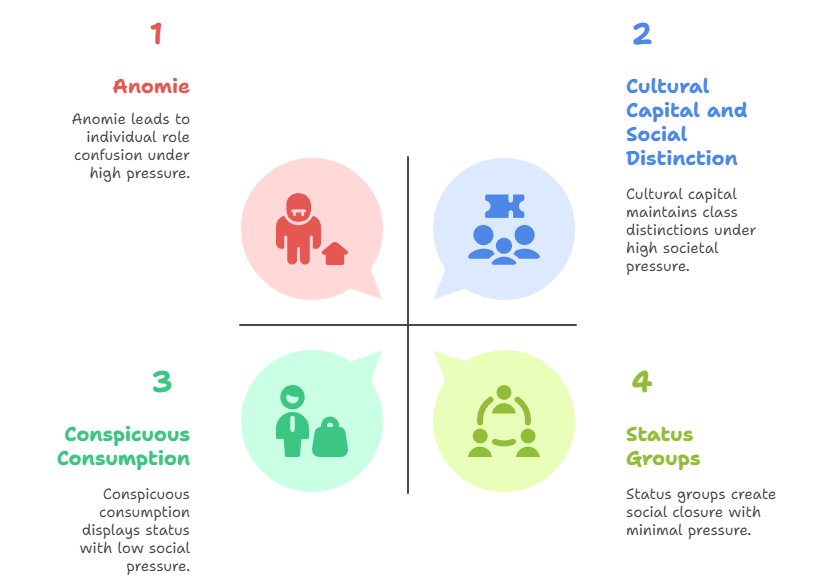
Sociological Analysis
Cultural Capital and Social Distinction: Bourdieu emphasized how cultural capital and taste are used to maintain class distinctions. People develop anxiety to perform a lifestyle acceptable to higher social classes, fearing exclusion from elite cultural spaces.
Status Groups: Weber’s concept of status groups explains how social honor is distributed unequally. In modern societies, these group identities based on lifestyle, education, or prestige create social closure and pressure to conform.
Anomie: Durkheim’s theory of anomie — normlessness — is relevant here. The breakdown of collective norms in modern society leads individuals to experience role confusion and anxiety about their place in the social hierarchy.
Veblen’s Theory of Conspicuous Consumption: Thorstein Veblen observed how people purchase luxury goods not for utility but for displaying social status, leading to a “rat race” of emulation and anxiety.
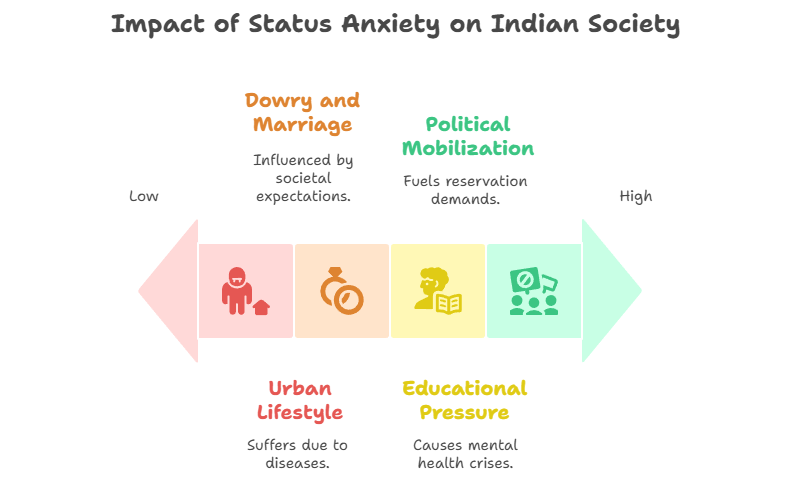
Impact of Status Anxiety on Indian Society
Educational Pressure: In India, academic achievement is linked with upward mobility, leading to mental health crises among students.
Dowry and Marriage Market: In many communities, higher social status correlates with larger dowries or better matrimonial prospects.
Urban Lifestyle Diseases: Anxiety, depression, and hypertension are on the rise in urban middle and upper-middle classes.
Political Mobilization: Aspiration-driven status anxiety is fueling the rise of caste-based reservations demands (e.g., Patidars, Marathas).
Conclusion
To effectively address status anxiety, modern societies must focus on rebuilding community ties and fostering collective support systems that counteract the isolating effects of individualism and hyper-competition. There is also a pressing need to shift from performance-based education models to those rooted in values, empathy, and holistic development. Additionally, implementing inclusive policies that aim to reduce socio-economic inequality and destigmatize mental health challenges is essential. Ultimately, status anxiety should not be viewed merely as a personal struggle but as a structural outcome of modern capitalist societies, driven by relentless comparison, consumerism, and social stratification. Tackling it requires a sociological approach that recognizes its roots in institutional arrangements and cultural norms.
PYQs
Paper 1:
How do Weber’s notions of class, status, and party explain social stratification in modern society? (2013)
Discuss the implications of conspicuous consumption for social inequality in a capitalist society. (2015)
Explain the concept of anomie. How is it relevant in understanding suicide in urban societies? (2016)
What is relative deprivation? Examine its role in the emergence of social movements. (2017)
Critically examine Bourdieu’s theory of cultural capital in understanding class reproduction. (2018)
Discuss the relevance of Veblen’s theory of the leisure class in the context of consumer culture. (2019)
“Consumerism and individualism have weakened the collective consciousness of modern society.” Explain with sociological perspectives. (2020)
Examine the role of education in the reproduction of inequality as suggested by Pierre Bourdieu. (2021)
Is meritocracy a myth in contemporary society? Discuss with reference to status-based inequalities. (2022)
Explain the relationship between status anxiety and social mobility. Illustrate with examples. (2023)
Paper 2:
Discuss the impact of urbanization and individualism on traditional Indian family values. (2015)
Evaluate the effects of globalization on status symbols and consumption patterns in Indian society. (2016)
Critically examine how status anxiety is reflected in dowry practices among upwardly mobile castes. (2017)
Examine the role of social media in shaping aspirations and anxieties among Indian youth. (2019)
Discuss the role of education and employment in changing the status of middle-class youth in India. (2020)
Discuss the relationship between educational competition, mental health, and status-based expectations in Indian society. (2021)
How do inequalities in access to cultural capital reinforce status anxieties among Dalits and backward classes? (2022)
Examine how the phenomenon of aspiration and lifestyle changes are reshaping caste dynamics in India. (2022)
Explain the emergence of new middle class in India and its link with changing status aspirations. (2023)











One comment