India, with its demographic dividend and rapidly growing economy, is at a critical juncture where reorienting the education system is essential to meet the demands of the 21st century. Despite notable progress in literacy rates and school enrolment, the quality of education and its relevance to contemporary needs remain pressing concerns. For India to harness its true potential and transform into a knowledge-based economy, a holistic overhaul of the education system is imperative.
Current Status and Achievements
India boasts one of the largest education systems in the world, with over 250 million students and more than 1.5 million schools. The Gross Enrolment Ratio (GER) at the primary level stands at nearly 100%, and at the higher secondary level, it has reached 59.7% (AISHE 2023). Significant government initiatives such as the Right to Education Act (2009), Sarva Shiksha Abhiyan, and the Midday Meal Scheme have played vital roles in expanding access.
At the higher education level, India has over 1,100 universities and 43,000 colleges. The National Institutional Ranking Framework (NIRF) and the Institutions of Eminence scheme aim to uplift the quality of higher education. Digital initiatives like SWAYAM, DIKSHA, and PM e-Vidya have expanded access to online learning platforms, especially post-COVID.
Key Challenges
Despite achievements, the Indian education system faces several deep-rooted challenges:
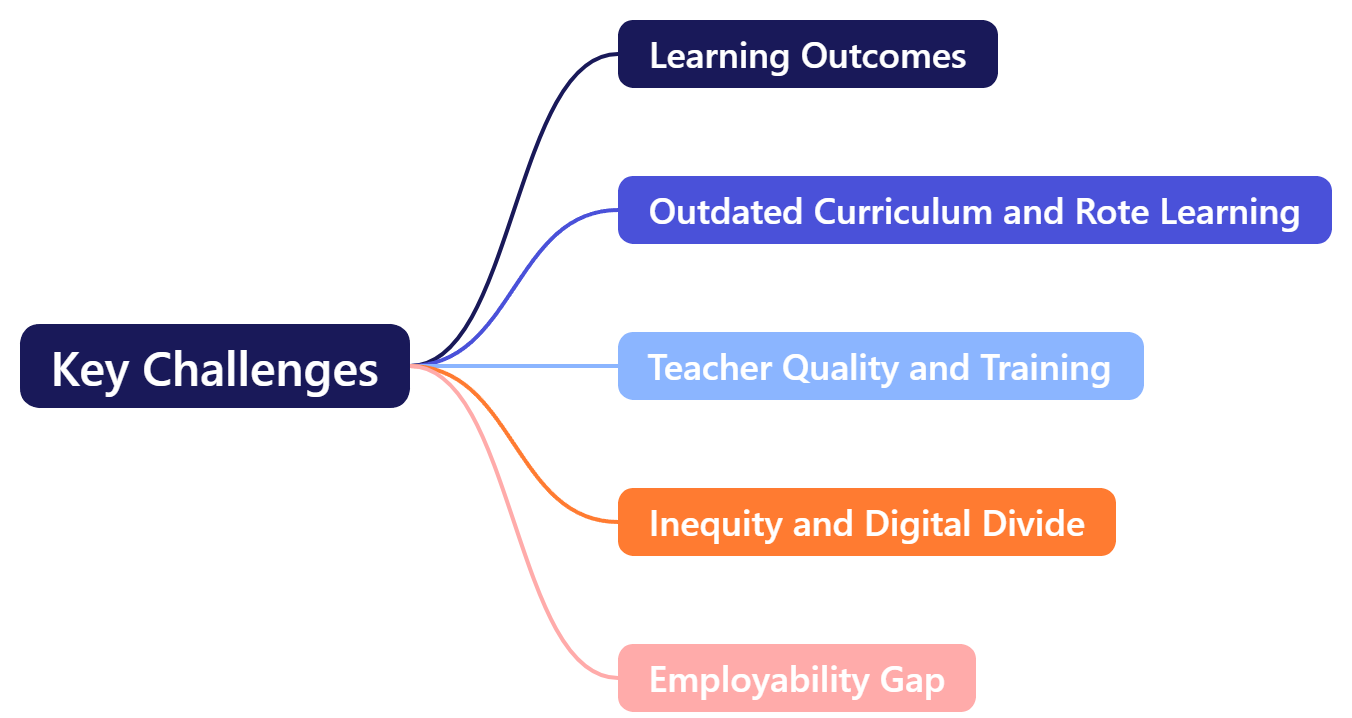
Learning Outcomes: According to ASER 2023, only 43.3% of Class 5 students in rural India can read a Class 2-level text, and only 25.9% can do basic arithmetic. These foundational learning gaps are persistent.
Outdated Curriculum and Rote Learning: The curriculum often emphasizes memorization over critical thinking, creativity, and problem-solving, making students ill-prepared for real-world challenges.
Teacher Quality and Training: Many teachers lack adequate training and subject knowledge. A 2022 report by the National Achievement Survey (NAS) highlighted poor pedagogical skills and teacher absenteeism as serious concerns.
Infrastructure Deficiencies: Despite improvements, many schools lack basic facilities like functional toilets, clean drinking water, electricity, and digital resources.
Inequity and Digital Divide: Access to quality education is still uneven, especially for students from marginalized communities, girls, and those in rural and tribal areas. The digital divide became glaring during the pandemic.
Employability Gap: A 2023 India Skills Report revealed that only 46.2% of graduates were found employable, underscoring the disconnect between education and industry requirements.
Recent Reforms and Initiatives
National Education Policy (NEP) 2020:
Proposes a 5+3+3+4 curricular structure.
Emphasizes early childhood education, foundational literacy and numeracy (NIPUN Bharat), and experiential learning.
Advocates mother tongue as the medium of instruction till Grade 5.
Aims for a 100% GER in school education and 50% in higher education by 2035.
Promotes vocational education, coding, AI, and multilingualism.
PM SHRI Schools: Modernizing over 14,500 schools across the country as model institutions under the NEP.
Skill India and National Credit Framework (NCrF): Integrating academic and vocational education, enabling lifelong learning pathways.
Digital Initiatives: Expansion of BharatNet, NDEAR (National Digital Education Architecture), and AI-based platforms for personalized learning.
Suggestions for Reforms
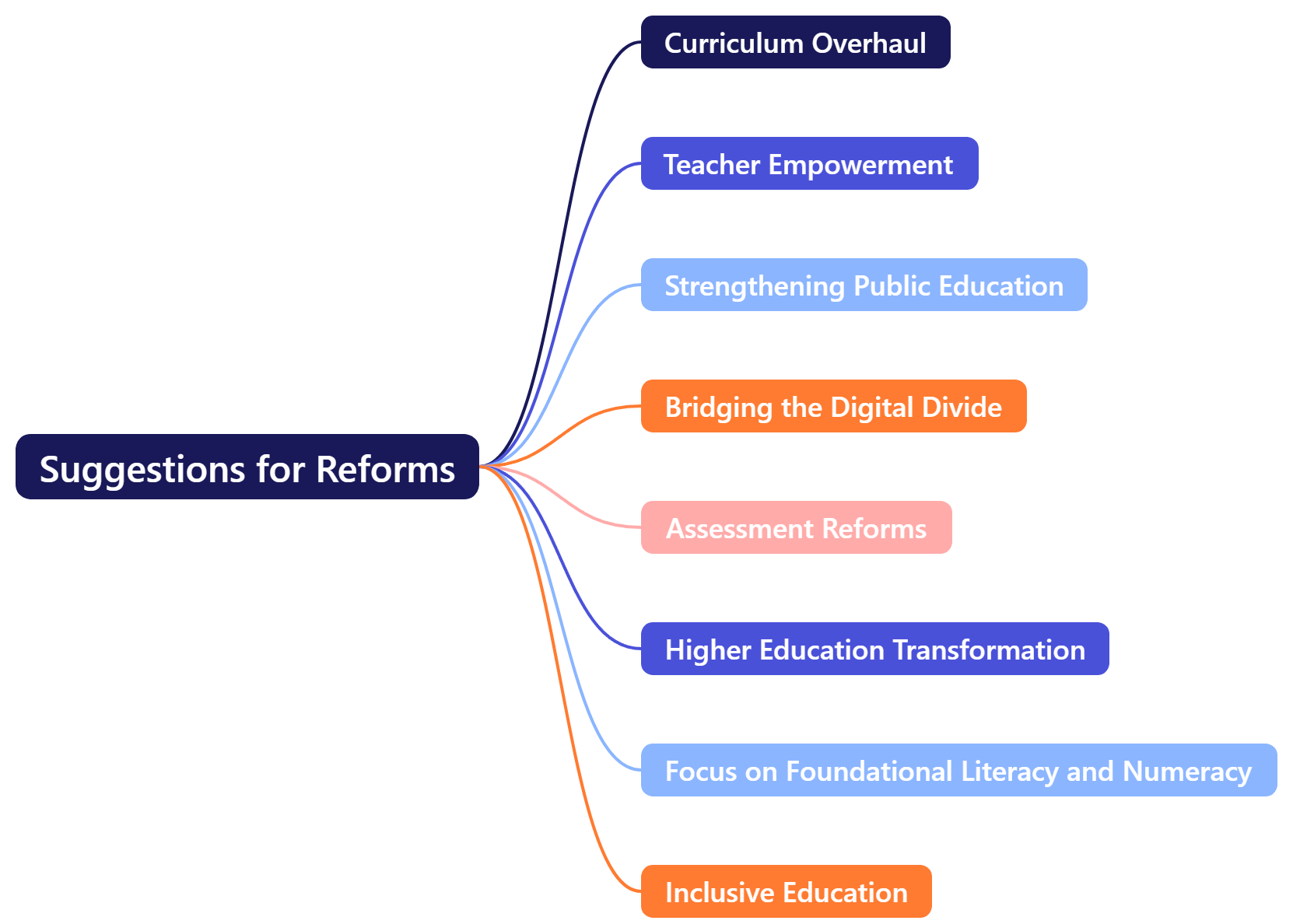
Curriculum Overhaul: Redesign syllabi to foster analytical thinking, creativity, ethics, and environmental consciousness. Interdisciplinary learning and project-based approaches should be mainstreamed.
Teacher Empowerment: Continuous professional development through platforms like NISHTHA. Improve teacher recruitment standards and link promotions with performance and training.
Strengthening Public Education: Increase public spending on education to 6% of GDP as recommended by NEP and Kothari Commission. Ensure timely disbursal of funds for infrastructure and learning resources.
Bridging the Digital Divide: Expand affordable internet connectivity and provide digital devices to students in underserved regions. Local-language content must be emphasized to ensure inclusivity.
Assessment Reforms: Move away from high-stakes exams to competency-based continuous assessment. Use tools like NAS and PARAKH for comprehensive evaluation.
Higher Education Transformation: Foster collaboration between academia, industry, and research bodies. Promote autonomy, innovation, and internationalization in universities.
Focus on Foundational Literacy and Numeracy: Full implementation of NIPUN Bharat to ensure all children attain basic skills by Grade 3.
Inclusive Education: Design special strategies for differently-abled children, and use gender-sensitive pedagogy to increase female participation.
Conclusion
The reorientation of India’s education system is not merely a policy imperative—it is a national necessity. As India aspires to become a $5 trillion economy and a global knowledge hub, education must be the bedrock of this transformation. Realizing the vision of NEP 2020 and building an inclusive, equitable, and future-ready education ecosystem requires collaboration among all stakeholders: government, educators, parents, and the community. Only then can India truly unlock the potential of its youth and stride confidently into the future.
To Read more topics like Modernising Logistics: Paving the Way for India’s Growthin Public Posts, visit: www.triumphias.com/blogs







One comment