



Religion and Social Control
(Relevant for Sociology Paper I: Religion and Society and Sociology Paper II: Religion and Society)

Introduction:Religion has historically served as a powerful mechanism for social control in almost all human societies. It not only defines what is sacred or profane, but also prescribes acceptable behaviors, regulates norms, reinforces authority, and offers moral codes that individuals are expected to follow. In sociology, religion is not just about belief in the supernatural — it is viewed as a social institution that shapes human behavior, often serving as an instrument of social regulation, especially in traditional and stratified societies like India. What is Social Control?Social control refers to the various means and processes by which society regulates individual and group behavior. These controls can be:
Religion operates mostly as an informal agent of social control, but in theocratic or fundamentalist systems, it may also influence formal legal structures. Sociological Analysis
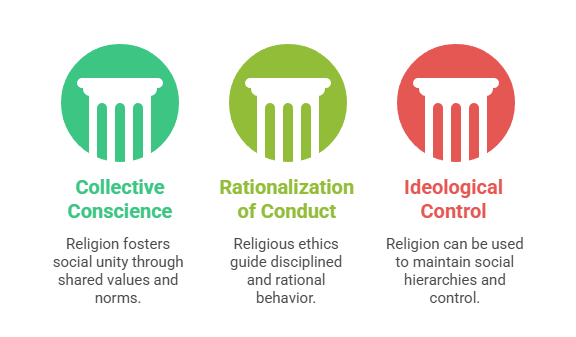
Durkheim, in his work “The Elementary Forms of Religious Life”, argued that religion reinforces social cohesion. By participating in religious rituals, individuals internalize the collective conscience — the shared values and norms of the group. This results in conformity, reducing deviant behavior and maintaining social order.
Weber’s classic “The Protestant Ethic and the Spirit of Capitalism” explored how religious ethics can lead to disciplined, rational behavior. In the Indian context, Hindu ethics of karma and dharma regulate one’s duties, while Islamic practices like sharia provide guidelines for personal and collective behavior.
Marx viewed religion as the “opium of the people.” He believed it was a tool used by ruling classes to maintain status quo, offering false consciousness and divine justification to inequality and exploitation. For instance, the caste system in India is often religiously justified, promoting acceptance of hierarchy as divinely ordained. Mechanisms through Which Religion Exercises Social Control
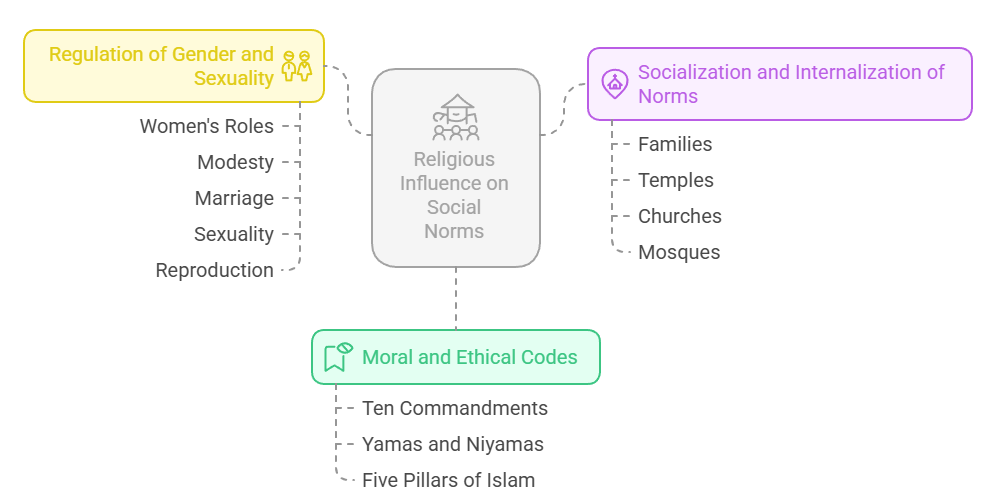
Religions provide moral commandments like the Ten Commandments (Christianity), Yamas and Niyamas (Hinduism), and Five Pillars of Islam, which act as behavioral checklists, ensuring moral conformity.
Religious institutions like families, temples, churches, and mosques play a key role in the early socialization of children, teaching them religious norms that shape their worldview.
Religion often dictates norms regarding women’s roles, modesty, marriage, sexuality, and reproduction. For example:
Religion and Social Control in India
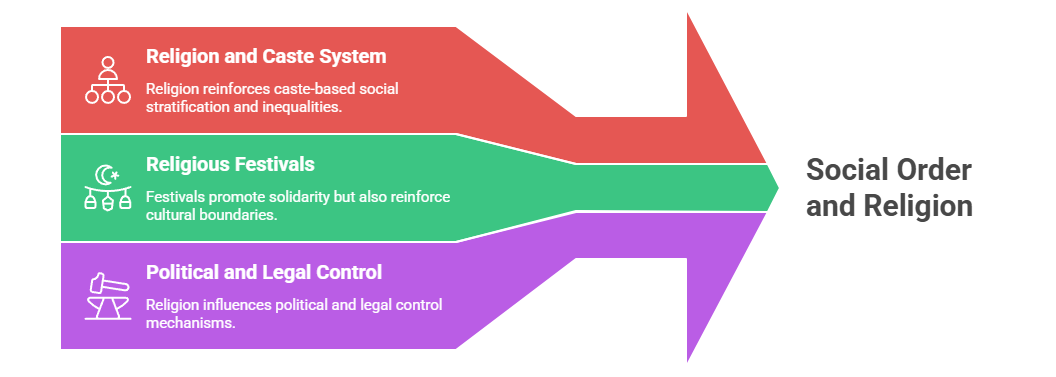
In India, religion and caste are deeply intertwined. Hinduism’s varna system has legitimized social stratification and occupational hierarchy for centuries. The concept of karma is often used to rationalize inequalities, discouraging protest and maintaining status quo.
Religious festivals like Diwali, Eid, Christmas, and Guru Nanak Jayanti act as collective social experiences, fostering solidarity but also reinforcing cultural boundaries. However, in a diverse society like India, religion can also be a source of communal tensions, especially when used for political mobilization (e.g., cow vigilantism, temple-mosque conflicts).
Critiques of Religion as Social Control
Many feminist scholars argue that religion reinforces patriarchy. Simone de Beauvoir called religion a “justification for women’s subordination.”
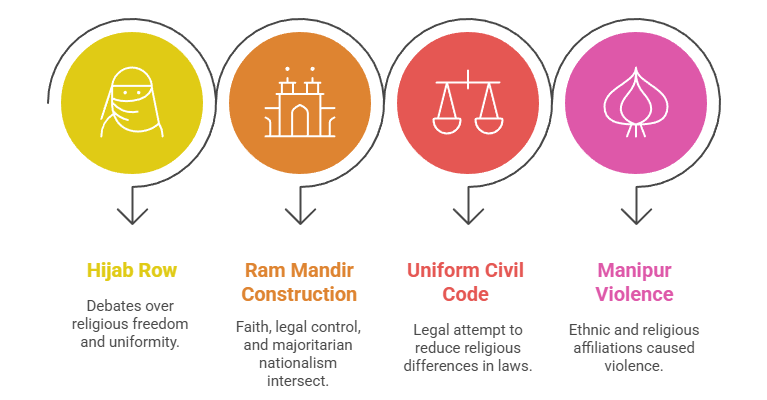
Religious nationalism often targets minorities, undermining their rights. In India, lynchings over cow slaughter, anti-Christian propaganda, and moral policing have raised concerns over religion-based vigilantism. Recent Developments
Religion as a Double-Edged Sword
Policy Recommendations and Suggestions
Conclusion:Religion has undeniably shaped human civilization, serving both as a moral compass and a mechanism of social control. However, when uncritically accepted, it can legitimize injustice, perpetuate inequality, and stifle progress. By applying Durkheimian functionalism, Weberian analysis, and Marxist critique, we gain a nuanced understanding of religion — one that recognizes its ability to both integrates and dominates. PYQs:Paper I
Paper II
|




To Read more topics, visit: www.triumphias.com/blogs
One comment