


Reference Group Theory and Its Applicability Across Different Social and Cultural Contexts
(Relevant for Sociology Paper 1: Sociological Thinkers)
IntroductionThe Reference Group Theory, developed by R.K. Merton (1950), builds upon the work of Herbert Hyman (1942) and Leon Festinger’s social comparison theory. It provides a framework for understanding how individuals evaluate their own behavior, status, and achievements relative to others. The theory differentiates between membership groups—the groups an individual actually belongs to—and non-membership or aspirational groups, which serve as standards or models for comparison. Merton presented the theory as a middle-range framework, aiming to explain phenomena like relative deprivation, social mobility, and anticipatory socialization. Although the theory captures a universal human tendency to compare oneself with others, its applicability is socially and culturally contingent. Its explanatory power is strongest in societies that are open, mobile, and achievement-oriented, whereas it is limited in rigid, stratified, or culturally isolated contexts. To understand this variation, it is essential to examine the theory’s functionality, limitations, individual and structural mediators, and cultural variability, supported by sociological examples. Context-Specific Applicability of Reference Group TheoryThe relevance of reference groups is not universal. It depends on social structure, cultural norms, and mobility opportunities, which influence both the formation of reference groups and the capacity for social comparison and aspiration. Sociologists often classify contexts as functional (open, mobile) or dysfunctional (rigid, closed) to study the theory’s applicability. Applicability in Open or Mobile Societies (Functional Context)In open societies, individuals have more opportunities to interact with diverse social groups, observe their lifestyles and achievements, and adjust their behavior accordingly. In these societies, non-membership reference groups play a crucial role in shaping aspirations and guiding social conduct. This process often occurs through anticipatory socialization, where individuals adopt the values, norms, and behaviors of aspirational groups before actually joining them. This prepares them for eventual integration and enhances social mobility.
In modern industrial and capitalist societies, young professionals frequently model themselves on corporate or elite occupational groups, learning not just technical skills but also social behaviors, etiquette, and professional attitudes. Immigrant communities adopt host-country cultural patterns, such as language, dress, and social norms, to gain acceptance and navigate new opportunities. In India, Sanskritization, a concept introduced by M.N. Srinivas, illustrates how lower castes emulate the practices of higher castes to improve social status. These examples show how reference groups facilitate upward mobility, helping individuals align their aspirations with broader social expectations.
Reference groups also play a critical role in identity formation. By observing aspirational groups, individuals internalize the norms and values necessary for success. For example, students may model study habits, lifestyle choices, and career ambitions after high-achieving peers or mentors. Similarly, professional networks in urban centers guide newcomers in adopting accepted practices and professional etiquette, shaping personal identity in line with social expectations. In these contexts, the theory operates functionally, enabling smoother integration and goal achievement. Limitations in Closed or Rigid Societies (Dysfunctional Context)
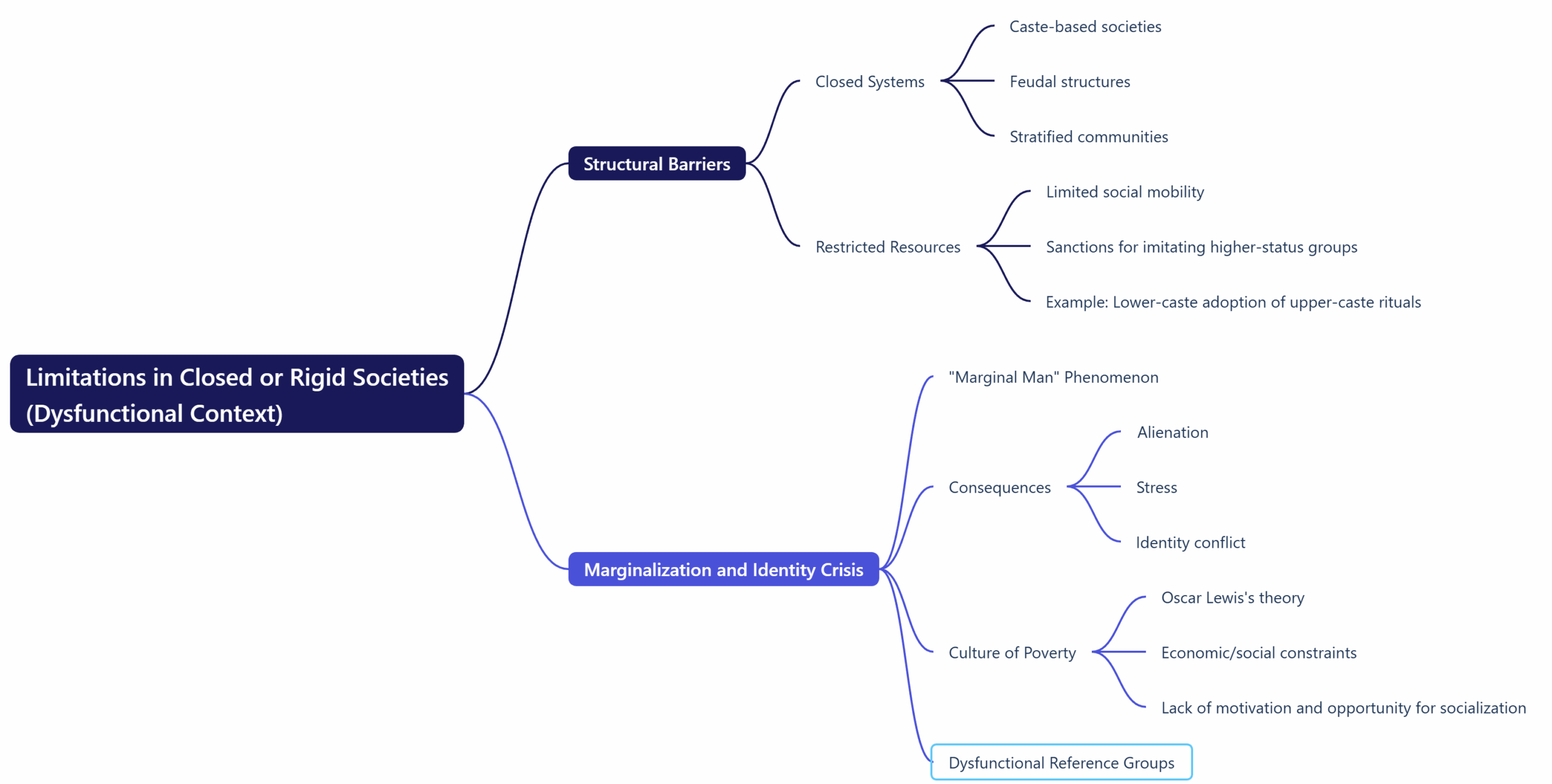
In contrast, the theory’s explanatory power diminishes in societies characterized by low mobility, rigid hierarchies, and cultural isolation. Even if individuals identify aspirational groups, structural barriers prevent meaningful integration or attainment of goals. This can lead to frustration, alienation, or the formation of marginal identities.
In closed systems, such as caste-based societies, feudal structures, or highly stratified communities, resources and institutional avenues for social mobility are restricted. Aspirants may face social sanctions if they imitate higher-status groups. For instance, lower-caste individuals adopting upper-caste rituals in traditional Indian villages often face exclusion rather than acceptance. Similarly, isolated tribes or ethnic enclaves may lack exposure to external groups, limiting opportunities for meaningful comparison.
Sociologists describe the resulting state as the “marginal man” phenomenon (Robert Park), where individuals are caught between their own group and aspirational groups, accepted by neither. This can lead to alienation, stress, and identity conflict. Oscar Lewis’s Culture of Poverty highlights how communities trapped in economic and social constraints may lack both motivation and opportunity for anticipatory socialization. In such contexts, reference groups are dysfunctional, exacerbating inequality rather than alleviating it. Influence of Individual and Structural FactorsWhile social openness or closure significantly influences reference group behavior, individual differences and structural inequalities also play a crucial role.
Personality traits, life experiences, and self-concept affect how strongly individuals identify with reference groups. Two individuals in the same structural position may respond differently to aspirational pressures; one may internalize and strive toward the group, while the other resists or disengages.
Social inequalities, including class, gender, and ethnicity, shape access to reference groups. For example, women in patriarchal societies may have limited exposure to aspirational role models, constraining anticipatory socialization. Ethnic minorities may form reactive reference groups, emphasizing identity and resistance rather than imitation, as seen in Black consciousness movements in the U.S. and South Africa. Access to cultural capital (Bourdieu) further mediates the ability to adopt aspirational behaviors, making reference group influence uneven across populations. Comparative Insight and Cultural VariabilityThe strength and nature of reference group influence vary across cultural contexts. In individualistic, achievement-oriented societies like the U.S. or Western Europe, social comparison drives behavior, motivates success, and structures identity. In contrast, collectivist or ascriptive societies, such as traditional Asian or tribal communities, emphasize loyalty to family, caste, or community over individual aspiration, muting the influence of non-membership groups. Cultural norms, values, and historical factors thus condition both the formation and effectiveness of reference groups. Sociological Dimensions and Broader Implications
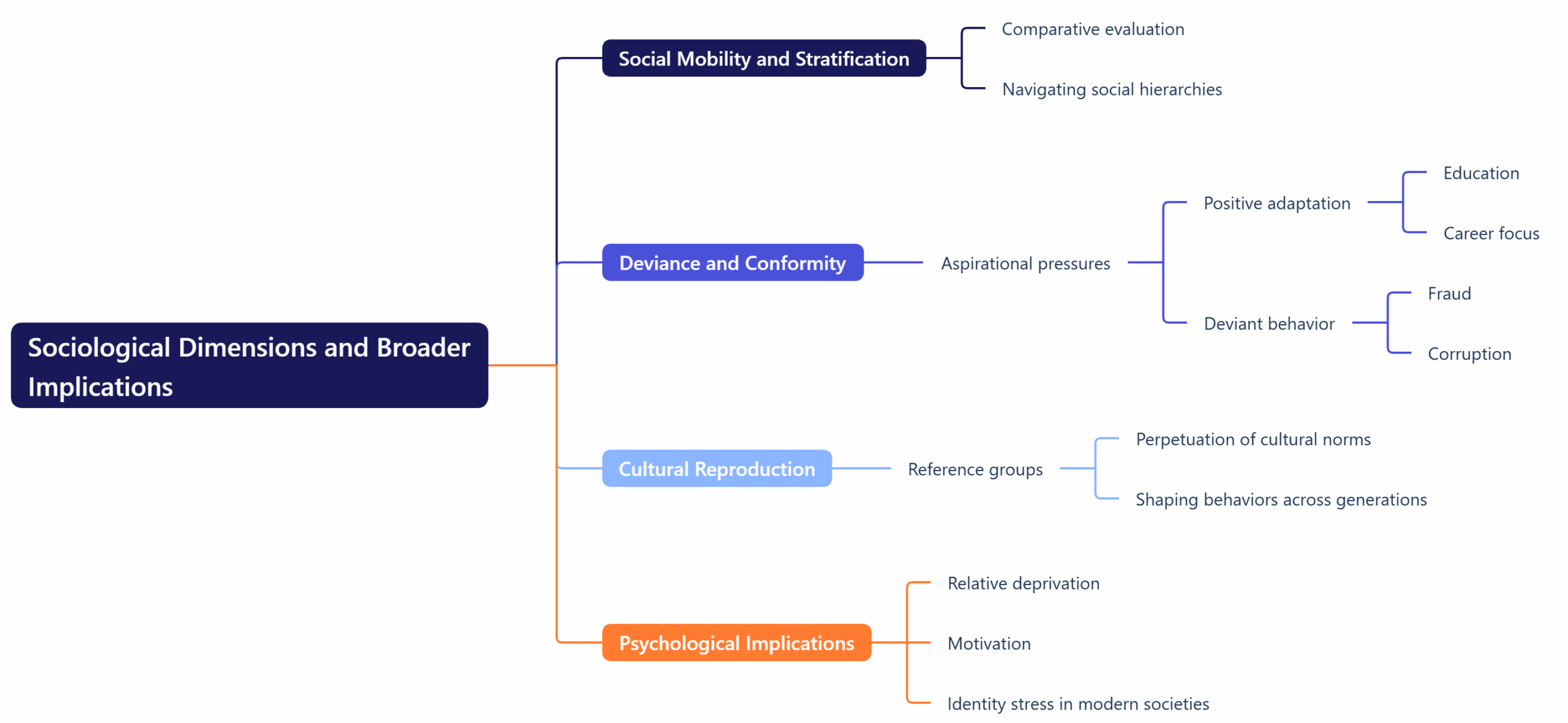
Reference group theory links to several sociological dimensions:
ConclusionR.K. Merton’s Reference Group Theory remains a vital sociological tool for understanding social comparison, aspiration, and relative deprivation. Its applicability is strongest in open, mobile societies, where aspirational behavior and social mobility are feasible. In closed or rigid systems, structural barriers, cultural isolation, and inequality limit its relevance. Individual traits and social structures further mediate reference group influence. Ultimately, the theory captures a universal human tendency to compare, but its consequences and effectiveness are culturally and socially contingent, highlighting the interplay between human motivation, societal norms, and structural opportunities. |


To Read more topics, visit: www.triumphias.com/blogs
Read more Blogs:
Legal Aid in India: A Sociological Perspective on Access, Justice, and Social Equality
2 comments