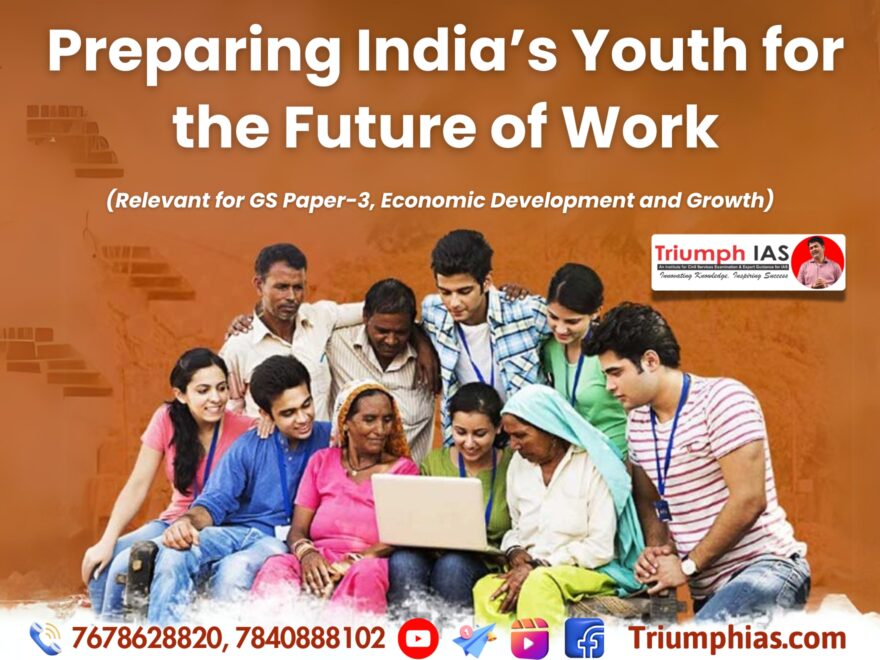
Preparing India’s Youth for the Future of Work
(Relevant for GS Paper-3, Economic Development and Growth)

As the world undergoes rapid technological, demographic, and socio-economic transformation, the nature of work is evolving. Traditional jobs are being reshaped by automation, artificial intelligence, and digital platforms. This shift has made skill development crucial for creating a future-ready workforce, especially in a country like India with a demographic dividend. The need for upskilling and reskilling has become not just a necessity, but a national priority.
Why Future-Ready Competencies Matter
Future-ready competencies encompass a mix of technical skills, soft skills, and adaptive capabilities that enable individuals to remain employable and productive in a dynamic global economy. These include:
-
- Digital literacy and computational thinking
- Critical thinking and problem-solving
- Creativity and innovation
- Emotional intelligence and collaboration
- Lifelong learning orientation
The World Economic Forum (WEF) in its Future of Jobs Report 2023 predicted that 44% of workers’ core skills will change by 2027. It also emphasized that analytical thinking, resilience, and technological literacy will dominate employer demands.
India’s Demographic Advantage – A Double-Edged Sword
India boasts the world’s largest youth population, with over 62% of its population in the working-age group (15–59 years) and nearly 30% in the age group of 15–29. While this offers a demographic dividend, it can turn into a liability if not backed by appropriate skill development.
According to the Periodic Labour Force Survey (PLFS) 2023-24, India’s unemployment rate among the educated youth stands at over 17%, indicating a mismatch between education and employable skills.
Government Initiatives for Skill Development
- Skill India Mission (Launched in 2015)
-
- A flagship scheme to train over 400 million people by 2022 across sectors.
- Major programs under this mission include:
- Pradhan Mantri Kaushal Vikas Yojana (PMKVY): Offers free short-term training and certification in various skills.
- Recognition of Prior Learning (RPL): Certifies informal skills gained through work experience.
- As per the 2024 report, over 1.38 crore candidates have been trained under PMKVY.
- National Apprenticeship Promotion Scheme (NAPS)
-
- Provides financial incentives to industries to hire and train apprentices.
- Aims to engage over 10 lakh apprentices by 2025.
- Skill Hubs and Samagra Shiksha
-
- The Ministry of Education launched Skill Hubs under the PMKVY 4.0 to integrate vocational education with formal schooling.
- These hubs offer bridge courses to school dropouts and out-of-school youth.
- Digital Skilling through e-Skill India Portal
-
- NSDC’s eSkill India platform offers more than 800 courses in multiple languages to promote digital and remote skilling.
- National Education Policy (NEP) 2020
-
- Emphasizes vocational education from grade 6 onwards.
- Aims for 50% of learners to have exposure to vocational education by 2025.
Sector-Wise Skilling Needs
- Green Skills
-
- With India’s commitment to achieving Net Zero by 2070, green jobs in sectors like renewable energy, sustainable agriculture, and electric vehicles are expanding.
- According to a CEEW report, India needs over 1 million green-skilled workers by 2030 in solar and wind energy alone.
- Digital and Tech Skills
-
- As per NASSCOM, India needs up to 30 million digitally skilled professionals by 2026.
- Demand is high for skills in AI, data science, cloud computing, cybersecurity, and blockchain.
- Healthcare & Care Economy
-
- Post-COVID-19, the care economy has seen exponential growth.
- WHO estimates that India needs additional 2 million healthcare professionals by 2030.
- Tourism and Hospitality
-
- India’s tourism sector, expected to reach USD 512 billion by 2028, offers huge employment potential in skilling areas like hospitality management and customer service.
Challenges in Skill Development
Despite numerous initiatives, several challenges persist:
-
- Quality of training: Many training centers lack updated curriculum and practical exposure.
- Low industry participation: Private sector involvement in curriculum design and delivery remains limited.
- Gender disparity: Female participation in skill training programs is still disproportionately low.
- Placement gaps: Training does not always translate into employment due to lack of soft skills or location mismatch.
Global Models Worth Emulating
India can draw lessons from:
-
- Germany’s Dual Vocational Training System, which integrates classroom learning with apprenticeships.
- Singapore’s Skills Future Initiative, which promotes lifelong learning through financial incentives and career guidance.
Way Forward: A Multi-Stakeholder Approach
-
- Industry-Academia Linkages: Courses must be co-designed with industry to reflect real-world requirements.
- Focus on Life Skills: Communication, teamwork, adaptability, and entrepreneurship should be part of all skilling programs.
- Localized Skill Planning: Skilling programs should be aligned with the economic profile and employment potential of each district.
- Digital Skilling at Scale: Expand access to remote and hybrid learning models, especially in rural areas.
- Skilling for Informal Sector: Special attention is needed for unorganized workers who constitute nearly 90% of India’s workforce.
Conclusion
Equipping India’s youth with future-ready competencies is pivotal for realizing the vision of Amrit Kaal—an era of inclusive development and economic leadership. With the right policy push, technology integration, and societal collaboration, India can transform its demographic potential into a global competitive advantage.
Investing in skill development is not merely about employment—it’s about empowerment, innovation, and nation-building.