Marriage is not just a biological or personal institution—it is deeply social, regulated by cultural norms, religious sanctions, and kinship systems. One key aspect of kinship systems across societies is preferential marriage, a rule-based practice that favours marriage between certain categories of relatives. While marriage customs may differ across tribes, castes, and regions, preferential marriage reflects the structural principles embedded in societies’ ideas of alliances, descent, and inheritance. This blog explores the concept of preferential marriage in sociological terms with reference to Indian society.
What is Preferential Marriage?
Preferential marriage refers to prescribed or preferred forms of marital alliances within a kin group, particularly those that favour marriage with specific categories of kin like cousins or maternal uncles’ daughters. These norms are socially institutionalized and guide marriage decisions across generations.
There are two main types:
Prescriptive Marriage: Marriage is mandated with a specific relative (e.g., mother’s brother’s daughter).
Preferential Marriage: Marriage with certain categories is encouraged but not mandatory.
Types of Preferential Marriages
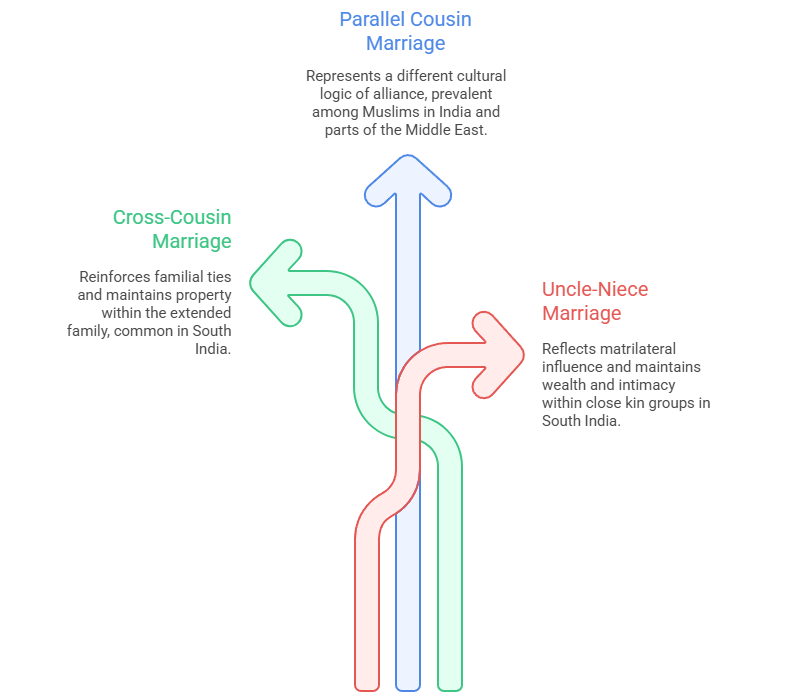
Cross-Cousin Marriage: In cross-cousin marriages, a person marries their mother’s brother’s daughter (MBD) or father’s sister’s daughter (FSD). This form is common in South India and aligns with the Dravidian kinship system. It is seen as a means of reinforcing familial ties and maintaining property within the extended family.
Parallel Cousin Marriage: This involves marrying a father’s brother’s daughter (FBD) or mother’s sister’s daughter (MSD). While it is generally not accepted in Hindu communities due to clan exogamy rules, it is prevalent among Muslims in India and parts of the Middle East. It represents a different cultural logic of alliance.
Uncle-Niece Marriage: In some South Indian communities, especially among certain castes, it is culturally acceptable for a man to marry his sister’s daughter (maternal niece). This practice reflects matrilateral influence and is often used to maintain wealth and intimacy within close kin groups.
Preferential Marriage in Indian Society
South India: Preferential marriages like cross-cousin and uncle-niece unions are widely practiced in South India. These customs are legitimized by the Dravidian kinship structure, which emphasizes close familial ties and internal lineage consolidation.
North India: In contrast, North Indian kinship norms emphasize exogamy, particularly gotra and village exogamy, which makes cousin marriages taboo. Marriages are typically arranged across distant kin to expand social networks and reinforce caste hierarchy.
Tribal Communities: Among tribal groups like the Gonds, Bhils, and Murias, preferential marriage often exists but varies by community. Some allow cross-cousin unions, reflecting flexible kinship norms that differ from both North and South Indian practices.
Sociological Analysis
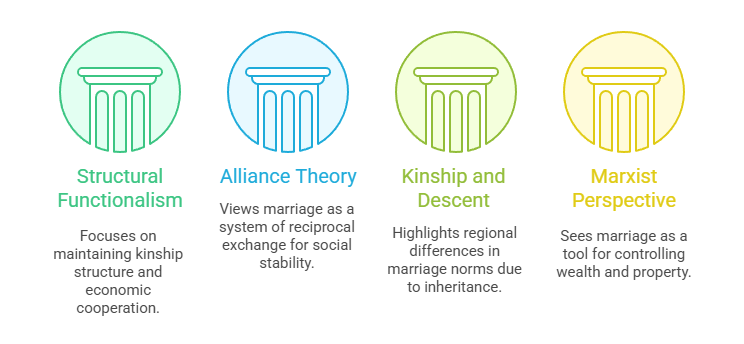
Structural Functionalism: According to structural functionalists like Radcliffe-Brown and Malinowski, preferential marriages serve to maintain the kinship structure by reinforcing group solidarity and facilitating economic cooperation among relatives.
Alliance Theory: Claude Lévi-Strauss, through his alliance theory, views preferential marriage—especially cross-cousin marriage—as a system of reciprocal exchange that creates long-term alliances between families and stabilizes social structure.
Kinship and Descent: Indian sociologists like Iravati Karve and M.N. Srinivas highlight how regional differences in descent and inheritance influence marriage norms. South India’s preference for intra-kin marriage reflects efforts to keep property and ritual authority within the family.
Marxist Perspective: From a Marxist lens, preferential marriage is a tool for maintaining control over wealth and property. Families often favour marriages within kin to avoid property fragmentation and ensure loyalty and class consolidation.
Socio-Cultural Functions of Preferential Marriage
Maintains clan solidarity
Ensures inheritance consolidation
Reduces dowry or bridewealth expenses
Reinforces trust-based familial relationships
Helps in gender negotiation within family structures
Changing Trends in Preferential Marriage
With modernization, urbanization, and women’s education, preferential marriages are undergoing significant transformations:
Decline in prescriptive kinship marriages in urban areas
Resistance among educated youth against uncle-niece marriages
State laws (like the Hindu Marriage Act, 1955) prohibit marriages within certain degrees of consanguinity
Medical awareness has highlighted genetic risks associated with repeated intra-kin marriage
Legal and Ethical Dimensions
Hindu Marriage Act (1955) prohibits marriage within sapinda relationships (close kinship up to three generations in father’s line and five in mother’s line)
Muslim Personal Law allows cousin marriages, including parallel cousins
Medical ethics today discourage close consanguineous unions due to risk of genetic disorders
Preferential Marriage and Gender Roles
In patriarchal societies, preferential marriage may reinforce traditional gender roles, keeping women tied to known kinship roles.
However, matrilineal implications in uncle-niece marriages can allow retention of kinship influence for women’s natal families.
Conclusion
Preferential marriage is more than a tradition—it is a reflection of deeply embedded social structures, values, and systems of kinship regulation. While modernity, legal reform, and education are reshaping these practices, the persistence of preferential marriages in certain regions and communities makes it a significant topic for sociological inquiry. Understanding the structural, functional, and cultural dimensions of this institution not only enhances your grasp of kinship studies but also offers a window into the diverse cultural mosaic that is India.
Previous Year Questions
Paper 1
Discuss the difference between rules of descent and rules of alliance. How do they influence kinship organization?(2023)
Explain the significance of kinship in the study of society. How do kinship terms reflect social structure?(2022)
Distinguish between matrilineal and patrilineal systems. How do they shape preferential marriage and inheritance?(2021)
What is the significance of the distinction between affinal and consanguine kin in kinship studies? Illustrate with suitable examples.(2020)
How do rules of endogamy and exogamy operate in regulating marriage alliances?(2019)
What is the contribution of alliance theory in understanding the kinship system in India? Discuss with reference to cross-cousin marriage.(2018)
Discuss the relevance of the concept of incest taboo in the study of preferential marriage systems.(2017)
Explain the features of Dravidian and Aryan kinship systems. How do they reflect differences in preferential marriage?(2016)
Describe the functional significance of preferential marriage rules in tribal societies.(2015)
Compare the principles of classification and usage in kinship terminology. How do they guide marriage patterns?(2014)
Paper 2 –
Highlight the regional variations in kinship and marriage practices in India with suitable illustrations.(2023)
Discuss the socio-cultural implications of cross-cousin marriage in South India.(2022)
What are the implications of preferential marriage on gender roles and kinship obligations in Indian society?(2021)
Explain the persistence of preferential marriage in South India despite legal and modern influences.(2020)
Discuss the contemporary challenges to traditional marriage practices in tribal and rural India.(2019)
How does caste influence rules of marriage and kinship in North Indian Hindu society?(2018)
Explain the impact of globalization and urbanization on kinship and marriage patterns in India.(2017)
Critically examine the changes in marriage norms among the educated urban middle class in India.(2016)
How have the laws governing marriage in India influenced traditional kinship and familial structures?(2015)
Discuss the continuity and change in marriage and family among tribal groups in India.(2014)
Hi, Couples looking to make their wedding stand out this site has been a goldmine for inspiration and tips: https://helloprenup.com/prenu…/how-to-get-a-prenup-online/ #prenuptialagreement #wedding #weddingphotographer







“Planning ahead? This guide has all the details on prenuptial agreements and how to protect your assets: https://helloprenup.com/prenuptial-agreements/protecting-support-from-your-parents-in-a-prenup/“
Hi ,
Such a valuable resource for couples who want to approach a prenup with clarity and mutual understanding https://helloprenup.com/prenuptial-agreements/5-things-you-need-to-ensure-your-prenup-is-legitimate/ #prenuptialagreement #wedding #weddingphotographer
Hi, Couples looking to make their wedding stand out this site has been a goldmine for inspiration and tips: https://helloprenup.com/prenu…/how-to-get-a-prenup-online/ #prenuptialagreement #wedding #weddingphotographer