


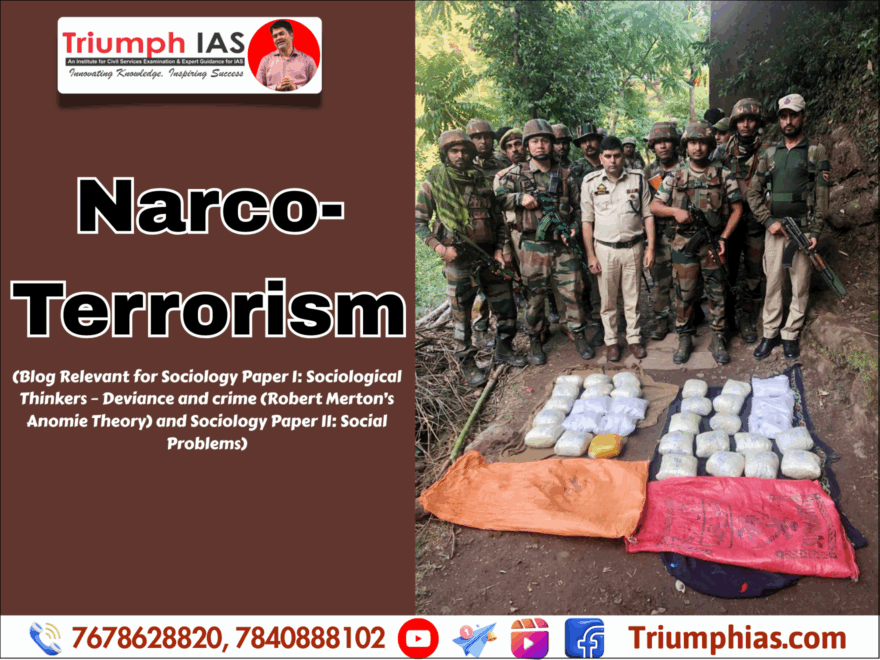
Narco-Terrorism
(Relevant for Sociology Paper I: Sociological Thinkers – Deviance and crime (Robert Merton’s Anomie Theory) and Sociology Paper II: Social Problems)

Introduction: Narco-TerrorismNarco-terrorism in Punjab has emerged as a dangerous nexus between drug trafficking, youth radicalization, and cross-border terrorism, threatening not only national security but also the social fabric of rural and urban Punjab. The alarming rise in drug addiction, cross-border smuggling, and terror funding reflects a deeper sociological crisis. This blog explores the issue through the lens of Robert K. Merton’s Strain Theory, examining the structural roots of deviance in society. Sociological Analysis:
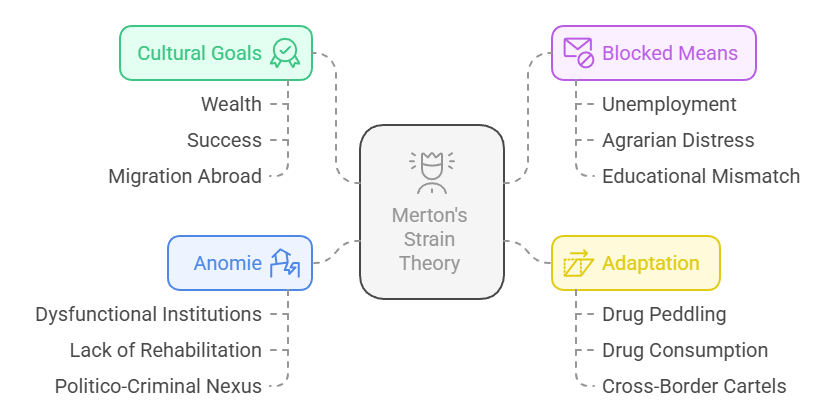
Robert K. Merton’s Strain Theory explains deviance as a response to the disjunction between culturally approved goals and institutionalized means. In the context of Punjab:
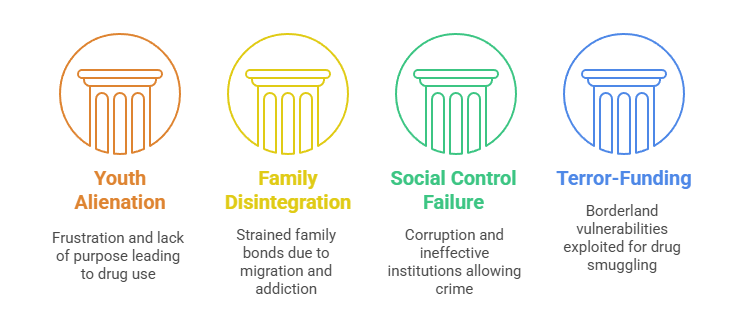
Merton classifies this as “innovation”, where individuals accept societal goals but use illegitimate means to achieve them. This phenomenon also represents a state of “anomie”, where normlessness arises due to the breakdown of societal regulations and expectations. Punjab, with its dysfunctional institutions, lack of rehabilitation infrastructure, and politico-criminal nexus, exemplifies this breakdown. Major Dimensions of the Issue
ConclusionNarco-terrorism in Punjab is not merely a law-and-order issue—it is a sociological emergency that demands holistic policy interventions, informed by theoretical insights such as Merton’s strain theory. Addressing youth aspirations, rehabilitating addicts, dismantling drug-political networks, and strengthening social institutions are critical to reclaiming Punjab’s future. As sociologists and policymakers alike must recognize, crime is often a symptom, not the disease. PYQsPaper I
Paper II
|



To Read more topics, visit: www.triumphias.com/blogs
Read more Blogs: