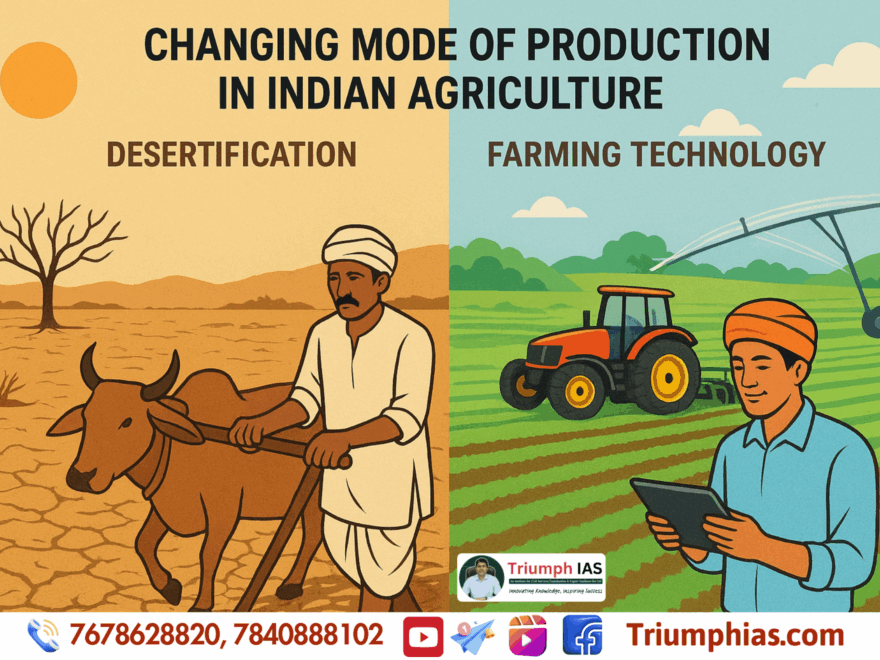
Agriculture in India has historically been the backbone of society, not just as an economic activity but as a mode of production shaping class, caste, and rural social structures. In recent years, the crisis of desertification and the rise of farming technologies such as soilification, precision agriculture, and AI-driven crop planning have transformed the very dynamics of agricultural production.
The question before sociologists is: Do these technologies redefine agrarian class relations, or do they reinforce existing inequalities? Can they resolve the agrarian crisis or do they create new forms of dependency on corporate and state structures?
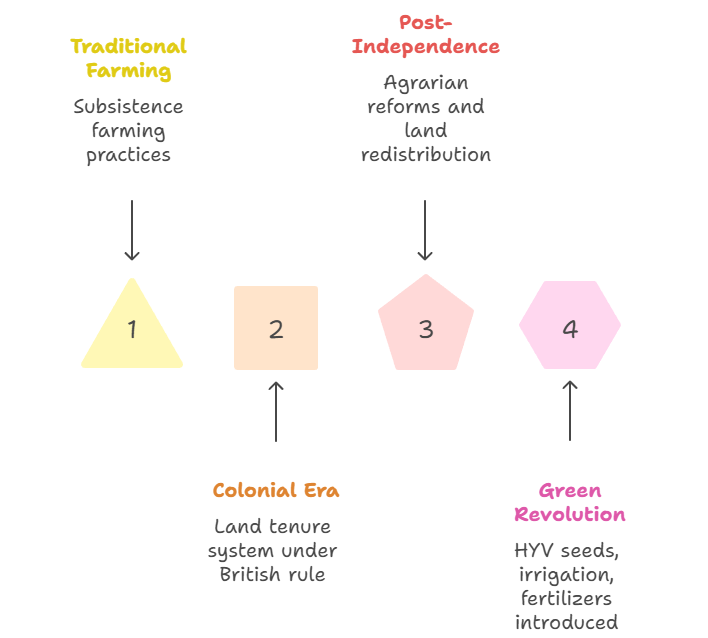
Historical Context: Agriculture and Mode of Production in India
Colonial Era: Under British rule, land tenure systems (Zamindari, Ryotwari, Mahalwari) transformed peasants into tenants and revenue-paying cultivators.
Post-Independence: Agrarian reforms attempted to redistribute land, but landed elites often retained control.
Green Revolution (1960s–70s): Introduced HYV seeds, irrigation, fertilizers – transforming Indian agriculture into a capital-intensive system. While it increased productivity, it also deepened regional inequalities and created agrarian capitalism.
Contemporary Phase: Current transformations (soilification, AI, agro-ecology) suggest a new technological mode of production where environment and sustainability are central.
Daniel Thorner and A.R. Desai argued that Indian agriculture reflects a semi-feudal, semi-capitalist mode. With desertification and climate change, however, a new eco-technological mode seems to be emerging.
Desertification and Agrarian Crisis
Nearly 30% of India’s land is degraded, with 96 million hectares affected.
Rajasthan contributes 23% of desertified land – symbolising ecological limits of intensive cultivation.
Sociological Implication: Land degradation exacerbates agrarian distress, migration, and rural unemployment. Marginal peasants and landless labourers face shrinking opportunities.
This aligns with Marx’s “metabolic rift” theory – capitalism’s exploitation of nature disrupts ecological balance, creating crises in soil fertility and water resources.
Technological Interventions: A New Agricultural Mode of Production
Soilification Technology in Rajasthan
Converts desert sand into fertile soil using polymers and bioformulations.
Enhances water retention and microbial activity.
Could reclaim large degraded tracts, altering land–labour relations.
Sociological angle: May empower marginal farmers in arid zones, but also risks creating dependence on scientific experts, corporates, and state agencies.
AI and Precision Farming (Baramati, Maharashtra)
Uses AI-driven tools for irrigation, pest control, and crop planning.
Yield increased by 40%, while input costs fell.
Represents the Weberian rationalisation of agriculture: calculation, data, surveillance.
Implications:
Larger farmers can adopt AI easily, while smallholders risk exclusion.
Reinforces agrarian class differentiation, echoing Bardhan’s analysis of agrarian class structure.
Sociological Interpretations of Changing Modes of Production
Marxist Lens
Capitalism increasingly penetrates agriculture through technology.
Farmers may become dependent on corporate seed, tech, and platforms.
Desertification itself reflects the contradictions of capitalist agriculture (overuse of land, monocropping).
Weberian Lens
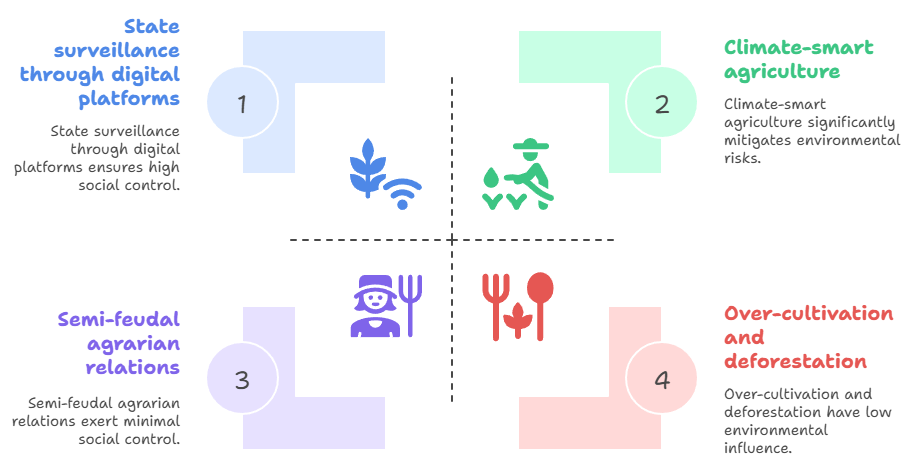
Bureaucratic rationalisation through digital platforms like U-WIN, eVIN ensures state surveillance and control.
AI and precision farming embody instrumental rationality, making agriculture a domain of data governance.
Peasant Studies
Daniel Thorner: Indian agriculture has moved from “feudalism” to “capitalism”. New tech accelerates this transition.
A.R. Desai: Agrarian relations reflect semi-feudal hold of landlords. With technology, semi-feudal landlords may convert into agrarian capitalists.
Environmental Sociology
Desertification is not just ecological but social. Over-cultivation, deforestation, and poor irrigation reflect human-environment interactions.
Ulrich Beck’s risk society: Climate change and land degradation create global risks, forcing adoption of “climate-smart agriculture”.
Case Studies
Pulse Polio Campaign → Polio-Free India (2014): Example of state–society cooperation in health. Similarly, soilification may require mass state-led participation.
Baramati Precision Farming (2019): Corporate–farmer collaboration, showing potential inequalities in access to technology.
Natural Farming in Andhra Pradesh: Large-scale state-led program, reducing chemical dependence, strengthening peasant autonomy.
Critiques
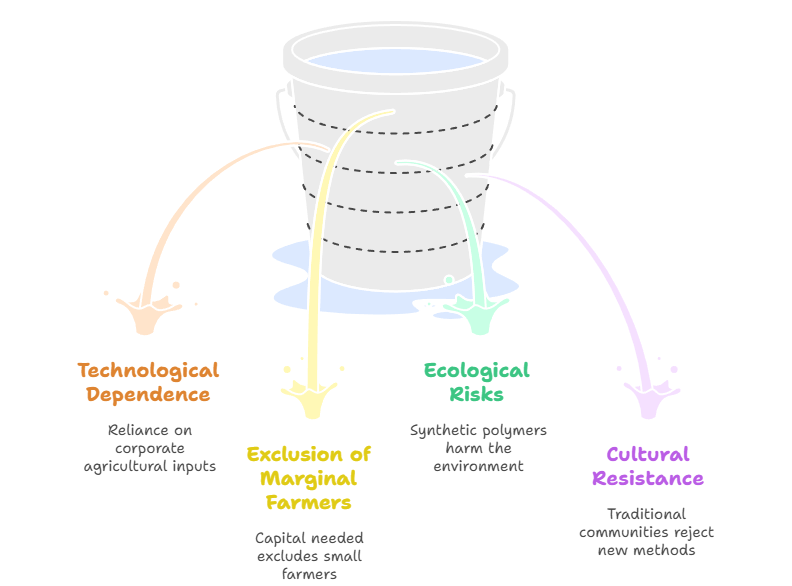
Technological Dependence
Farmers risk dependence on corporate inputs, digital platforms, and expert knowledge.
Echoes Marxist critique of commodification of agriculture.
Exclusion of Marginal Farmers
Precision farming, soil polymers require capital.
May deepen agrarian differentiation, with big farmers gaining disproportionately.
Ecological Risks
Introducing synthetic polymers for soilification may have long-term ecological consequences.
Cultural Resistance
Traditional communities may resist AI-driven or lab-based agriculture.
Sociology of knowledge (Berger & Luckmann) shows how socially constructed beliefs affect adoption.
Government Initiatives in Sociological Context
National Action Plan on Desertification: Reflects globalisation of environmental governance (UNCCD).
PMKSY (Krishi Sinchai Yojana): Highlights state’s effort to modernise irrigation – a continuation of Green Revolution rationality.
Soil Health Card Scheme: Example of knowledge-based governance – farmers are disciplined into “scientific” fertiliser use.
Natural Farming, Millets Promotion: Represents revival of traditional, eco-centric practices, often aligned with subaltern perspectives.
Broader Sociological Implications
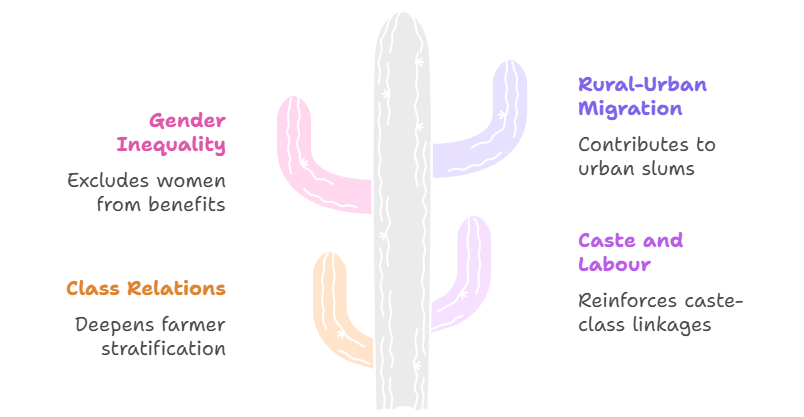
Class Relations
Capitalist penetration of agriculture deepens stratification between large and marginal farmers.
Caste and Labour
Land degradation and migration affect Dalits and landless labourers the most, reinforcing caste–class linkages in agrarian distress.
Gender
Women farmers, often without land titles, may be excluded from technological schemes and benefits.
Rural–Urban Linkages
Migration due to desertification contributes to urban slum growth, linking agrarian change with urban sociology.
Conclusion
The changing mode of production in Indian agriculture, shaped by desertification and emerging farming technologies, represents a dialectic between crisis and innovation. On one side, land degradation threatens rural livelihoods and accelerates distress migration. On the other, soilification, AI-driven farming, and natural farming provide pathways toward sustainability.
From a sociological perspective, these changes must be understood not merely as technological progress but as transformations in class relations, caste dynamics, gender roles, and state-society interactions. The future of Indian agriculture lies in balancing technological modernisation with ecological sustainability and social equity.
Thus, the debate on the mode of production in Indian agriculture today is no longer limited to “feudal vs. capitalist” but extends to “technological–ecological capitalism vs. sustainable alternatives.”
You’ve raised a great point about how agriculture in India is not just about the economy, but also deeply interwoven with social structures. The shift from traditional methods to high-tech solutions might be more disruptive to rural social fabric than we expect.







You’ve raised a great point about how agriculture in India is not just about the economy, but also deeply interwoven with social structures. The shift from traditional methods to high-tech solutions might be more disruptive to rural social fabric than we expect.