


Towards Cleaner Skies: India’s Journey to Sustainable Air Quality
(Relevant for GS paper-3, Environmental Conservation)

IntroductionAir pollution is one of the most pressing environmental challenges in India today. According to the 2024 World Air Quality Report by IQAir, 9 of the world’s 10 most polluted cities are in India, with Begusarai, Bihar, topping the list. Chronic exposure to air pollution not only undermines public health but also affects economic productivity and environmental sustainability. India’s journey towards sustainable air quality is, therefore, both a public health necessity and a developmental imperative. Understanding the Air Pollution Crisis
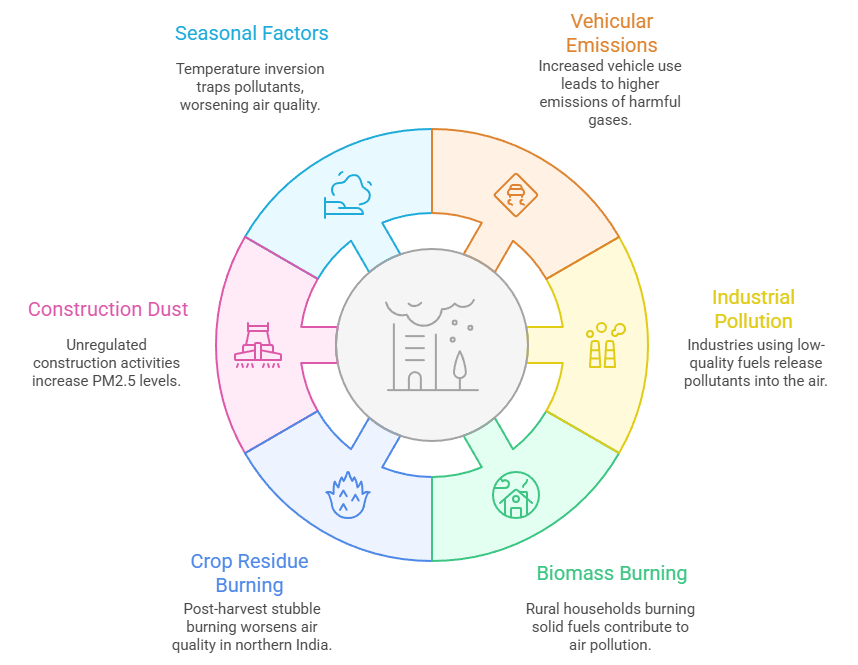
India’s air pollution problem stems from multiple sources:
The Health Effects Institute (HEI) reported in 2024 that exposure to air pollution caused 1.6 million premature deaths in India in 2022 alone, with children and elderly populations most vulnerable. India’s Institutional Framework and Policy Response
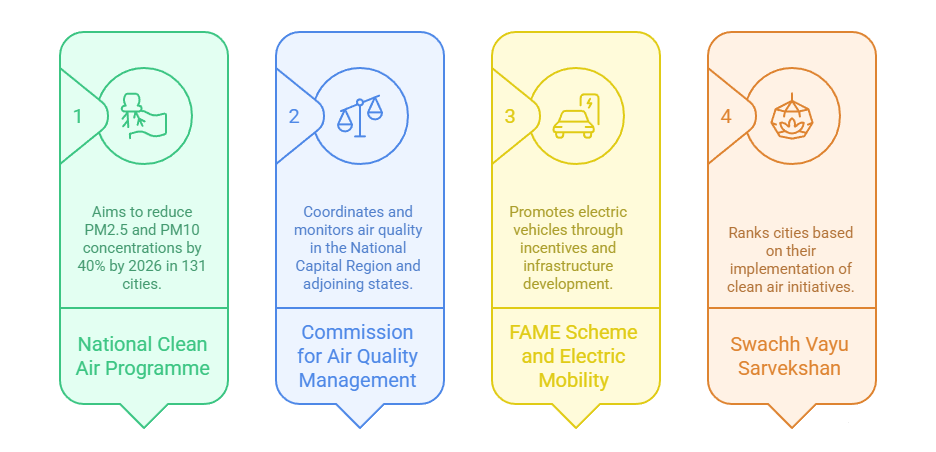
Over the years, India has developed a multi-pronged strategy to improve air quality:
Launched in 2019 and updated in 2023, NCAP aims to reduce PM2.5 and PM10 concentrations by 40% by 2026 (revised target) in 131 non-attainment cities. Key features include:
In July 2024, the MoEFCC reported that 95 cities showed improvement in PM10 levels over a 3-year average.
Established in 2021, CAQM has legal powers to coordinate and monitor air quality in the National Capital Region (NCR) and adjoining states. It has enforced bans on diesel generators, promoted smog towers, and implemented GRAP (Graded Response Action Plan) during severe air pollution events.
Under the FAME-II (Faster Adoption and Manufacturing of Hybrid and Electric Vehicles) scheme, the government has provided over ₹10,000 crore in incentives, promoting electric two-wheelers, buses, and cars. In Budget 2025–26, an additional ₹5,000 crore was allocated to bolster EV infrastructure in Tier-2 and Tier-3 cities.
Launched in 2023, it ranks cities based on their implementation of clean air initiatives. Indore, Surat, and Bhopal topped the rankings in the 2024 edition among million-plus cities. Technological and Sectoral Interventions
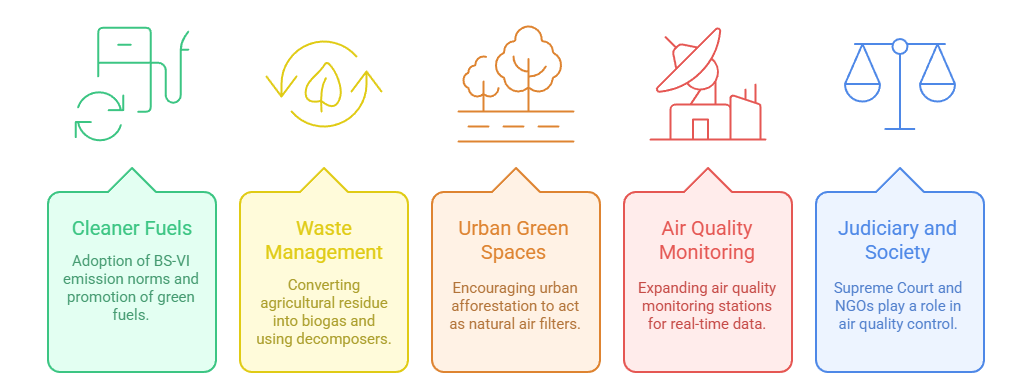
Cleaner Fuels and Vehicles
Waste and Biomass Management
Urban Green Spaces and Carbon SinksPrograms like Nagar Van Yojana encourage urban afforestation to act as natural air filters. Over 600 Nagar Vans have been sanctioned since 2020. Air Quality MonitoringIndia has expanded its Continuous Ambient Air Quality Monitoring Stations (CAAQMS) to over 500 stations nationwide, enabling real-time data analysis. Role of Judiciary and Civil Society
Challenges AheadDespite efforts, several challenges persist:
Way Forward: Towards Sustainable Air Quality
ConclusionIndia’s fight for cleaner air is not only a technical and administrative challenge but also a moral one. Sustainable air quality is essential for public health, climate resilience, and overall quality of life. While government schemes and judicial actions are steps in the right direction, lasting change will require a whole-of-society approach — involving citizens, industries, scientists, and policy-makers. By aligning environmental goals with developmental priorities, India can indeed pave the path to breathable skies and healthier futures. |



To Read more topics, visit: www.triumphias.com/blogs
One comment