(Relevant for Sociology Paper I: Stratification and Mobility; Social Change in Modern Society and Sociology Paper II: Challenges of Social Transformation)
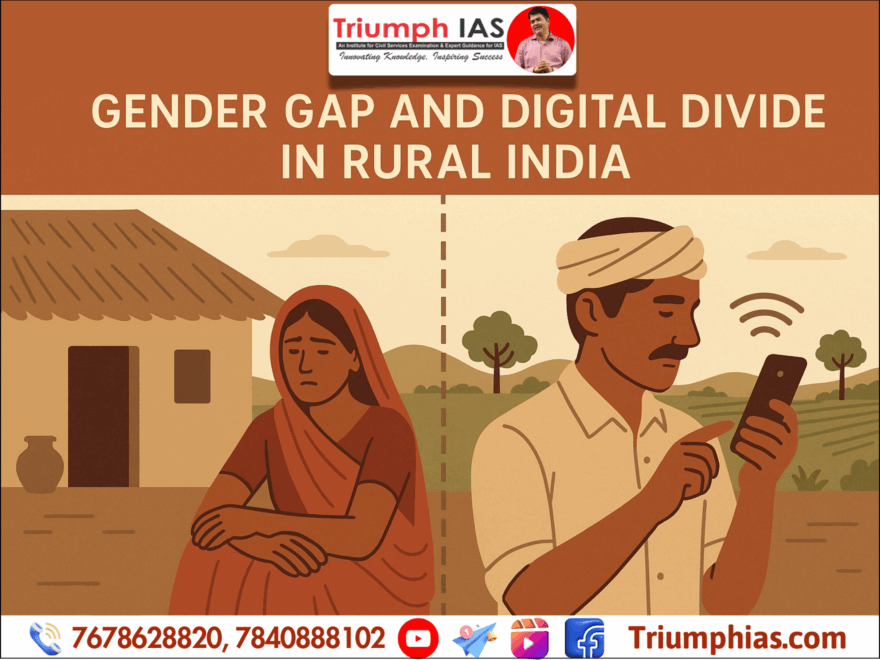
The Annual Status of Education Report (ASER) 2024 offers critical insights into the changing landscape of education in rural India. The report not only documents progress but also exposes persistent challenges, especially in the realms of digital literacy, gender inequality, and educational access. These findings are significant for sociology and shed light on deeper issues like social stratification and the digital divide—themes central to the sociology.
Key Findings: Digital Divide and Gender Gap in Rural Teens
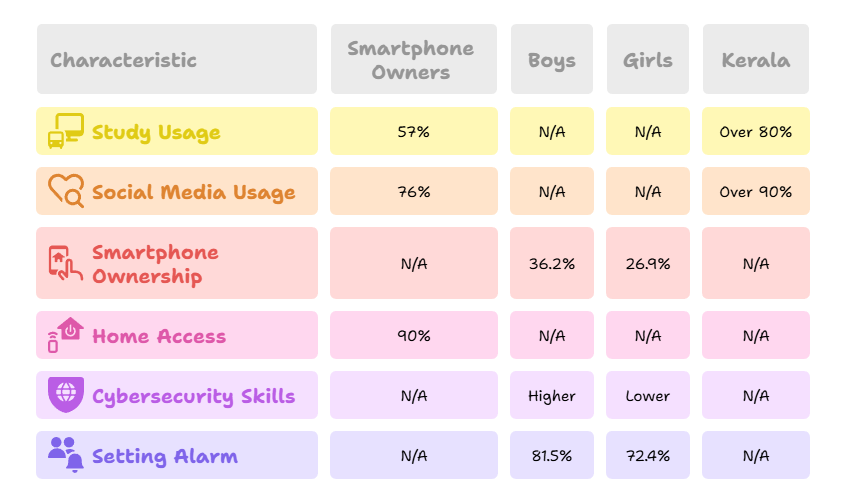
2% of rural teens (14-16 years) know how to use a smartphone, but only 57% use it for studies.
76% use smartphones for social media, highlighting a preference for entertainment over educational usage.
Gender gap in smartphone ownership: 36.2% of boys vs. 26.9% of girls own smartphones.
90% have access to a smartphone at home, but personal ownership is much lower, especially for girls.
Digital literacy gap:Boys show higher awareness and skills related to cybersecurity than girls, with the widest gap in setting an alarm (81.5% boys vs. 72.4% girls).
Kerala leads in digital usage: Over 80% use smartphones for education and over 90% for social media.
Socio-Cultural Patterns Revealed
Gendered Digital Access: The consistent gender gap across states points to deep-rooted patriarchal norms and gendered access to resources.
Digital Literacy as Social Capital:Knowledge of online safety, privacy, and technical skills is emerging as a new marker of social stratification.
The Role of Educated Mothers
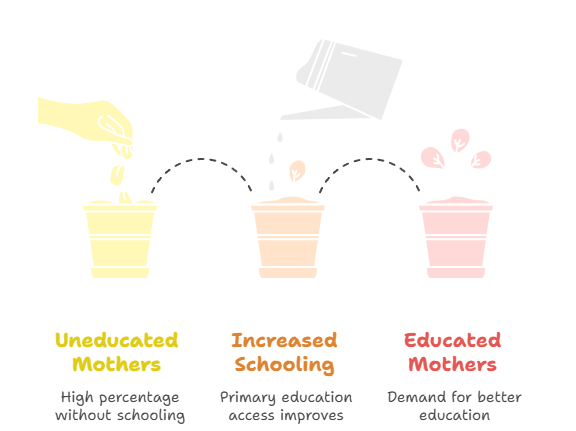
Proportion of schooled mothers rising: In 2014, 43% of mothers had no schooling; by 2024, this dropped to 24%.
Mothers with atleast primary schooling surged from 43% to 64% in a decade.
Schooled mothers as change agents: Their growing numbers drive demand for better local education (e.g., Anganwadi centres) and improved early years’ education.
Trends in Schooling
Student attendance in government primary schools has improved to 9% (from 72.4% in 2018).
Teacher attendance is up to 87.5%.
Rise of small schools: More than half of government primary schools have fewer than 60 students, especially in states like Himachal Pradesh, J&K, Uttarakhand, and Karnataka.
Multigrade classrooms: Two-thirds of classrooms for Classes 1 & 2 have students from different grades, reflecting resource constraints in small schools.
Sociological Analysis
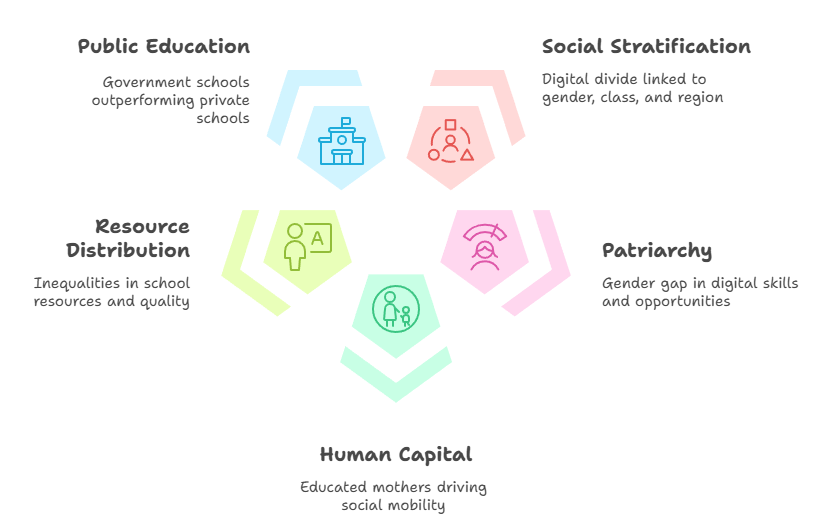
Social Stratification and Digital Divide: The digital divide in rural India is not just about access, but deeply linked to social hierarchies—gender, class, and region. As Pierre Bourdieu’s theory of capital suggests, digital literacy is now a crucial form of ‘cultural’ and ‘social’ capital. Boys enjoy more freedom and access due to entrenched patriarchy, while girls face restrictions that limit their technological empowerment and, consequently, their future opportunities.
Persistence of Patriarchy: Despite rising female literacy, the persistent gender gap in smartphone ownership and digital skills reflects traditional gender roles and social expectations. The gap also mirrors broader patterns of educational and occupational segregation, which are central themes in the sociology of gender.
Human Capital and Intergenerational Mobility: The rise in the proportion of educated mothers signals social mobility and changing aspirations among rural families. As functionalists like Emile Durkheim argued, education acts as an agent of socialization and integration—educated mothers demand better educational infrastructure and are more involved in their children’s learning.
Multigrade Classrooms and Resource Distribution: The increase in small government schools and multigrade classrooms highlights inequalities in resource allocation and the persistent challenge of providing quality education in remote areas. This scenario can be linked to the conflict perspective (Karl Marx), which critiques how structural inequalities perpetuate disparities in educational access and outcomes.
Public vs. Private School Recovery: Government schools have reportedly outperformed private schools in bouncing back from pandemic-induced learning loss. This underscores the importance of public education as a leveller in times of crisis and brings attention to debates on privatization vs. public provisioning of education.
Conclusion
The ASER 2024 report not only maps the progress in rural education but also throws light on emerging social divisions and the persistent digital and gender divide. Bridging these gaps requires targeted policy interventions, digital inclusion strategies, and empowerment of girls and women in rural India. The report is a vital resource to understand how social structures, cultural norms, and educational policies intersect to shape the lives and futures of India’s rural youth.
PYQs
Paper 1:
Examine the intersection of gender, technology, and education in shaping new forms of social inequality.(2023)
Explain the concept of social mobility and critically assess the role of education in promoting inter-generational mobility in Indian society.(2022)
How does digital divide reinforce existing social inequalities in India? Illustrate with examples.(2021)
Assess the sociological implications of online learning and digital education on rural youth.(2021)
Examine the impact of information and communication technology (ICT) on social relationships and educational opportunities in rural India.(2020)
How do family, school, and peer group contribute to the process of socialization in the context of technological change?(2019)
Discuss the role of education as an instrument of social change in the context of rural society in India.(2018)
Evaluate the effectiveness of government policies in bridging the gender gap in education.(2017)
Critically analyse the relationship between social stratification and access to technology in contemporary India.(2016)
What are the main challenges faced by rural women in accessing education and digital resources? Suggest measures for improvement.(2015)
Paper 2:
Examine the role of mothers’ education in improving educational outcomes for children in rural India.(2023)
How has the expansion of digital infrastructure affected the educational landscape in rural India?(2022)
Analyse the effectiveness of community-based interventions in promoting digital education in rural areas.(2022)
How do socio-cultural factors influence women’s access to digital literacy in Indian villages?(2021)
To what extent have the COVID-19 pandemic widened educational inequalities in India? Discuss with reference to rural and urban divide.(2020)
Evaluate the impact of government schemes like Sarva Shiksha Abhiyan and Digital India in reducing educational inequality.(2019)
Describe the significance of small schools and multigrade classrooms in addressing the diverse needs of rural learners.(2018)
Critically examine the role of education in the process of modernization of rural society in India.(2017)
“Education is the key to social change.” Illustrate this statement with reference to any one marginalized group in India.(2016)
Discuss the factors responsible for the persistence of gender gap in literacy in rural India.(2015)