



Challenges to Indian Federalism: Contemporary Dynamics and Debates
(Relevant for GS paper-2, Federalism)

Indian FederalismIndian federalism, while constitutionally entrenched, faces several stress points in today’s political landscape. The growing complexity of multi-layer governance has brought both cooperative potential and disruptive fissures. Below are the key challenges shaping this dynamic: Population-Based Delimitation & Regional EquityA major flashpoint is the delayed Census and its linkage to electoral delimitation. Former finance minister P. Chidambaram recently criticised the Centre’s decision to postpone the Census to 2027 as a strategy to swiftly trigger delimitation — recalibrating the boundaries of Parliamentary seats — before the Supreme Court’s 2026 deadline. He argued this could tilt representation away from southern states like Tamil Nadu towards northern states, posing a direct federal challenge: population-based representation versus regional equity. Chief Minister M.K. Stalin has echoed these concerns, urging a more consultative and balanced approach. As this debate intensifies, it raises questions about whether delimitation must remain merit- and equity-based rather than politically opportunistic. Reassertion of State Autonomy via AgitationsStates continue to voice grievances against central encroachments. Tamil Nadu has again appealed to the Centre to establish a Pennaiyar water-dispute tribunal, citing violations of century-old agreements by Karnataka’s dam actions. This reflects how Centre-State water issues, emblematic of federal stress, persistently fester due to unresolved interstate tensions. Similarly, in Jammu & Kashmir, former Chief Minister Omar Abdullah decried its downgraded status — from full state to Union Territory — as a political “demotion,” calling for restoration of statehood. This underlines how federal identity and devolution are central to the politics of regional dignity and trust. Fiscal Federalism Under Strain
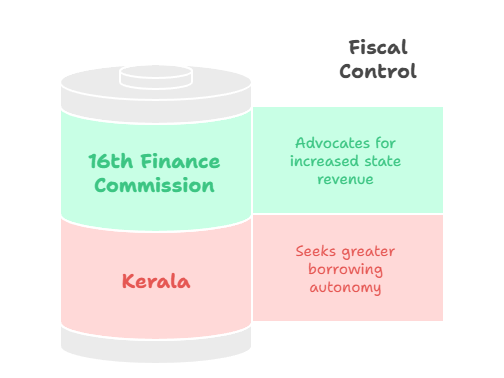
The financial interdependence between the Centre and States is growing more contentious, particularly in borrowing and revenue sharing.
These fiscal discussions unveil the tension between giving states more fiscal control and the Centre’s role as economic custodian — both of which are critical aspects of constitutional federalism. Cooperative vs Competitive Federalism
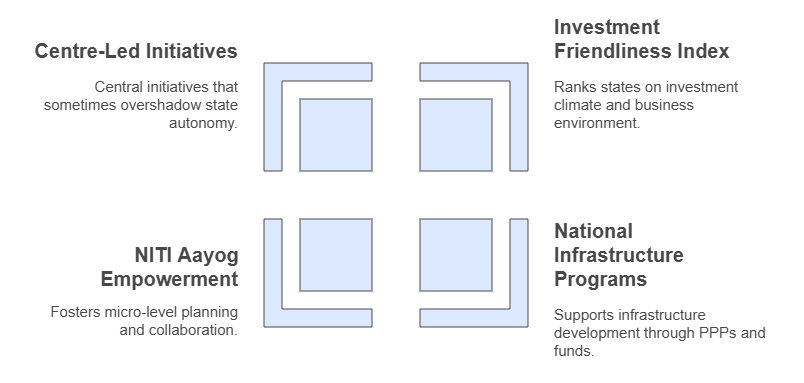
Policy mechanisms have emerged to balance cooperation and competition between Centre and States — yet these too pose challenges.
Thus, while cooperative models promise synergy, they sometimes result in central dominance under the guise of collaboration. Institutional Frictions & State Pushback
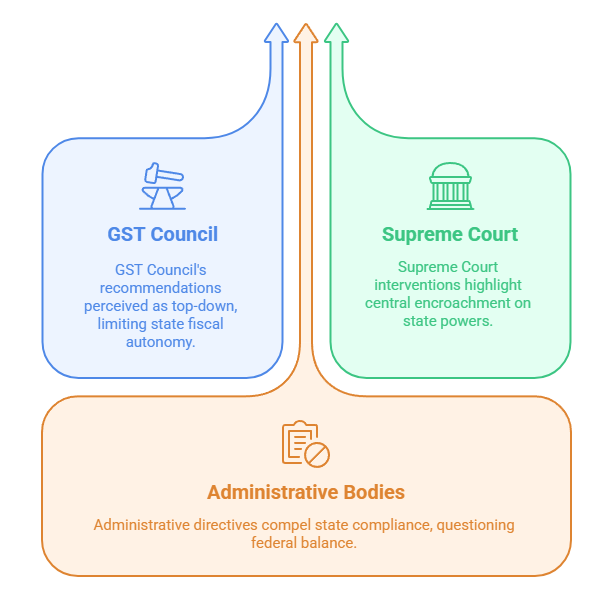
Multiple institutions symbolize structural pressure on federal norms:
Evidently, institutional friction reflects deeper struggles between autonomy and unity. Ideological Tensions & Cultural FederalismAt the heart of federalism lies a cultural plurality. Contemporary controversy in Kerala, where the state government skipped an event at Raj Bhavan over a perceived RSS-affiliated ‘Bharat Mata’ portrait, illustrates tension between nationalistic symbolism and regional identity These flashpoints remind us that federalism must accommodate ideological diversity—balancing national integration with pluralistic identities. Centre-State Relations: Governance versus ControlThe relationship between tiers of government is becoming more hierarchical, with concerns across multiple areas:
Frameworks like Articles 245–291, Seventh Schedule, and Articles 256–263 remain intact, but the reality of day-to-day governance reveals imbalances that challenge their spirit ConclusionIndian federalism stands at a crossroads — oscillating between central imperatives and state aspirations. The delayed Census, state demands for autonomy, ideological differences, and financial contention are more than administrative flashpoints; they indicate underlying structural stress. For a resilient and responsive federation, India must uphold constitutional spirit while empowering its states with clarity, accountability, and fiscal freedom. This evolving federal narrative, deeply relevant for UPSC, calls for a nuanced and evidence-based discourse — grounded in both legal frameworks and recent developments. |





To Read more topics, visit: www.triumphias.com/blogs
One comment