



Custody and Constitutional Rights: A Call for Reform
(Relevant for GS paper-2, Government Policies and Interventions)

Introduction: Custody and Constitutional RightsThe principle of justice demands that the custodial environment serve not as a zone of impunity, but as a domain where the dignity and rights of detainees are protected. Yet, India continues to grapple with rampant custodial torture, police brutality, and prison overcrowding. Reforming custodial norms is vital not only for upholding constitutional guarantees under Articles 21 and 22 but also for strengthening public trust, reducing human rights violations, and endorsing rehabilitation over punishment. Custodial Violence: Alarming TrendsAccording to the Global Torture Index 2025, India is rated a “high risk” country for systemic custodial brutality, including torture, extrajudicial detentions, and deaths The NHRC reported 2,739 custodial deaths in 2024, with 155 attributed to police custody . Between 2016 and 2022, over 11,650 custodial deaths were recorded, indicating persistent systemic failure . Exemplary cases include the Parbhani custodial death of Somnath Suryawanshi, where medical reports disclosed multiple injuries contrary to police claims of natural death. In July 2025, the Bombay High Court officially recognized the incident as custodial death and ordered an FIR . Another case from Uttar Pradesh’s Jalaun district prompted NHRC suo-motu action after reports indicated that police left the deceased unacknowledged at a hospital while detaining his relatives . Despite such cases, conviction rates are disturbingly low. Data since 2018 shows no conviction of police personnel for rights violations or custodial deaths . Institutional Gaps: Law, Accountability & Oversight
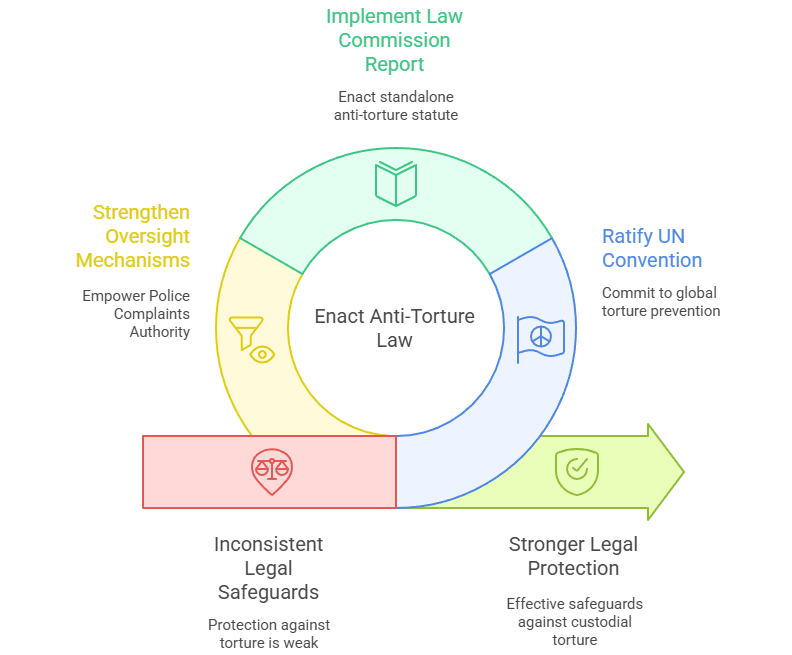
Though Article 21 guarantees protection of life and liberty, legal safeguards against custodial torture are inconsistent. The Bharatiya Nagarik Suraksha Sanhita (BNSS), 2023 covers custodial torture, but no specific anti-torture law has yet been enacted . India signed but did not ratify the UN Convention Against Torture; the 273rd Law Commission Report (2017) recommended a standalone anti-torture statute with a reverse burden of proof in custodial injury cases . The Status of Policing in India Report 2025 (SPIR) reveals worrying police culture: 20% of surveyed personnel support the use of torture to instill fear; 35% consider it justified to some extent. Moreover, endorsement of mob violence was shockingly high in sensitive crime contexts . Oversight mechanisms like the Police Complaints Authority (PCA) are often toothless—set up in only 17 states, with diluted enforcement power and slow processes . Prison Conditions & Custodial ReformIndia’s prisons suffer from acute problems of overcrowding and undercapacity. As of 2022, occupancy rates reached 131%, with undertrial detainees comprising 75.8% of all inmates. Many undertrials remain in prison for years without trial or conviction . Delhi’s 16 prisons house nearly 19,000 inmates against capacity of just over 10,000, whereas Tihar Jail now houses over 14,000 inmates despite a sanctioned capacity of 5,200 . Understaffing—34% officer vacancies and 60% correctional staffing shortages—compounds these issues. Only 90 doctors serve Delhi’s prisoner population of 18,000 . Reformative Initiatives and Emerging Best Practices
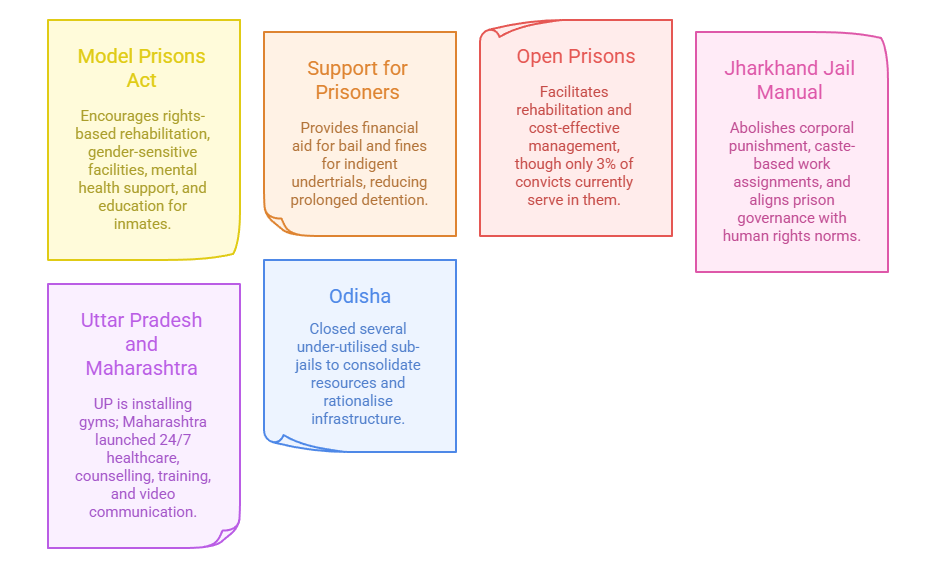
Several reform measures have gained traction:
State-level reforms include:
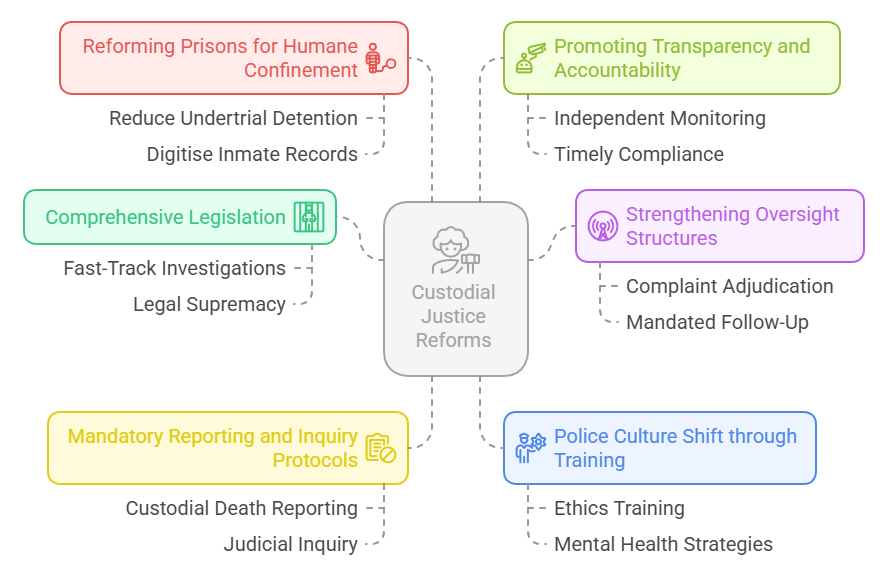
Key Reforms Needed
ConclusionReform of custodial norms is essential to safeguard constitutional rights, ensure state accountability, and regenerate the public’s faith in justice institutions. Deep-rooted challenges such as police impunity, overcrowded prisons, and weak oversight persist—but reforms like anti-torture laws, judicial inquiry mandates, prison modernisation, and rehabilitation-oriented policy offer a clear path forward. Achieving justice “behind bars” is more than a policy goal—it’s a moral imperative and a test of democratic integrity. |



To Read more topics, visit: www.triumphias.com/blogs