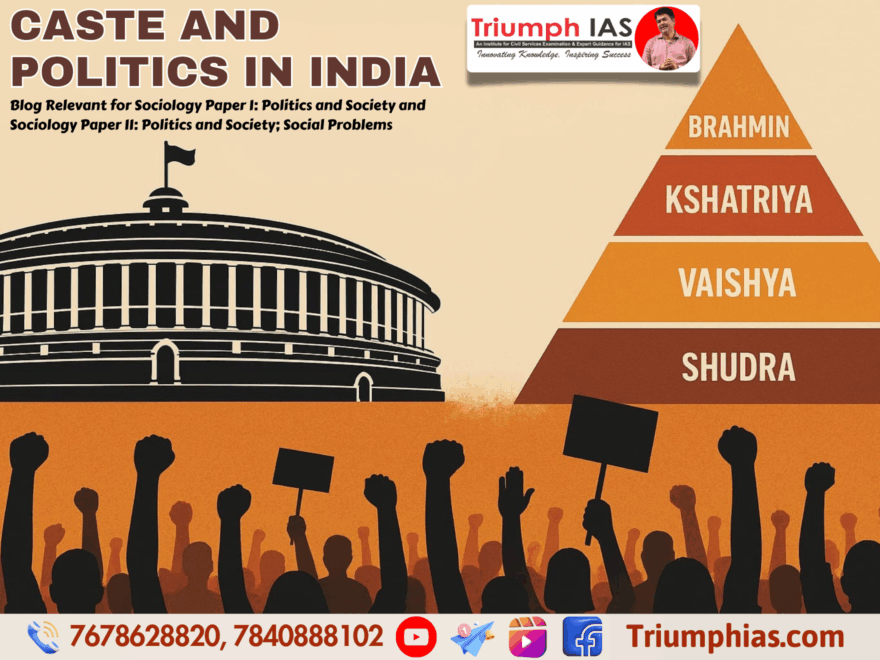
Caste and politics in India are deeply interlinked, shaping the country’s electoral dynamics, governance structures, and social policies. While the Indian Constitution envisions equality and prohibits caste-based discrimination, the persistence of caste identities in political mobilization reflects the complex interplay between tradition and modernity.
Historical Context of Caste and Politics
The interaction between caste and politics is not new. In colonial India, caste identities were politically reinforced through census classifications, separate electorates, and preferential recruitment in administration.Post-independence, political leaders like B.R. Ambedkar emphasized the annihilation of caste as a prerequisite for true democracy, but caste networks continued to influence political participation.
Colonial Legacy: British policies institutionalized caste categories, which later became tools for political bargaining.
Post-Independence Politics: With universal adult franchise, marginalized castes found political expression through democratic processes.
Sociological Analysis
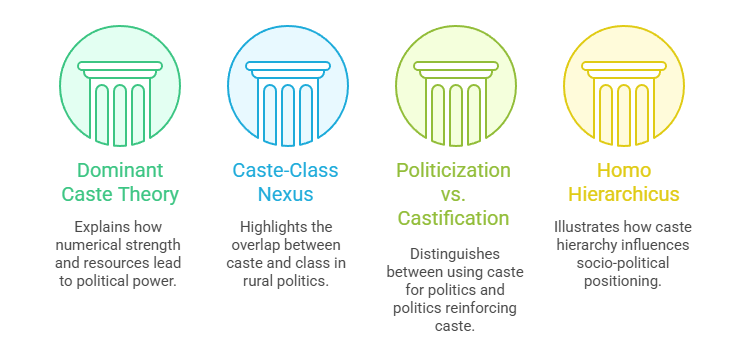
Dominant Caste Theory: N. Srinivas argued that political power often lies with the dominant caste — a caste with numerical strength, economic resources, and social prestige in a region. This explains why regional politics often revolves around caste alliances.
Caste-Class-Political Power Nexus: Andre Béteille emphasized that caste and class often overlap in rural India, influencing voting patterns and leadership emergence.
Politics of Caste and Caste of Politics: Rajni Kothari distinguished between politicization of caste(using caste for political mobilization) and castification of politics (politics reinforcing caste identities).
Homo Hierarchicus: Louis Dumont’s idea of hierarchical ordering helps understand how caste identity continues to influence socio-political positioning, despite legal equality.
Caste Mobilization in Electoral Politics
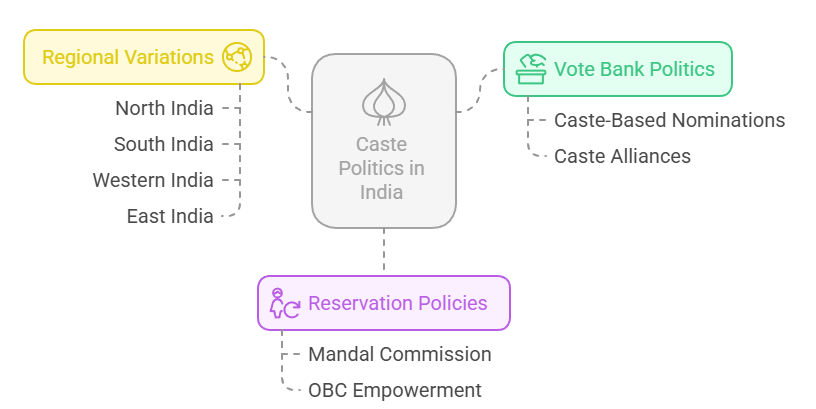
Vote Bank Politics
Political parties often rely on caste-based vote banks, nominating candidates from dominant or numerically strong castes to secure electoral victories. Example: In Uttar Pradesh, caste alliances like Yadav–Muslim, Dalit–Brahmin coalitions have shaped government formations.
Reservation Policies
The Mandal Commissionrecommendations (1990) expanded caste-based reservations, reshaping Indian politics by empowering Other Backward Classes (OBCs) and altering the caste power structure.
Regional Variations
North India: Politics is dominated by Jats, Yadavs, Kurmis, and Dalits.
South India: Dravidian movements in Tamil Nadu mobilized backward castes against Brahmin dominance.
Western India: Marathas in Maharashtra, Patidars in Gujarat play decisive roles.
East India: Caste politics in Bihar and Odisha revolve around Yadavs, Koeris, and Dalits.
Role of Caste in Policy Making
Reservation in Education and Jobs: Ensures political attention to backward classes.
Caste Census Demand: Politically sensitive topic, influencing welfare policies.
Welfare Schemes Targeting Castes: Schemes like scholarships, housing benefits are often caste-specific.
Impact on Indian Democracy
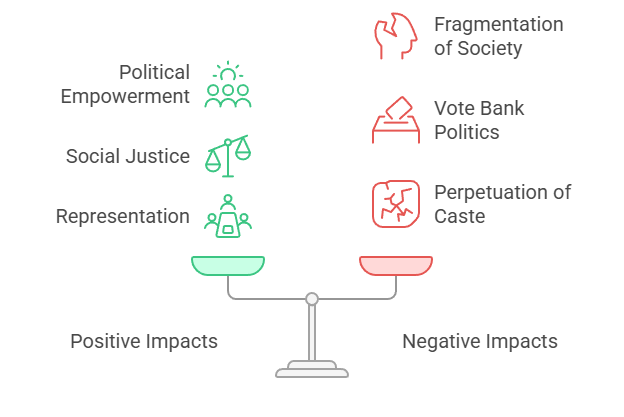
Positive Impacts
Political Empowerment: Caste mobilization has brought marginalized groups into mainstream politics.
Social Justice: Reservation policies have facilitated upward mobility.
Representation: Ensures diversity in political leadership.
Negative Impacts
Fragmentation of Society: Caste-based politics can deepen social divides.
Vote Bank Politics: Issues of governance and development may get overshadowed by caste considerations.
Perpetuation of Caste Identities: Instead of weakening caste, politics often reinforces it.
Contemporary Issues
Caste-based Violence: Incidents in Haryana, Rajasthan, and Tamil Nadu highlight caste tensions.
Maratha and Patidar Reservations: Ongoing demands for inclusion in OBC category show caste’s continued political relevance.
Caste Census 2024 Debate: Political parties are divided over publishing caste-based data from the Census.
Dalit Political Mobilization: Rise of leaders like Chandrashekhar Azad in Uttar Pradesh shows evolving forms of caste assertion.
Supreme Court on Reservation: The 103rd Constitutional Amendment and EWS quota debates reflect intersections between caste and economic criteria.
Way Forward
Strengthening Issue-based Politics: Shift focus from caste identity to development, education, healthcare, and employment.
Promoting Inter-caste Dialogue: Encouraging social integration through community programs.
Transparent Caste Census: Data can inform targeted welfare measures without deepening divides.
Educational Reforms: Promote constitutional values of equality and fraternity.
Conclusion
Caste and politics in India have a mutually reinforcing relationship. While democratic politics has empowered marginalized castes, it has also entrenched caste identities in the political sphere. A balanced approach is needed — one that recognizes caste-based inequalities while moving towards a more inclusive, development-oriented politics.
PYQs
Paper 1 –
How has the politicization of caste impacted the process of social change in India? (2014)
Explain Rajni Kothari’s thesis on “Politics of Caste and Caste of Politics” in the Indian context. (2015)
Discuss M.N. Srinivas’s concept of “dominant caste” and examine its relevance in contemporary Indian politics. (2016)
Examine the relationship between caste and class in shaping political leadership in rural India. (2017)
How does caste operate as a pressure group in the Indian political system? Illustrate with suitable examples. (2018)
Explain Louis Dumont’s perspective on caste hierarchy and analyze its political implications. (2019)
How do caste-based movements challenge or reinforce the social stratification system in India? (2020)
Critically assess the role of caste in the functioning of Indian democracy. (2021)
Discuss the role of caste in electoral mobilization in contemporary India. (2022)
Examine the role of caste identity in political participation and representation in post-independence India. (2023)
Paper 2 –
Analyze the impact of the Mandal Commission on caste politics in India. (2014)
Analyze the interplay of caste and religion in shaping political outcomes in contemporary India. (2015)
Discuss the role of caste in shaping regional political parties in India, with examples from at least two states. (2016)
Examine the link between caste-based reservations and political mobilization in India. (2017)
Critically examine the role of caste alliances in coalition politics at the state and national levels. (2018)
Discuss the role of caste in shaping leadership patterns in Panchayati Raj Institutions. (2019)
Explain how caste politics has transformed in the era of globalization and liberalization. (2020)
Evaluate the impact of caste-based political mobilization on the development agenda in India. (2021)
Discuss how caste has influenced voting behavior in at least two recent general elections. (2022)
How has the demand for a caste census influenced political debates in contemporary India? (2023)






One comment