


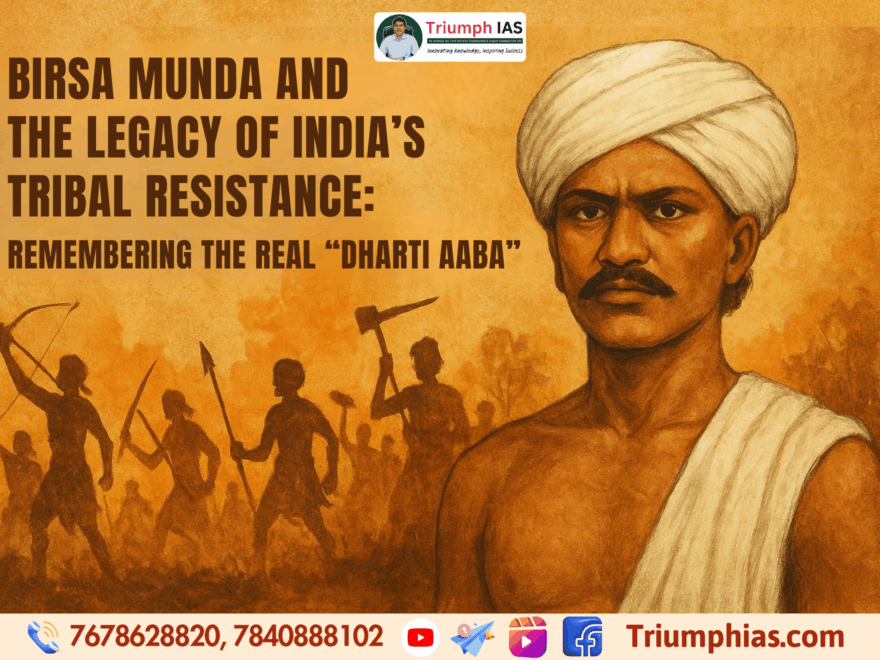
Birsa Munda and the Legacy of India’s Tribal Resistance: Remembering the Real “Dharti Aaba”
(Relevant for Sociology Paper 2: Tribal Communities in India)
Birsa Munda and the Legacy of India’s Tribal Resistance: Remembering the Real “Dharti Aaba”Every year on 15 November, India observes Janjatiya Gaurav Diwas, a day that honors the life, courage, and spirit of Bhagwan Birsa Munda, the legendary tribal freedom fighter who led one of the most organized indigenous uprisings against British rule. But in 2025, this commemoration has taken on an even grander scale with the Janjatiya Gaurav Varsh Pakhwada (1–15 November) — a fortnight of nationwide celebrations marking 150 years of Birsa Munda’s birth, and a tribute to centuries of tribal resilience, culture, and contribution to India’s history. Led by the Ministry of Tribal Affairs, this year-long observance — from 15 November 2024 to 15 November 2025 — under the banner of Janjatiya Gaurav Varsh (JJGV), aims not just to remember tribal heroes but to reassert the pride and identity of India’s indigenous communities. It seeks to turn remembrance into movement, and history into empowerment. But beyond the official observance lies a deeper story — one of land, dignity, and defiance. The story of Birsa Munda is not an isolated episode; it’s part of a long continuum of tribal resistance that shaped India’s anti-colonial consciousness long before 1857 and well after independence. The Rise of a Revolutionary: Birsa Munda and the UlgulanBorn in 1875 in the Chotanagpur Plateau (now Jharkhand), Birsa Munda grew up witnessing the devastating impact of British land policies on his community. The Permanent Settlement Act of 1793 and subsequent revenue systems dismantled traditional Khuntkatti land ownership — a communal system where tribal families collectively held land. These policies paved the way for moneylenders and landlords (dikus), who exploited tribal peasants through forced labor (begar), debt, and land alienation. What emerged was not merely economic exploitation, but a cultural dislocation. British missionaries introduced Christianity, while the administration sought to ‘civilize’ tribal populations — eroding their traditions, beliefs, and autonomy. Birsa, who briefly converted to Christianity, later rejected it after realizing its association with colonial domination, famously remarking, “Saheb Saheb ek topi.” Out of this tension was born a new consciousness — a synthesis of spiritual revival and political rebellion. Birsa proclaimed himself as the messiah of the Mundas, preaching the message of “Abua Dishum, Abua Raj” — Our Land, Our Rule. His faith, the Birsait movement, blended tribal traditions with reformist ideas, emphasizing purity, equality, and self-governance. The movement culminated in the Ulgulan (The Great Tumult) of 1899–1900, where thousands of tribal men and women rose in armed defiance. They refused to pay rent, boycotted colonial courts, and attacked symbols of British authority. It was not merely a revolt against oppression — it was an assertion of identity and sovereignty. Though Birsa was captured and died in jail in 1900 at just 25 years old, his dream of Birsa Raj inspired generations of resistance. His legacy led to concrete policy change: the Chotanagpur Tenancy Act of 1908, which recognized and protected tribal land rights — a rare acknowledgment of indigenous claims in colonial India. Tribal Revolts Before Birsa: Seeds of ResistanceBirsa Munda’s uprising was not an isolated spark. It was part of a long lineage of tribal revolts that erupted across India in response to colonial intrusion and social disruption. Long before mainstream nationalist movements took shape, tribal communities had already been waging their own battles for autonomy and dignity.
Each of these movements, often dismissed in colonial historiography as “primitive” or “spontaneous,” actually revealed deep political and ecological awareness. Tribals understood that land was not a commodity — it was life itself, an extension of the community’s soul. Sociological Lens: Tribal Resistance and Identity FormationFrom a sociological perspective, tribal revolts like the Ulgulan represent a struggle for cultural survival. Émile Durkheim might interpret them as efforts to preserve collective conscience — the shared moral framework that binds a society. The imposition of British law, Christianity, and market economy disrupted the organic solidarity of tribal life, leading to social anomie. Revolt became a means of restoring moral balance.
The Modern Continuum: From Resistance to RecognitionToday, Janjatiya Gaurav Varsh represents more than commemoration; it’s a collective attempt to rewrite national memory. For decades, tribal revolts were footnotes in mainstream history — overshadowed by urban, elite-led nationalist narratives. Recognizing Birsa Munda and others restores the balance, situating tribal struggles at the heart of India’s freedom movement. Yet, the challenges they fought persist in new forms. Tribal communities still face land displacement, mining-induced migration, and loss of forest rights. Development projects often repeat colonial patterns — alienating the very people who once fought to protect their ecosystems. Initiatives like the Pradhan Mantri Janjati Adivasi Nyay Maha Abhiyan (PM JANMAN) and Dharti Aaba Janjatiya Utkarsh Gram Abhiyan reflect an effort to bridge that historical gap — ensuring that inclusion and empowerment go hand in hand with remembrance. But true honor to Birsa Munda’s legacy will come not from statues or slogans, but from policy justice — protecting land, language, and life of tribal communities. Conclusion: Remembering the “Dharti Aaba”Birsa Munda remains more than a historical figure — he is a symbol of resistance, identity, and hope. His vision of Birsa Raj was not about separatism; it was about justice — an order where people lived in harmony with their land and traditions, free from exploitation. The Janjatiya Gaurav Varsh Pakhwada reminds India that its freedom struggle did not begin in cities or parliaments, but in forests, hills, and villages where men and women like Birsa, Sidhu-Kanhu, Tilka Manjhi, and Alluri Sitarama Raju rose to defend their dharati — their motherland. As India celebrates 150 years of Birsa Munda, it must also listen to the echo of his call — that true progress comes not from erasing tribal identity, but from embracing it as part of the nation’s living conscience. |






To Read more topics, visit: www.triumphias.com/blogs
Read more Blogs:
Children, Capital, and Control: A Sociological Lens on India’s Paediatric Drug Regulation Crisis
One comment