Between Modernity and Tradition: The Ongoing Struggle for Women’s Equality in India | Sociology Optional Coaching | Vikash Ranjan Classes | Triumph IAS 2025 | UPSC Sociology Optional
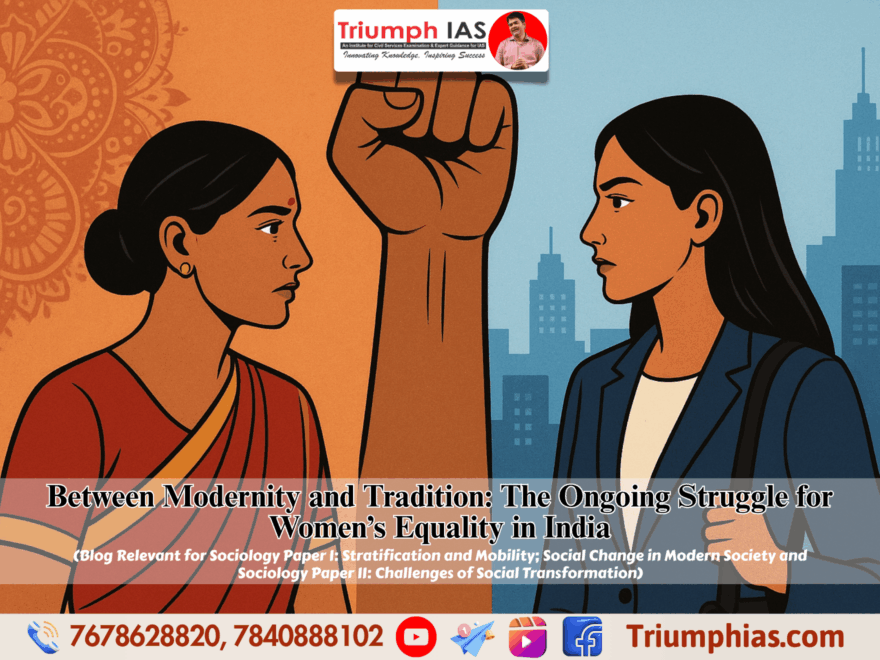
Between Modernity and Tradition: The Ongoing Struggle for Women’s Equality in India
Between Modernity and Tradition: The Ongoing Struggle for Women’s Equality in India
(Relevant for Sociology Paper I: Stratification and Mobility; Social Change in Modern Society and Sociology Paper II: Challenges of Social Transformation)
The tension between modernity and tradition is one of the most persistent features of social change in India. For women, this tension is particularly intense because gender roles are deeply embedded in patriarchal traditions, while modernization promises freedom, equality, and opportunities. The “battle” between these two forces creates a conflicted social space, making the path towards empowerment both promising and challenging.
Modernity and Tradition:
Modernity: Refers to societal transformation driven by industrialization, rationalization, globalization, education, and technology, emphasizing individual rights and gender equality.
Tradition: Refers to the set of cultural practices, values, and social norms passed down through generations, often rooted in religion, family structure, and patriarchy.
The battle arises because modernity often challenges traditional gender norms, while tradition resists changes that threaten established hierarchies.
Why Women Are at the Center of This Battle
Women become the site of this struggle because their roles are symbolically linked to cultural identity. In patriarchal societies:
Tradition assigns women roles as caregivers, bearers of honor, and custodians of culture.
Modernity demands women’s participation in public life, education, workforce, and politics.
The result is role conflict—women are expected to be both modern and traditional at the same time, creating psychological and social pressures.
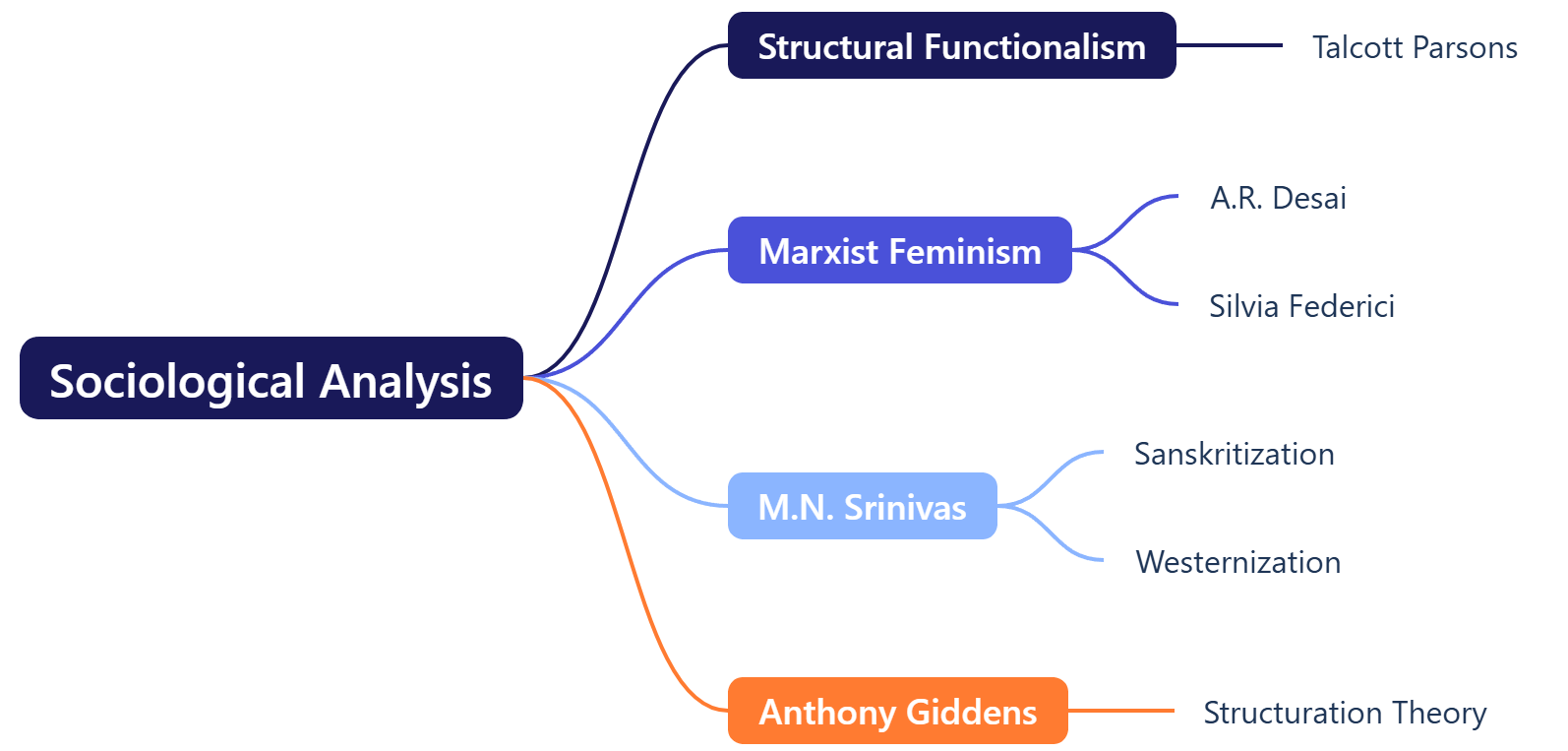
Sociological Analysis
Structural Functionalism (Talcott Parsons) Parsons viewed traditional gender roles as functional for maintaining social stability. In this view, men are typically assigned instrumental roles (breadwinning) and women expressive roles (caregiving). Modernity disrupts this balance, forcing institutions like the family and workplace to adjust, leading to transitional stress for women.
Marxist Feminism (A.R. Desai, Silvia Federici) Marxist feminists argue that capitalism uses modernity to integrate women into the labour market but often in exploitative forms. While women gain paid work, they also continue unpaid domestic labour, creating a “double burden” that keeps them subordinate both in traditional households and modern workplaces.
M.N. Srinivas – Sanskritization and Westernization Srinivas showed that Sanskritization can reinforce traditional gender norms by imitating upper-caste patriarchal practices. In contrast, Westernization promotes education, legal rights, and freedom for women. However, these two processes often coexist, creating contradictions in women’s lives.
Anthony Giddens – Structuration Theory Giddens explained that women act within structural constraints while exercising personal agency. Modernity offers choices such as education and career, but traditional norms about marriage, family honour, and modesty still limit how far women can act on those choices.
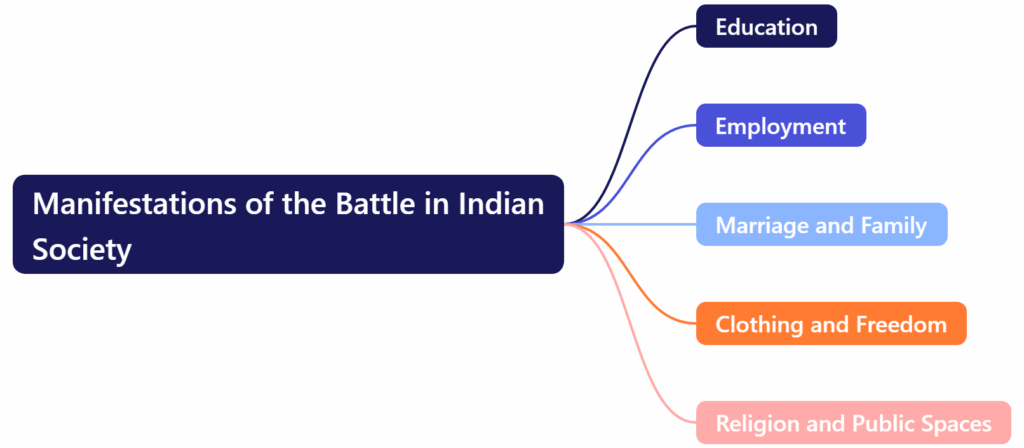
Manifestations of the Battle in Indian Society
Education Modernity has improved female literacy rates and encouraged professional education. However, tradition still dictates subject choices, discourages higher education after marriage, and imposes restrictions on girls’ mobility.
Employment Urbanization and globalization have opened job opportunities for women in IT, finance, and administration. Yet, the gender pay gap, workplace harassment, and cultural expectations of prioritizing family over career remain significant hurdles.
Marriage and Family While modernity has popularized love marriages and inter-caste unions, tradition continues to enforce arranged marriages and, in extreme cases, punish defiance through honour killings or community sanctions.
Clothing and Freedom Modern influences encourage diverse dress choices, but traditional norms still police women’s clothing, associating modesty with morality and holding women responsible for maintaining family honour.
Religion and Public Spaces Women increasingly demand equal rights to enter religious places and lead rituals. However, traditional customs often restrict their access, citing notions of purity and religious codes.
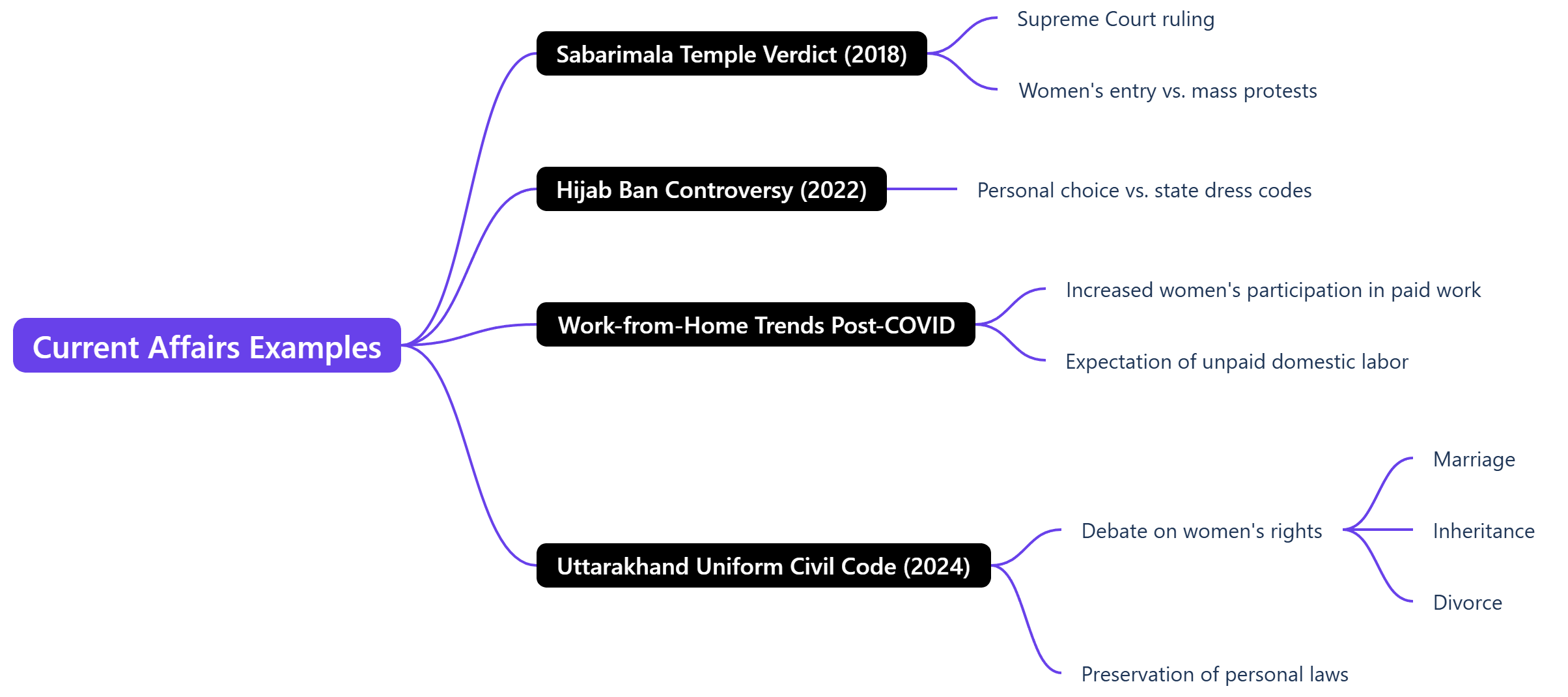
Current Affairs Examples
Sabarimala Temple Verdict (2018) – Supreme Court ruling in favour of women’s entry vs. mass traditional protests.
Hijab Ban Controversy (2022) – Clash between personal choice and state-imposed dress codes.
Work-from-Home Trends Post-COVID – More women participating in paid work but still expected to handle unpaid domestic labor.
Uttarakhand Uniform Civil Code (2024) – Debate over women’s rights in marriage, inheritance, and divorce vs. preservation of personal laws.
Impact of Globalization
Globalization accelerates exposure to modern values such as gender equality, legal rights, and workplace inclusion. However, it also triggers cultural backlash where traditionalists see modernity as a threat to identity.
Positive: Economic independence, political representation, global sisterhood movements.
Negative: Cultural alienation, double burden of work and home.
Policy Measures and the Way Forward
Legal Reforms: Strengthen implementation of laws like POSH Act, Domestic Violence Act, Equal Remuneration Act.
Education: Gender-sensitive curriculum to challenge stereotypes.
Workplace Inclusion: Policies for maternity benefits, flexible work hours, and equal pay.
Cultural Change: Encourage community dialogues to reconcile modern rights with cultural sensitivities.
Media Representation: Promote balanced portrayal of women beyond stereotypes.
Conclusion
The battle between modernity and tradition is not a simple choice for women—it is a constant negotiation. While modernity opens doors to freedom, education, and economic independence, tradition continues to impose restrictions in the name of culture and morality. The goal should not be to discard tradition entirely but to reinterpret it in ways that respect women’s autonomy and dignity.
PYQs
Paper 1
Explain how social change and tradition interact to produce gender inequalities in Indian society. (2015)
How do role conflict and status conflict emerge for women in transitional societies? (2016)
Examine how modernization affects the institution of family and the status of women. (2017)
Discuss the concept of cultural lag and its impact on gender relations in contemporary Indian society. (2018)
Analyse the relationship between Westernization and Sanskritization in shaping women’s roles. (2019)
Evaluate the feminist critique of modernization theory with reference to women in developing countries. (2020)
Critically analyse the role of patriarchy in shaping women’s life chances in modern society. (2022)
Discuss Anthony Giddens’ view on agency and structure with examples from women’s struggles in India. (2023)
Examine the impact of globalization on women’s identity and family life in India. (2021)
How does intersectionality help in understanding women’s experiences of modernity and tradition? (2023)
Paper 2
Discuss the impact of Westernization on the status of women in India. (2015)
Evaluate the role of women’s movements in challenging traditional gender norms in India. (2016)
Analyse the changing nature of marriage and family in India under the influence of modernization. (2017)
Critically examine the role of Sanskritization in reinforcing patriarchal norms in Indian society. (2018)
Analyse how education has acted as both a liberating and restrictive force for women in India. (2018)
How has globalization affected women’s participation in the workforce and their social position in India? (2019)
Examine the conflicting demands of tradition and modernity in the lives of Indian women with suitable examples. (2020)
Discuss the challenges faced by working women in reconciling work and family roles in urban India. (2021)
Examine how religious traditions influence women’s rights in contemporary India with reference to recent court verdicts. (2022)
Explain the persistence of honour-based violence in the context of inter-caste and inter-religious marriages. (2023)