


The Urban Paradox: India’s Cities, Power, and the Crisis of Local Governance
(Relevant for Sociology paper 2: Industrialization and Urbanisation in India)
Introduction: The Urban ParadoxIndia’s cities are simultaneously symbols of progress and sites of deep dysfunction. They produce nearly 70% of India’s GDP and house over 30% of the population, yet they are riddled with uncollected garbage, failing infrastructure, and recurring floods. Beneath these physical symptoms lies a sociological crisis — a crisis of governance, participation, and power. Despite the promise of decentralization under the 74th Constitutional Amendment Act (1992), Indian cities remain governed not by their residents but by distant state bureaucracies. This disjunction between urban growth and political empowerment has created what sociologist Henri Lefebvre once called “the right to the city” denied — where the people who inhabit urban spaces have the least say in shaping them. This blog explores India’s urban crisis not merely as an administrative failure but as a sociological problem: the alienation of citizens from urban power structures, the reproduction of inequality through governance mechanisms, and the struggle for democratic participation in everyday city life. The Structural Roots of India Urban Malaise
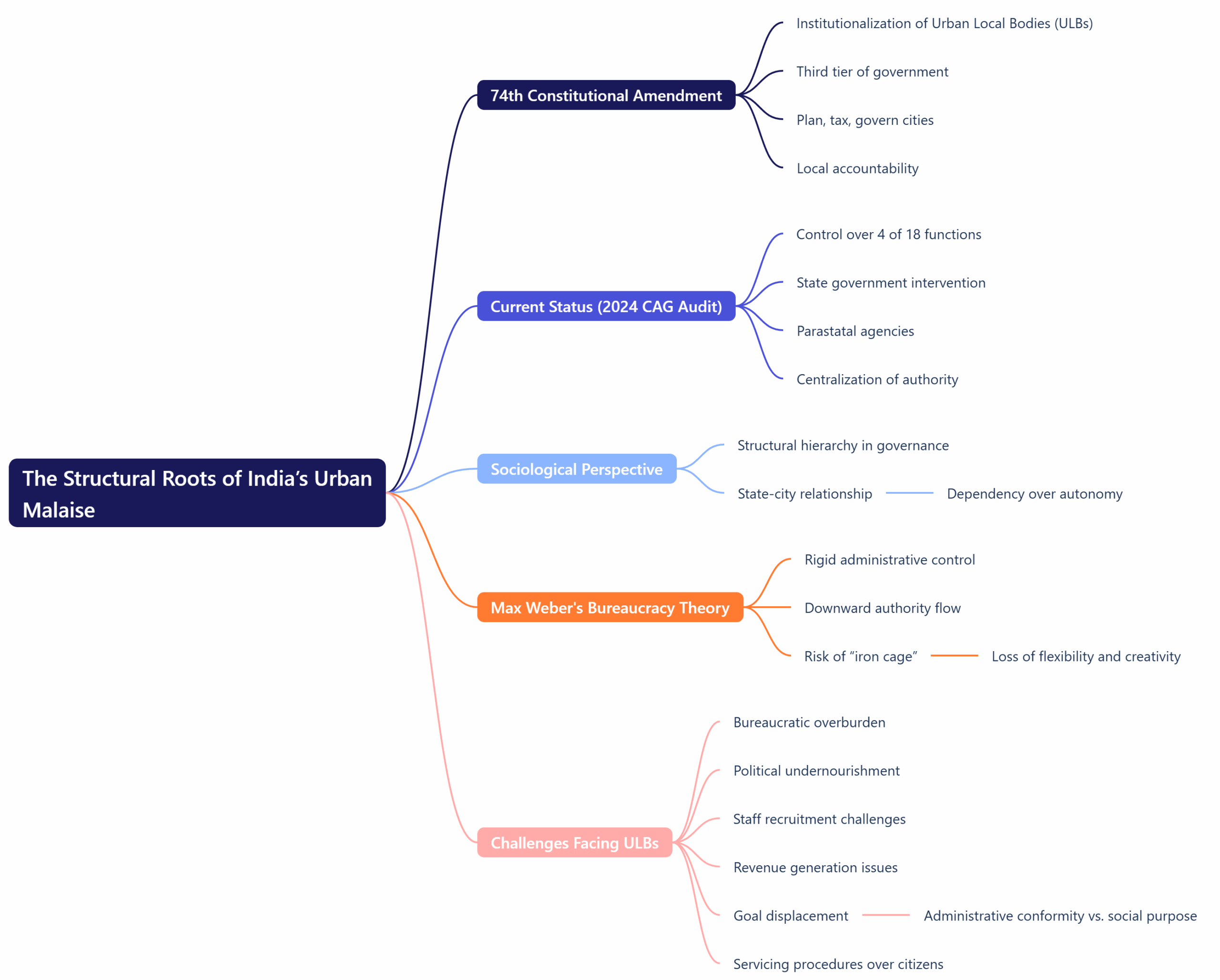
The 74th Constitutional Amendment sought to institutionalize urban local bodies (ULBs) as the third tier of government. These institutions were to plan, tax, and govern cities with local accountability. Yet, over 30 years later, this promise remains unfulfilled. A CAG audit in 2024 reveals that ULBs in most states have control over only 4 of the 18 functions assigned to them by the Constitution. State governments routinely intervene in urban affairs through parastatal agencies, delaying funds and centralizing authority. From a sociological lens, this reflects a structural hierarchy of power in Indian governance. The relationship between the state and the city is marked by dependency rather than autonomy. Max Weber’s theory of bureaucracy helps explain this: Indian urban governance operates through rigid administrative control, where authority flows downward through legal–rational systems. But this very rationalization, as Weber warned, can turn into an “iron cage” — trapping institutions in procedures, robbing them of flexibility and creativity. ULBs are bureaucratically overburdened but politically undernourished. Their inability to recruit staff or generate revenue illustrates what sociologist Robert Merton termed “goal displacement” — where administrative conformity replaces social purpose. Cities, instead of serving citizens, serve procedures. Democratic Deficit: The Alienation of Urban CitizenshipThe sociological significance of India’s urban crisis extends beyond administration. It touches the very concept of urban citizenship — who gets to participate, decide, and benefit from city life. The democratic deficit in urban governance is staggering: 61% of ULBs across 17 states lack elected councils, and only five states have directly elected mayors. Many District and Metropolitan Planning Committees exist only on paper. This absence of democratic participation fosters citizen alienation — the sense that urban residents are merely subjects of governance rather than its authors. From the standpoint of Emile Durkheim, this represents a form of anomie — a breakdown of normative and moral frameworks that bind individuals to collective life. In cities that should embody solidarity and civic engagement, people experience disconnection and distrust. When citizens cannot influence decisions about water supply, housing, or transport — the very elements that shape daily existence — the city ceases to be a space of belonging. It becomes, as sociologist Manuel Castells observed, a “space of flows” — governed by technocrats, data systems, and distant administrators rather than by lived communities. Fiscal Dependence and Urban InequalityFiscal weakness is not merely a budgetary concern — it is a sociological marker of inequality. Across 15 states, ULBs faced an average funding shortfall of ₹1,606 crore due to delayed or partial fund transfers. Despite having the power to levy property taxes, most ULBs cannot revise rates independently. The result: a 42% expenditure–revenue gap and declining investment in public services. This financial dependency reinforces what Pierre Bourdieu would call symbolic domination — where powerlessness is reproduced through economic and institutional structures. Wealthier cities attract capital and visibility through programs like the Smart Cities Mission, while smaller municipalities languish in neglect. Fiscal centralization thus translates into spatial inequality: smart enclaves of digital governance coexist with marginalized neighborhoods lacking sanitation or housing. In sociological terms, India’s cities embody dual urbanism — spaces of affluence and exclusion existing side by side, governed by unequal access to institutional resources. Urban Reforms: Technology Without TransformationOver the past decade, India has launched multiple initiatives — AMRUT, Smart Cities Mission, Swachh Bharat Mission (Urban), and the National Urban Digital Mission — aimed at improving urban infrastructure and service delivery. These programs emphasize efficiency, data, and technological innovation. However, from a sociological perspective, technology-driven governance risks deepening what Jürgen Habermas called the “colonization of the lifeworld” — where bureaucratic and technological rationalities overshadow communicative, democratic processes. Smart governance may optimize traffic lights and waste collection, but it often bypasses local deliberation and citizen participation. In many cities, “smart” has become synonymous with surveillance and privatization, not empowerment. The digital city, sociologically speaking, may be intelligent but not inclusive. Sociological Viewpoint: Theorizing the Indian Urban Condition
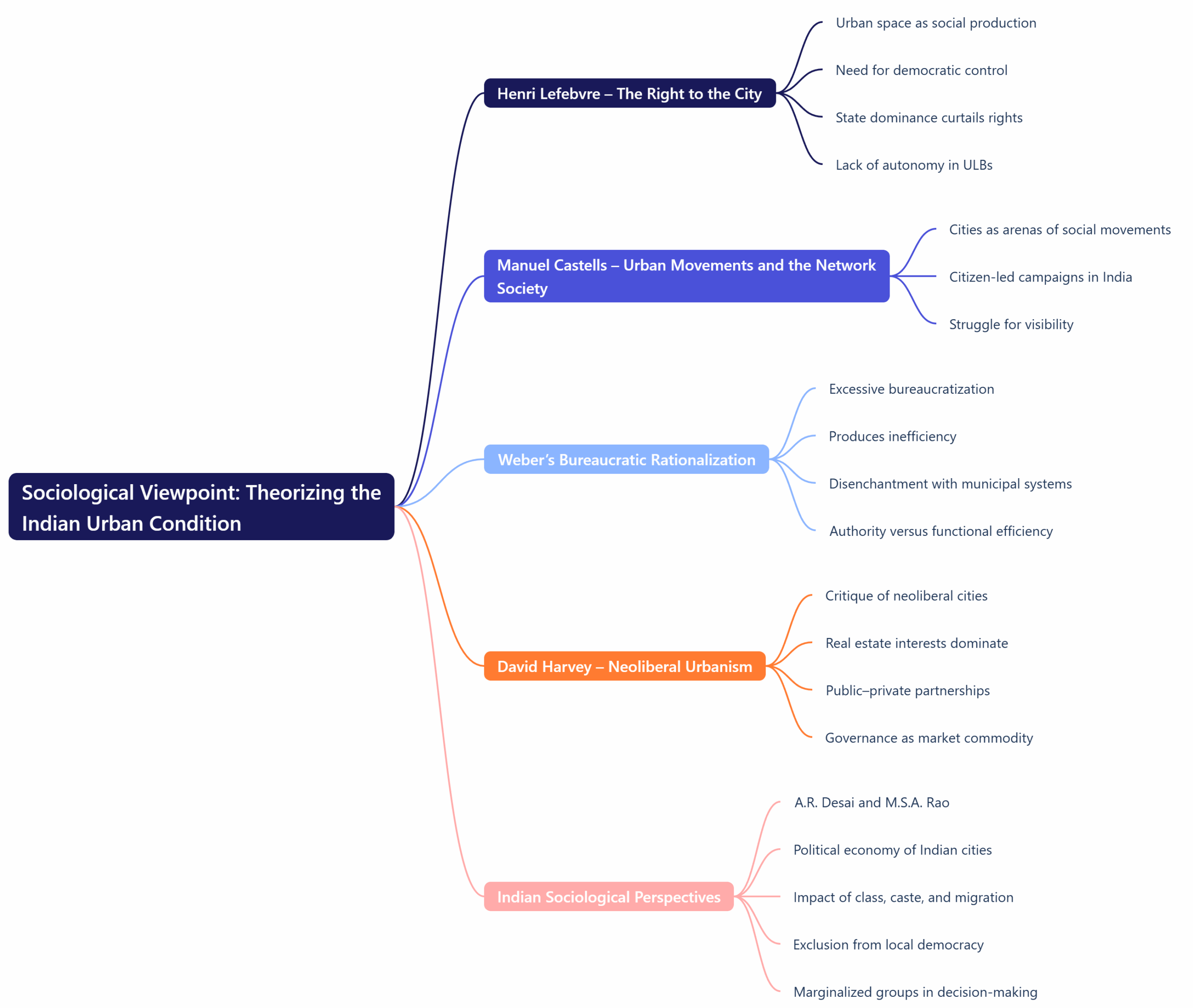
Sociologists have long examined cities as sites of power, conflict, and identity formation. India’s urban crisis can be interpreted through several classical and contemporary perspectives:
Through these lenses, India’s urban governance crisis is not merely a technical problem but a social struggle for power, participation, and justice. Toward a Democratic Urban FutureTo reclaim the sociological essence of the city — as a space of community and creativity — reforms must go beyond digital dashboards and infrastructure projects. The challenge is to rebuild urban citizenship through empowered local governance:
Sociologically, this is about restoring the social contract of the city — where residents are not governed objects but active participants in shaping urban life. Conclusion: Cities as Mirrors of DemocracyIndia’s urban crisis is not just about drainage systems or housing shortages — it is about who governs the city, and for whom. Without genuine decentralization, Indian cities risk becoming spaces of managed chaos rather than democratic possibility. Sociologist Robert Park once wrote that “the city is man’s most consistent and successful attempt to remake the world he lives in after his heart’s desire.” If that is true, then India’s cities today reflect not desire but disempowerment. To rebuild them is to reimagine democracy itself — from the ground up, from the neighborhood outward, where urban life becomes a shared project of citizenship, equity, and belonging. |


To Read more topics, visit: www.triumphias.com/blogs
Read more Blogs:
Bringing India Northeast into the Sociological Mainstream: A Civilizational Imperative
Reimagining Equality: The Sociology of Reservation beyond the 50% Cap
10 comments