India’s agrarian society is again witnessing a wave of farmers protest, reviving memories of the historic 2020–2021 agitation. The 2024–2025 farmers protest, widely known as “Delhi Chalo 2.0”, saw thousands of farmers marching toward the capital, demanding legal guarantees for Minimum Support Price (MSP), debt relief, and the implementation of the Swaminathan Commission’s recommendations.
This agitation, like its predecessor, is not merely a call for better agricultural prices, but a reflection of the deep structural inequalities in India’s rural society. The protest brings into focus issues like agrarian distress, caste-class dynamics, rural marginalization, and the state’s role in regulating agriculture.
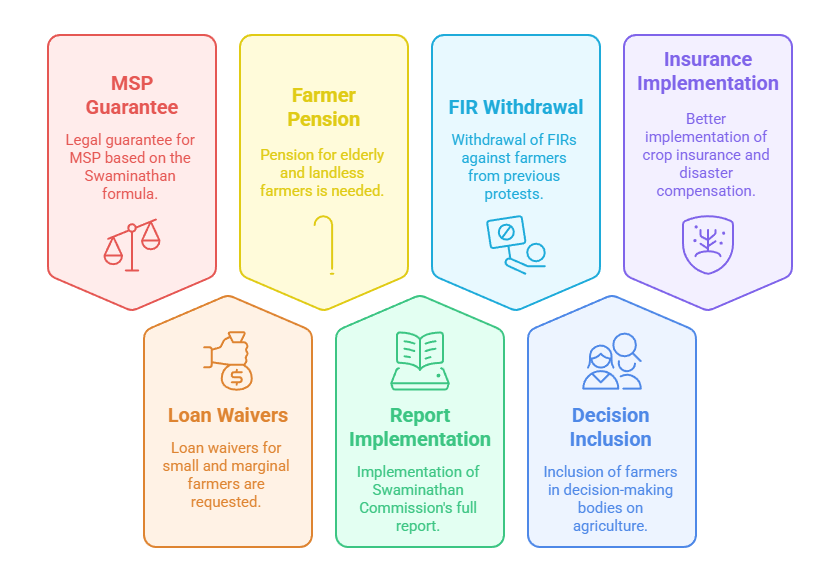
Core Demands of the Farmers Protest
Legal guarantee for MSP based on the Swaminathan formula (C2+50%).
Loan waivers for small and marginal farmers.
Pension for elderly and landless farmers.
Implementation of Swaminathan Commission’s full report.
Withdrawal of FIRs against farmers from the previous protests.
Inclusion of farmers in decision-making bodies on agriculture.
Better implementation of crop insurance and disaster compensation.
Sociological Analysis
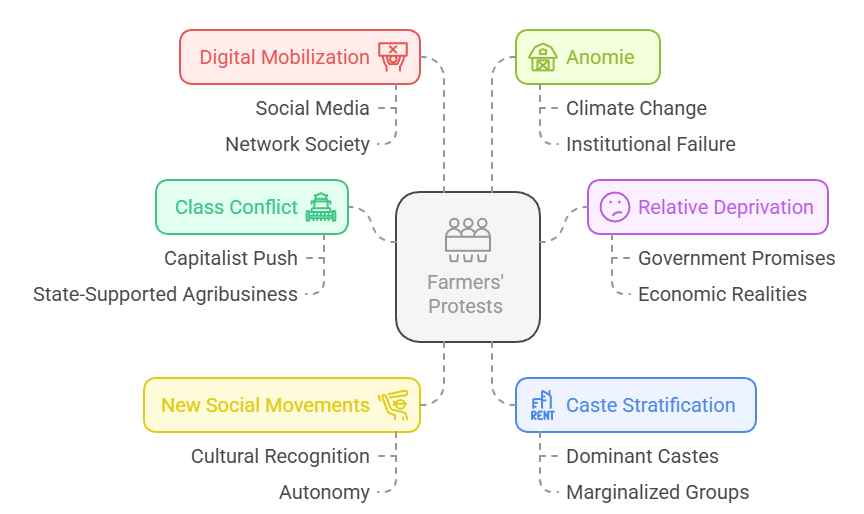
Class Conflict in Agrarian Structure: The farmers’ protest is a textbook example of agrarian class conflict, aligning with Karl Marx’s theory of class struggle. The capitalist push in Indian agriculture — evident in corporatization, contract farming, and reduction in subsidies — pits landowning peasantry and laborers against state-supported agribusiness lobbies.Indian sociologist A.R. Desai viewed peasant movements as revolts against capitalist exploitation in rural society, and the current protest mirrors this in the post-liberalization context.
Relative Deprivation Theory – Farmers experience relative deprivation — a gap between expectations (due to government promises like MSP, subsidies, Swaminathan reforms) and reality (increasing debts, low prices, and input costs). This emotional discontent mobilizes masses for collective action, as seen in the strong emotional undertones in farmer speeches and slogans.
New Social Movements (NSMs) – The protest is not just a reaction to economic injustice, but a movement about identity, dignity, and democratic participation. It resonates with Touraine’s theory of New Social Movements, where movements are not limited to material demands but seek cultural recognition and assert autonomy over decisions affecting their livelihoods.For instance, the slogans during protests — “Annadata ka apmaan nahi sahenge” (We won’t tolerate disrespect to food-providers) — reflect an appeal to moral and symbolic recognition.
Caste and Agrarian Stratification: Land ownership in rural India is deeply linked with caste hierarchy. The farmers’ protests predominantly represent dominant agrarian castes such as Jats, Marathas, and Patidars, who are economically vulnerable due to falling prices but socially assertive due to their numerical strength and historical landholding.However, Dalit and landless laborers, despite being critical to rural agriculture, are often marginalized in leadership roles in such agitations. This brings attention to internal stratification within peasant movements, something sociologist Gail Omvedt explored extensively.
Digital Mobilization – Unlike earlier agrarian uprisings, these protests heavily rely on social media — Twitter, Facebook, YouTube — to mobilize, document abuse, and gain support. This reflects Castells’ theory of the network society, where digital communication shapes resistance and redefines power structures in civil movements.
Anomie in Rural India: Émile Durkheim’s concept of anomie — a state of normlessness — is evident in rural India. With climate change, economic liberalization, and declining institutional trust, rural communities experience social disintegration, leading to mass frustration and protests. The failure of local institutions like panchayats and cooperatives to protect farmers deepens this sense of disorientation.
Case Studies and Real-Life Examples
Buxar Kisan Sabha (June 21–22, 2025) led by Rakesh Tikait, confronting state’s acquisition intentions.
Bharti Kisan Union (BKU) and its leadership in mobilizing farmers.
Punjab farmers’ use of tractors and trolleys as protest sites (symbolizing autonomy).
Role of women farmers in organizing langars and leading marches — breaking gendered stereotypes in peasant resistance.
Use of crowdfunding and international advocacy (e.g., diaspora support in UK, Canada) to sustain the movement.
Youth and students joining the movement — expanding the base beyond traditional farmer households.
Historical trajectory starting from Champaran to modern-day land fights grounds the movement’s legacy.
Government Response and Policy Implications
The government’s response included:
Dialogue and negotiation offers.
Assurances on MSP legislation (yet to be formalized).
Crackdowns via barricades, FIRs, and internet blackouts.
Temporary financial compensation schemes like PM-KISAN though deemed insufficient.
Policy analysts argue that piecemeal approaches won’t address the structural crisis of agrarian overpopulation, inadequate irrigation, and market fluctuations. The agitation calls for a comprehensive rural development vision.
Conclusion
The 2024–25 farmers’ protest is a landmark moment in India’s agrarian history, not just because of its scale but due to its multi-dimensional character — economic, political, cultural, and digital. It offers critical sociological insights into how agrarian distress, structural inequality, and policy disconnect can lead to organized resistance.
For UPSC Sociology students, this movement is a live case study on rural India’s changing social dynamics, proving that agriculture is not just a livelihood but a site of identity, power, and collective assertion.
PYQs
Paper I:
Discuss the role of ideology in the origin and development of social movements. (2021)
Explain how agrarian relations can lead to peasant movements. (2020)
Explain the role of relative deprivation in social movements with examples. (2019)
Distinguish between peasants and farmers. (2016)
Protest movements are indicators of healthy democracy. Discuss. (2015)
Paper II:
Discuss the nature of recent farmers’ movements in India. Are they class-based or identity-based? (2021)
Analyze the impact of globalization on rural agrarian structure in India. (2019)
Agrarian unrest and farmers’ suicides are a result of structural contradictions. Elaborate. (2018)









One comment