Hierarchy has always been a defining feature of human societies. Whether through caste, class, gender, race, or ethnicity, structured inequality creates predictable patterns of privilege and disadvantage. Yet, in the twenty-first century, hierarchies are no longer fixed in the way they once were. Globalization, technological change, social movements, and shifting cultural values have blurred old boundaries, producing what sociologists describe as muddled hierarchies.
The concept of muddled hierarchies connects directly with themes like stratification and mobility, caste and class, gender and work, social change, globalization, and Indian society.
What Are Muddled Hierarchies?
The term “muddled hierarchies” captures the blurring, overlapping, and often contradictory patterns of stratification in modern society. Traditional hierarchies were rigid: caste in India, feudal estates in Europe, racial segregation in the United States. Today, these structures still exist, but they intersect with new forms of inequality and new opportunities, making boundaries less clear.
For instance:
A Dalit entrepreneur in urban India may achieve financial success yet still face caste prejudice.
A highly educated woman may enter elite professions but struggle against glass ceilings.
A gig worker may belong to a middle caste but still experience downward mobility due to unstable income.
These complexities make it difficult to neatly map people’s status. This is what sociologists call muddled hierarchies.
Classical Hierarchies vs. Muddled Hierarchies
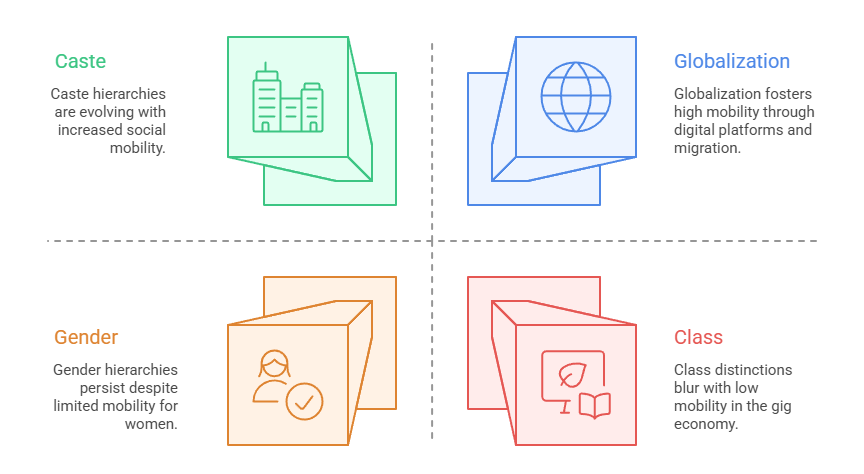
Caste: Traditional Indian society was based on rigid caste hierarchies. Today, while caste still influences marriage, politics, and social networks, economic liberalization and urbanization have opened pathways for mobility. This creates muddled hierarchies where a person’s caste status does not always align with their class position.
Class: Marx visualized society as divided into bourgeoisie and proletariat. Weber introduced multiple layers (status, power, prestige). In today’s service-based gig economy, these distinctions blur further. An Uber driver in Delhi may earn more than a schoolteacher in rural Bihar but hold less prestige.
Gender: Patriarchy remains strong, yet women’s entry into education, politics, and workforce has reshaped gender hierarchies. At the same time, new challenges like unpaid care burden, sexual harassment at work, and glass ceilings create contradictions.
Globalization: Zygmunt Bauman’sliquid modernity explains the fluidity of status in globalized societies. Migration, digital platforms, and transnational work create winners and losers across traditional boundaries, generating new muddled hierarchies.
Sociological Analysis
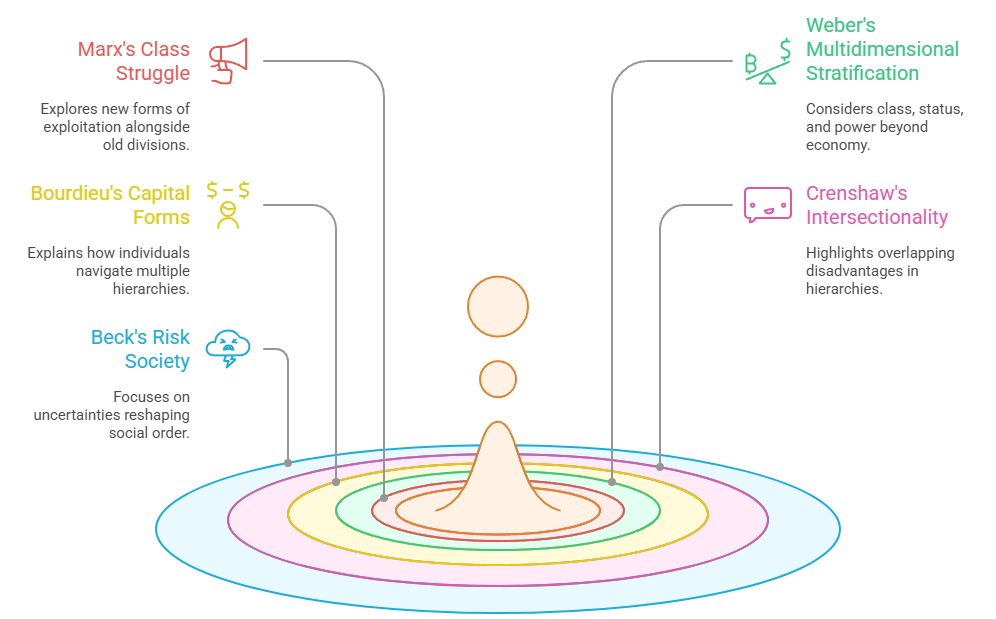
Karl Marx – His theory of class struggle helps us see how new forms of exploitation (e.g., gig work, contract labour) exist alongside old caste-based divisions.
Max Weber – His multidimensional view of stratification (class, status, power) is particularly relevant, since muddled hierarchies cannot be explained by economy alone.
Pierre Bourdieu – His concepts of economic, social, cultural, and symbolic capital explain how individuals navigate multiple hierarchies. For example, an English-educated Dalit student may possess high cultural capital, but face symbolic violence in elite institutions.
Intersectionality (Kimberlé Crenshaw) – Overlapping disadvantages of caste, class, and gender often produce muddled hierarchies. A Dalit woman in rural India may face triple discrimination despite affirmative action.
Ulrich Beck’s Risk Society – He highlights new uncertainties like job insecurity, environmental risks, and technological disruptions that reorder hierarchies unpredictably.
Muddled Hierarchies in the Indian Context
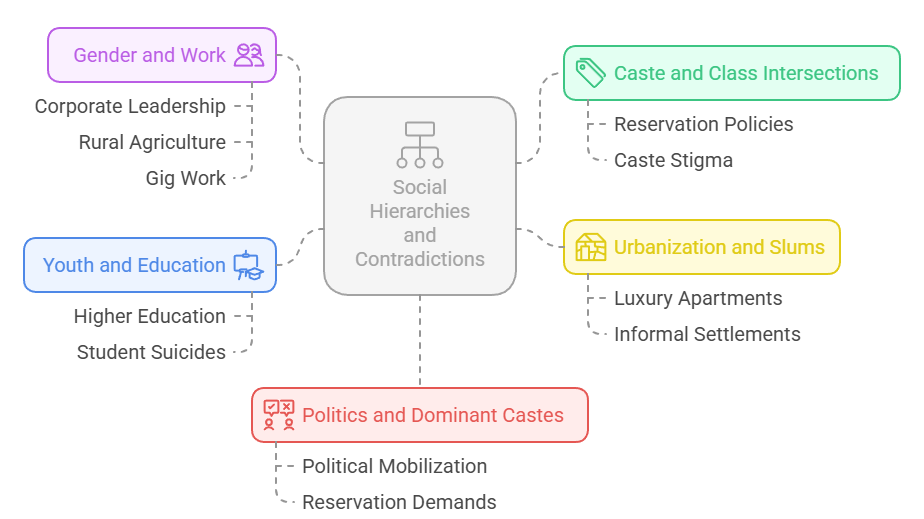
Caste and Class Intersections
Reservation policies have allowed upward mobility for Scheduled Castes and OBCs, yet caste stigma persists.
Urban middle classes now include Dalits, OBCs, and minorities, but social acceptance is partial.
The 2023 caste census debate in Bihar highlighted how economic class and caste identity are no longer perfectly aligned.
Gender and Work
Women in corporate spaces often occupy high-class positions but remain underrepresented in leadership.
In rural India, women work extensively in agriculture but are often categorized as “helpers,” reflecting muddled recognition of their labour.
Rising cases of women in gig work (e.g., food delivery, beauty services) blur gender hierarchies but also expose them to safety risks.
Urbanization and Slums
City spaces demonstrate stark contradictions: luxury apartments beside informal settlements.
Migrants may experience upward income mobility but live in precarious housing, creating dual and muddled status positions.
Youth and Education
Access to higher education (IITs, IIMs, central universities) has diversified student populations.
Yet suicides among Dalit and Adivasi students reveal how hierarchies persist despite meritocracy.
Politics and Dominant Castes
Political mobilization by intermediate castes (e.g., Yadavs, Marathas, Jats) shows shifting power relations.
These groups may be economically strong but still demand reservations, reflecting contradictions in hierarchy.
Global Dimensions
Global supply chains have created transnational hierarchies: workers in Bangladesh or India stitch clothes for Western brands but earn a fraction of global profits.
Migrant labourers from South Asia in the Gulf earn higher incomes but live in restrictive conditions.
The digital divide creates a new hierarchy: access to internet and digital skills determines opportunities more than traditional markers.
Way Forward
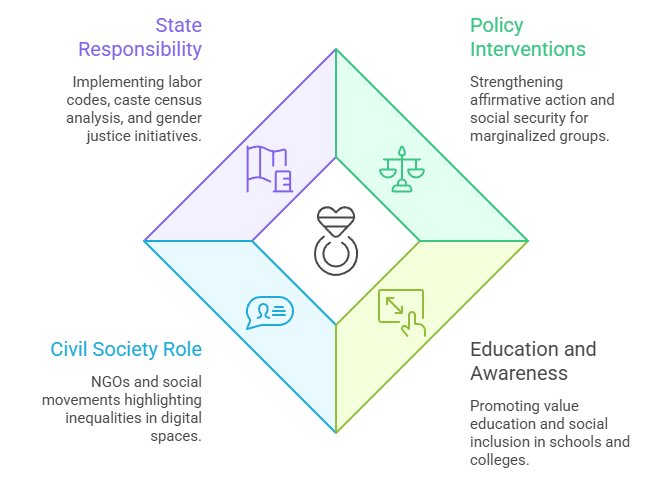
Policy Interventions
Strengthen affirmative action with attention to intersectionality.
Extend social security to gig and informal workers.
Gender-sensitive labour policies.
Education and Awareness
Focus on value education and social inclusion in schools and colleges.
Encourage inter-caste and inter-religious interactions.
Civil Society Role
NGOs and social movements can highlight inequalities in new spaces like digital platforms.
State Responsibility
Implementation of labour codes, caste census analysis, and gender justice initiatives.
Conclusion
Muddled hierarchies show us that inequality is not disappearing, but transforming. Old structures of caste, class, and gender still exist, but they are overlaid with new divisions created by globalization, digital capitalism, and identity politics. This is a challenge and an opportunity—to go beyond rigid models and understand the complex, fluid, and often contradictory nature of social stratification today.
The idea of muddled hierarchies helps answer questions on social change, stratification, gender, caste, work, and globalization with a nuanced lens. It reminds us that progress is rarely linear and that social reality is often layered with contradictions.
PYQs
Paper II –
What do you understand by discrete castes and muddled hierarchies? Substantiate your answer with suitable illustrations. (2018)







One comment