India healthcare system has made commendable progress in recent decades, but challenges such as accessibility, affordability, infrastructure gaps, and disease burden persist. With a population exceeding 1.4 billion, transforming healthcare into a robust, inclusive, and efficient system is not just a public welfare imperative—it is a strategic necessity for national development.
As the country navigates the post-pandemic landscape, the focus has shifted towards creating a resilient, technology-driven, and equitable healthcare system that serves both urban elites and rural poor alike.
Current Status of India Healthcare System
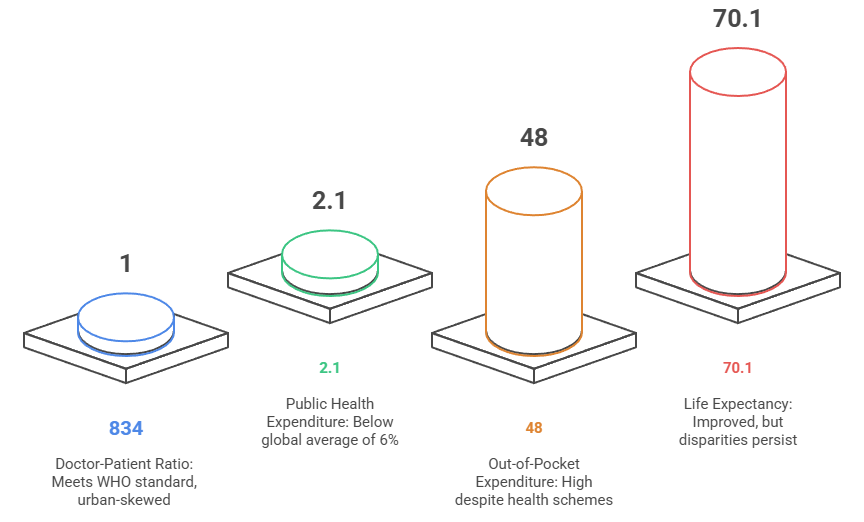
Doctor-Patient Ratio: India has 1 doctor for every 834 people (as per the National Health Profile 2023), which meets the WHO standard of 1:1000, but the distribution remains skewed towards urban areas.
Public Health Expenditure: Government spending on health is around 2.1% of GDP (2023–24), still below the global average of 6%.
Out-of-Pocket Expenditure (OOPE): Despite schemes like Ayushman Bharat, over 48% of total health spending in India is still borne out-of-pocket by households.
Life Expectancy: Improved to 70.1 years (World Bank, 2023), but disparities remain across states and social groups.
Major Challenges in India Healthcare Landscape
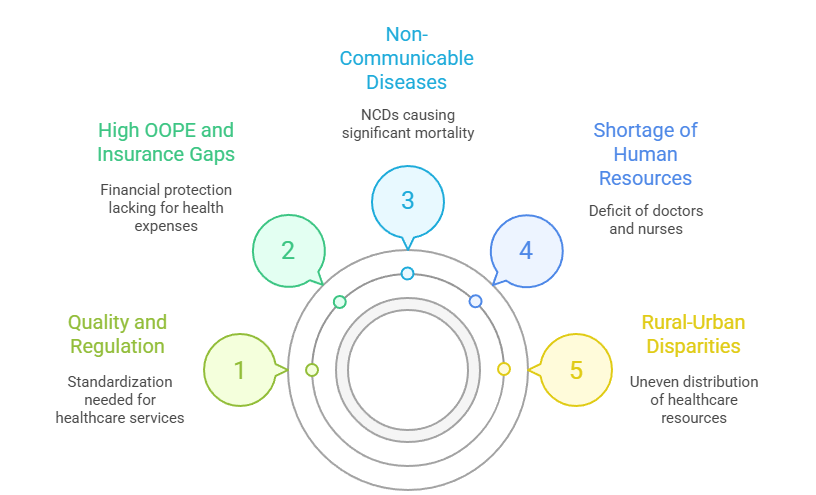
Rural-Urban Disparities
Over 65% of India population lives in rural areas, but most doctors, specialists, and hospitals are concentrated in cities.
Primary Health Centres (PHCs) and Community Health Centres (CHCs) often face a shortage of staff, medicines, and equipment.
Shortage of Human Resources
India faces a deficit of over 6 lakh doctors and 2 million nurses (as per NITI Aayog estimates).
The doctor-to-patient and nurse-to-patient ratios are worse in tribal and backward regions.
Non-Communicable Diseases (NCDs)
NCDs like diabetes, hypertension, and cancer account for over 65% of all deaths in India.
Lack of regular screening and poor awareness leads to late-stage diagnosis, increasing treatment costs.
High OOPE and Insurance Gaps
A significant percentage of the population lacks financial protection, making catastrophic health expenses a common cause of poverty.
Only about 37% of Indians have any form of health insurance.
Quality and Regulation
The unregulated private sector caters to over 70% of outpatient care and nearly 60% of hospital care, but often lacks standardization in pricing and quality.
Government Initiatives Transforming Healthcare
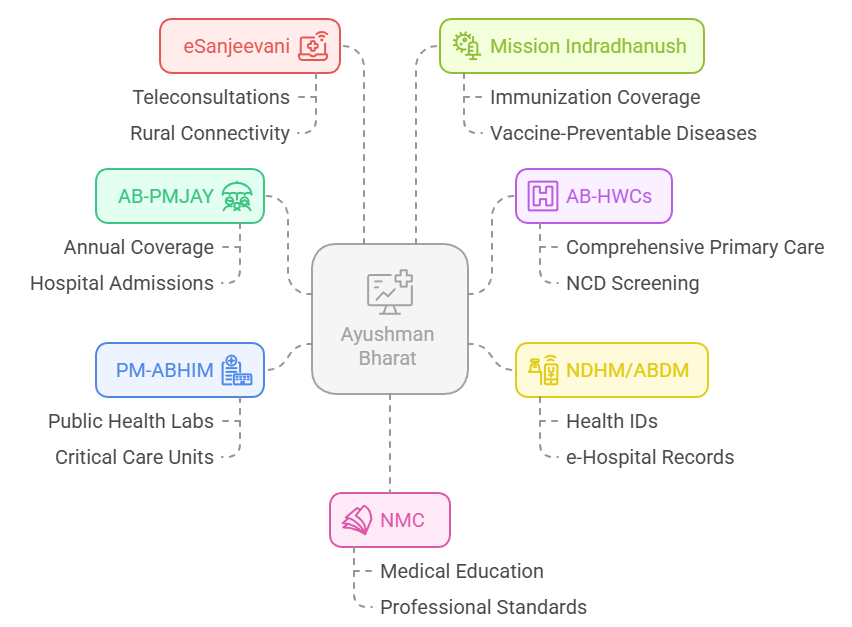
Ayushman Bharat – Pradhan Mantri Jan Arogya Yojana (AB-PMJAY)
Launched in 2018, it is the world’s largest health insurance scheme, offering Rs. 5 lakh annual coverage per family to over 12 crore poor and vulnerable families.
As of 2024, over 6 crore hospital admissions have been facilitated under the scheme.
Ayushman Bharat – Health and Wellness Centres (AB-HWCs)
Over 1.7 lakh HWCs have been operationalized as of mid-2024, offering comprehensive primary care, including NCD screening, maternal and child health, and mental healthcare.
National Digital Health Mission (NDHM) / Ayushman Bharat Digital Mission (ABDM)
Aims to create a digital health ecosystem with components like Health IDs, e-Hospital records, e-Pharmacy, and teleconsultation.
Over 50 crore Health IDs have already been issued.
PM Ayushman Bharat Health Infrastructure Mission (PM-ABHIM)
Announced in 2021 with an outlay of Rs. 64,180 crore, it seeks to strengthen public health labs, critical care units, and emergency response systems across the country.
eSanjeevani Telemedicine Platform
India’s flagship teleconsultation platform, with over 16 crore consultations completed by 2024.
Especially effective in connecting rural populations with urban specialists.
Mission Indradhanush & Intensified MI
Immunisation drive targeting children and pregnant women; coverage has crossed 90% in many districts, significantly reducing vaccine-preventable diseases.
National Medical Commission (NMC)
Replaces the MCI to ensure transparency in medical education and professional standards, encouraging expansion of medical colleges and quality training.
Emerging Trends and Innovations
Public-Private Partnerships (PPPs)
Several state governments (like Gujarat, Rajasthan, and Andhra Pradesh) are leveraging PPPs to improve access and quality of care, especially for diagnostics and dialysis.
Telemedicine and AI Integration
AI-based diagnostic tools and remote health monitoring are being piloted in many government programs to enhance early detection and resource optimization.
Promotion of AYUSH Systems
India is promoting traditional systems of medicine—Ayurveda, Yoga, Unani, Siddha, and Homeopathy—with the creation of AYUSH health centres and research institutes under the Ministry of AYUSH.
Case Study: Mohalla Clinics and Delhi Model
The Mohalla Clinics in Delhi serve as an example of accessible, low-cost, primary healthcare delivery at the community level. These clinics offer free consultations, medicines, and diagnostics, and have been replicated in other states like Telangana and Punjab.
Recommendations for a Future-Ready Healthcare System
Increase Public Health Spending
Raise expenditure to at least 2.5% of GDP by 2025 (as per National Health Policy 2017 target).
Expand Insurance Coverage
Integrate informal workers and middle-class families under universal health coverage.
Strengthen Primary Healthcare
Invest in human resources, supply chains, and digital infrastructure at the grassroots level.
Regulate and Standardize the Private Sector
Implement pricing caps, quality audits, and grievance redressal systems for private hospitals and labs.
Focus on Preventive and Mental Healthcare
Promote lifestyle changes, awareness campaigns, and destigmatize mental health services.
Bridge the Rural-Urban Divide
Incentivize medical professionals to work in rural and remote areas, and improve infrastructure and connectivity.
Conclusion
India’s healthcare transformation is at a critical juncture. While visionary schemes like Ayushman Bharat, digital health missions, and infrastructure investments have laid a strong foundation, sustained efforts are essential to ensure healthcare for all—not just in policy, but in practice.
A holistic, inclusive, and technology-enabled approach can turn India’s healthcare system into a model of resilience and equity, capable of not only treating disease but also fostering well-being, productivity, and social justice across the nation.









One comment