


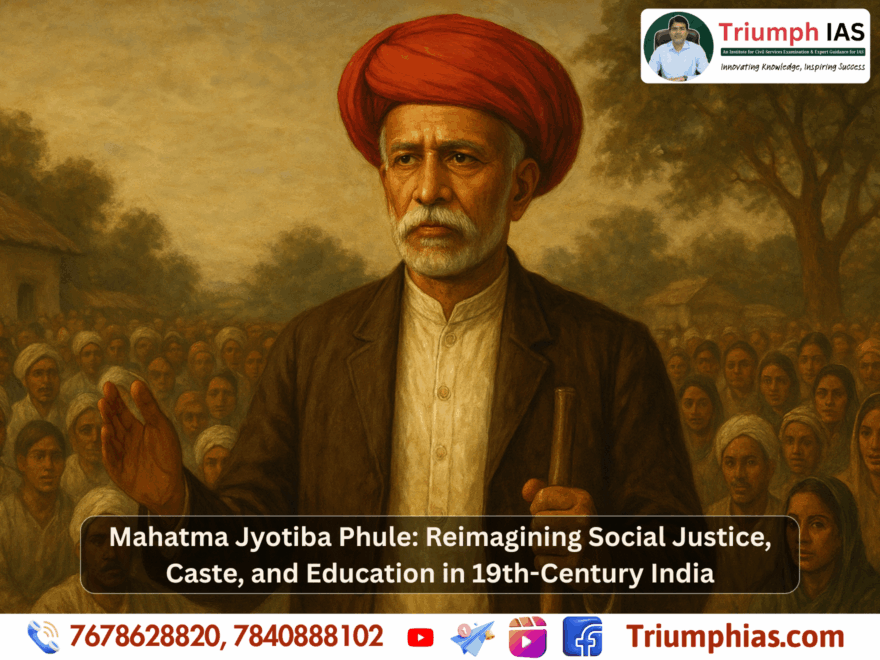
Mahatma Jyotiba Phule: Reimagining Social Justice, Caste, and Education in 19th-Century India
(Relevant for Sociology Paper 1: Stratification and Mobility and Social Change in Modern Society and Sociology Paper 2: Caste System and Vision of Social Changes in India)
|
Mahatma Jyotiba Phule, one of the most revolutionary voices against caste, patriarchy, and social inequality whose legacy is more than a list of reforms—it represents an intellectual and moral rebellion that changed the foundations of Indian society. His life’s work marks a fundamental shift in how we understand caste oppression, women’s emancipation, peasant exploitation, and the transformative power of education. Jyotiba Phule: A Sociological Mind Ahead of His TimeBorn in 1827 in Pune, Phule was a thinker shaped as much by lived oppression as by Enlightenment ideals. Thomas Paine’s Rights of Man played a pivotal role in shaping his philosophy, helping him see inequality not as fate but as a violation of human rights. Phule intuitively applied what Karl Marx, Louis Dumont, Max Weber, and Emile Durkheim would later theorize in different contexts: that social hierarchies are human-made, maintained by ideology, and embedded in institutions.
This fusion made Phule not just a reformer—but a pioneering sociological thinker. The Anti-Caste Crusader: Dismantling Brahminical PowerPhule’s founding of the Satyashodhak Samaj in 1873 marks a historic moment in the anti-caste struggle. Unlike earlier reform movements—often led by upper-caste elites—Phule’s movement emerged from the oppressed themselves, aiming to dismantle Brahminical orthodoxy. The use of folk dramas, public lectures, and the newspaper Deenbandhu democratized knowledge, allowing marginalized communities to access ideas otherwise monopolized by elites. In sociological terms, Phule was challenging what Pierre Bourdieu calls “cultural capital” by creating alternative spaces for learning and protest. His movement sought not mere reform but a counter-hegemonic narrative, one that portrayed caste not as divinely ordained but as socially constructed oppression. The Educational Revolution: A Radical Break with TraditionPhule and Savitribai Phule’s contribution to education is perhaps their most transformative achievement. In 1848, they founded India’s first school for girls—an act revolutionary enough to provoke hostility, stone-throwing, and social boycott. Yet they persisted, establishing more schools, including night schools for farmers, labourers, and women. This was not just schooling—it was a social revolution. Savitribai becoming India’s first female teacher symbolized a rupture in patriarchal structures, challenging what feminists like Gerda Lerner would later describe as the historical construction of male dominance. Literary Interventions: Writing as ResistancePhule’s writings served as intellectual weapons against caste and inequality. His major works reflect a deep sociological imagination:
In each work, Phule challenged the ideological foundations of caste, showing how religious texts and customs were used as tools of domination. His reinterpretation of Shivaji as a non-Brahmin icon disrupted historical narratives, an early example of what contemporary sociologists call “subaltern historiography.” Gender Justice: A Radical Feminist Before the Word ExistedPhule’s feminism was far ahead of his time. He:
He saw women, Shudras, and Dalits as “the downtrodden trinity” crushed under Brahminical patriarchy. His work anticipated modern intersectional feminism, which scholars like Kimberlé Crenshaw describe as the overlapping oppression of caste, gender, and class. Phule’s Progressive Politics: Beyond Religion and NationalismPhule did not romanticize tradition. He openly critiqued the 1857 Revolt, calling it largely an upper-caste struggle to regain lost privileges. He supported certain aspects of British rule because he believed it could help dismantle oppressive native hierarchies—an unpopular but deeply sociological position. He also embraced religious pluralism, even supporting Pandita Ramabai’s conversion, recognizing that escape from caste sometimes required exiting Brahminical religious frameworks. This makes Phule’s worldview closer to Ambedkar’s rational humanism than to conservative reformers like Dayanand Saraswati or Bal Gangadhar Tilak. Legacy: Phule’s Long Shadow Over Modern IndiaPhule influenced a lineage of anti-caste thinkers, most notably Dr. B.R. Ambedkar, who considered him one of the greatest liberators in Indian history. Ambedkar’s emphasis on education, annihilation of caste, and women’s empowerment reflects Phule’s foundational ideas. Phule’s legacy continues to shape sociopolitical movements today—from Dalit uprisings and OBC mobilization to feminist struggles for dignity. His insistence that social reform must precede political freedom remains one of the most radical messages of the 19th century. ConclusionMahatma Jyotiba Phule remains one of India’s most transformative social thinkers, not only for challenging caste and patriarchy but for redefining the moral purpose of education, questioning hegemonic religious practices, and empowering the most oppressed sections of society through institutions, literature, and collective mobilization. His work represents a profound interrogation of inequality and a reconstruction of society on principles of justice, rationality, and human dignity. As India continues to grapple with caste discrimination and gender inequality, Phule’s vision serves as both a reminder of the unfinished struggle for social emancipation and an enduring blueprint for a more egalitarian future. |
To Read more topics, visit: www.triumphias.com/blogs
Read more Blogs:
Assam’s Anti-Polygamy Bill, 2025: Gender Justice, Personal Laws, and the Sociology of Reform
2 comments