(Relevant for Sociology Paper I: Work and Economic Life; Social Mobility and Stratification and Sociology Paper II: Industrialization and Urbanization in India)
In a landmark shift, the Ministry of Statistics & Programme Implementation (MoSPI) released India’s first-ever monthly employment statistics. The unemployment rate stood at 5.1% in April 2025, with a slightly higher joblessness among men (5.2%) than women (5%).The Labour Force Participation Rate (LFPR) was 55.6%, while the Worker Population Ratio (WPR) was 52.8%.
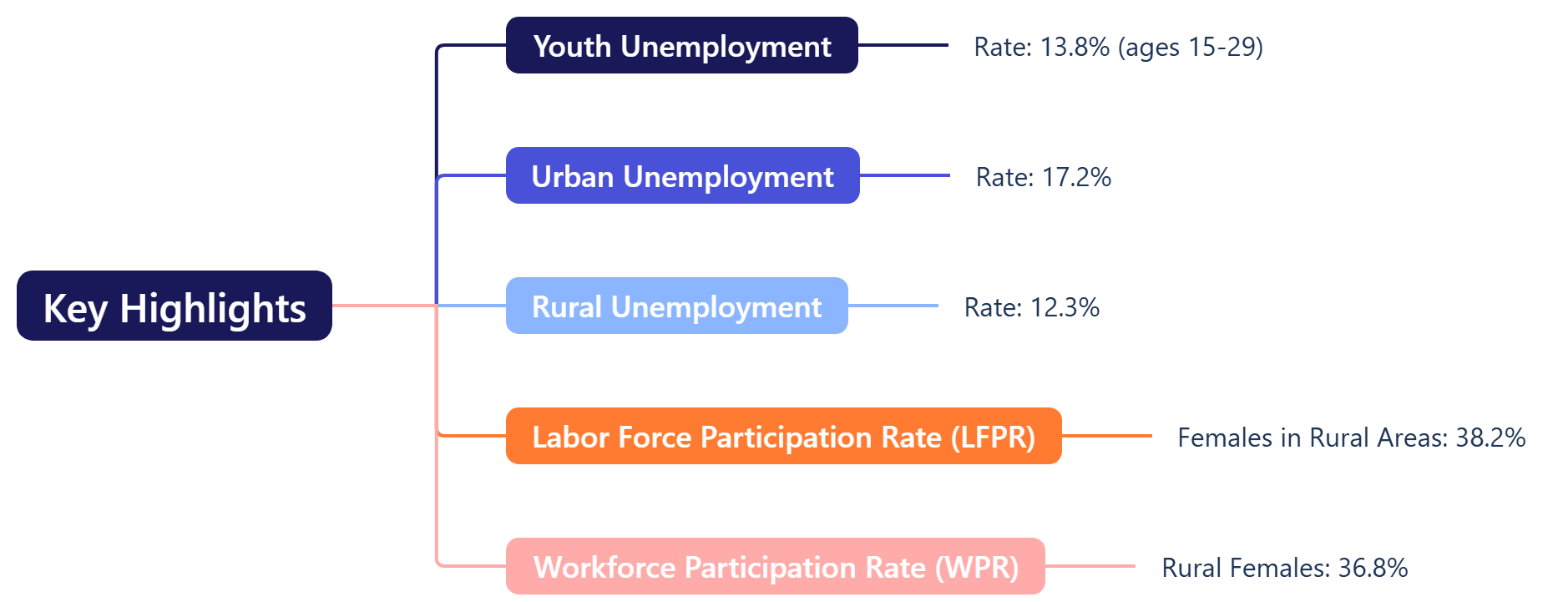
Key Highlights: India Unemployment Rate
Youth Unemployment (15-29 years): 13.8%
Urban Unemployment Rate: 17.2%
Rural Unemployment Rate: 12.3%
LFPR for females in rural areas: 38.2%
WPR among rural females: 36.8%
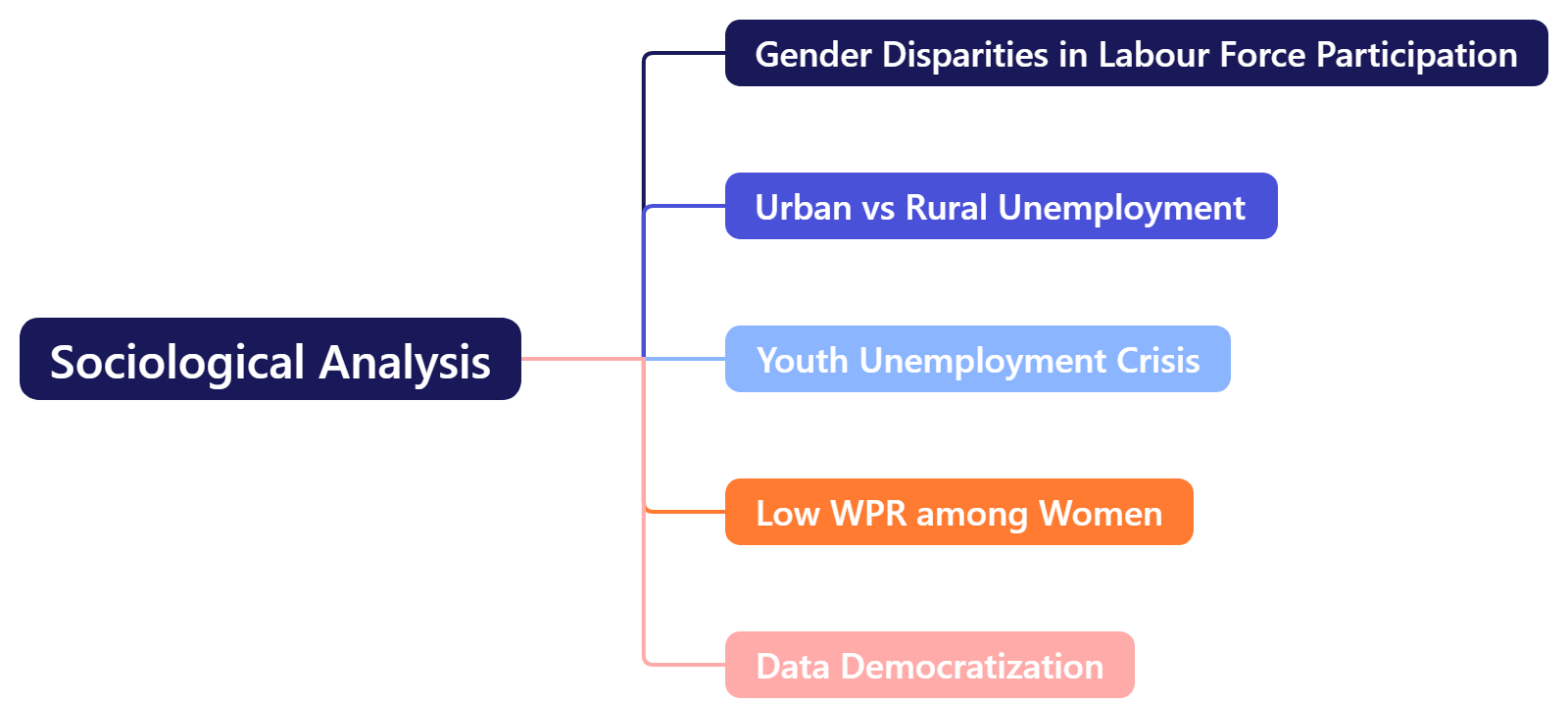
Sociological Analysis
Gender Disparities in Labour Force Participation: Though women’s unemployment rate is marginally lower than men’s, this is largely due to low female LFPR (38.2% rural, 23.5% urban). This aligns with Sylvia Walby’s theory of patriarchal structures, where social reproduction responsibilities and safety concerns limit women’s public participation.
Urban vs Rural Unemployment: The stark difference between urban (17.2%) and rural (12.3%) unemployment highlights dualism in labour market structures. Urban areas have high structural unemployment due to technology-led displacement and mismatch in skills — a feature of Daniel Bell’s Post-Industrial Society.
Youth Unemployment Crisis: Youth (15–29 years) unemployment at 13.8% reflectsblocked mobility and status frustration, as theorized by Robert Merton. This group faces credential inflation — educational qualifications no longer guarantee employment, resulting in strain and deviance.
Low WPR among Women: Despite economic need, women’s WPR remains low at 32.5% nationally, pointing to the undervaluation of unpaid domestic labour, a concept emphasized by Nancy Fraser and Feminist Political Economy.
Data Democratization: The shift to monthly PLFS allows high-frequency data for real-time social planning. This reflects Anthony Giddens’ concept of reflexive modernity, where policies are restructured continuously based on data feedback loops.
Conclusion:
The April 2025 PLFS offers crucial insights into India’s employment challenges, especially youth distress, gender gaps, and urban joblessness. For effective policy design, sociological analysis must complement economic data to ensure that structural inequalities in labour markets are addressed through holistic and inclusive reforms.
PYQs
Paper 1:
Discuss the sociological significance of the informal sector in the globalised Indian economy. (2023)
Examine how caste and class affect the economic organisation of Indian villages. (2021)
What are the sociological implications of feminization of labour in contemporary times? (2020)
How does Emile Durkheim’s concept of division of labour explain increasing specialisation in modern economies? (2019)
Discuss the impact of neoliberal policies on the nature of labour and employment in India. (2018)
Distinguish between work and labour. Explain how changes in production systems impact labour relations. (2017)
Explain the role of labour in the process of social change in industrial societies. (2016)
What is the significance of work in the life of individuals and society? Illustrate with sociological perspectives. (2015)
Analyse the impact of post-industrial economy on labour and employment. (2014)
Paper 2:
Discuss the causes and consequences of youth unemployment in contemporary India. (2019)
Explain the changing nature of labour in rural India in the context of development and displacement. (2023)
Critically examine the implementation and impact of MGNREGA on rural employment and social justice. (2022)
Comment on the regional disparities in labour force participation in India. (2021)
Discuss the challenges of jobless growth in India with reference to recent data on employment. (2020)
Examine the feminization of labour in India under globalization. (2020)
Analyse the impact of new economic policy on the working class structure in India. (2018)
Discuss the problems faced by migrant labourers in Indian cities. (2017)
What are the major causes of low female labour force participation in India? Suggest sociological solutions. (2016)
Evaluate the role of labour movements in shaping industrial relations in India. (2015)








One comment