



India Global Power Aspirations Constraints and Capacities
(Relevant for Sociology Paper 1: Politics and Society)
Introduction: India global powerIndia’s rising economic trajectory, its demographic heft, and its expanding international footprint have revived debates about its status as an emerging global power. Despite being the world’s fastest-growing major economy, India’s quest for great power status is often tempered by developmental contradictions, strategic ambiguity, and institutional fragility. The Sociology of Power and Nation-State IdentityIndia’s aspiration to be a global power is not simply a geopolitical issue but reflects Max Weber’s notion of legitimate power—the ability of a state to exercise influence not merely through coercion or economic dominance, but through legitimacy in the eyes of both its citizens and global peers. India’s foreign policy retains its strategic autonomy—avoiding firm alignment with any one bloc. This is consistent with its civilisational identity and legacy of non-alignment, but it creates ambiguity in terms of how India is perceived globally. Constructivist IR theories suggest that state power is also based on norms, identity, and ideas—India’s emphasis on being a “civilisational state” needs to be backed by consistent messaging and institutional performance to be persuasive globally. Economic Power vs Structural Inequalities
India is now the 4th largest economy globally, yet ranks 144th in per capita GDP (market exchange rates, 2024). This dichotomy reflects dualism in development, a concept long discussed in sociology and development theory.
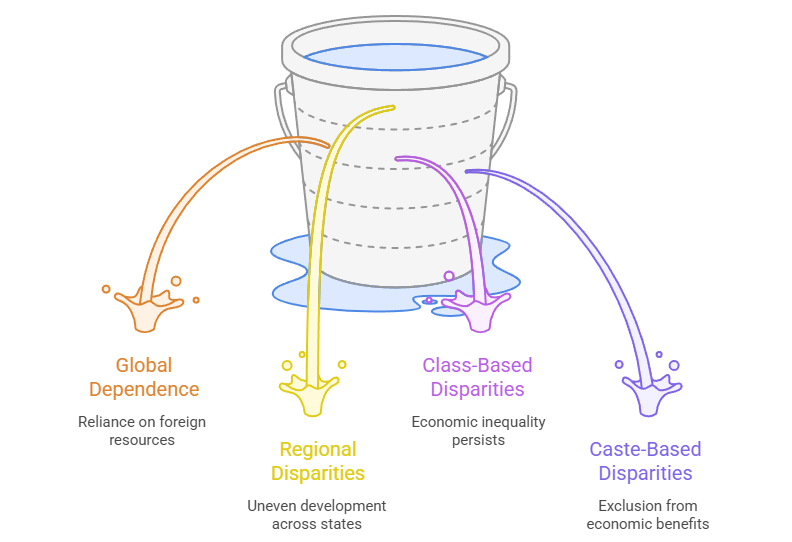
According to dependency theorists like Andre Gunder Frank, countries like India continue to be structurally dependent on the Global North for capital, technology, and markets. Despite economic growth, India’s dependence on arms imports (9.5% of global imports) and foreign electronics/energy echoes this structural subordination.
The Inequality-Adjusted HDI (IHDI) score of 0.475 reflects sharp regional, class, and caste-based disparities. States like Goa (HDI ~0.75) coexist with states like Uttar Pradesh (~0.60), showing uneven development. Modernization theory, which assumes that economic growth will eventually “trickle down,” is challenged by India’s reality. Functionalist perspectives, too, find it difficult to explain persistent exclusion of large populations from the benefits of growth. Human Capital and Demographic Dividend: A Structural Functionalist View
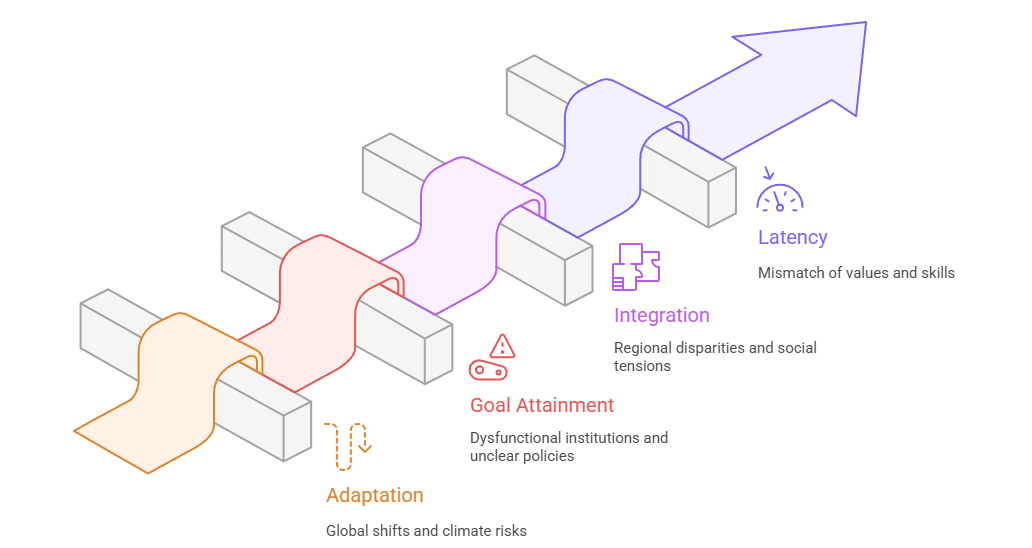
India’s young median age (28.2 years) and vast labor pool could provide a massive economic advantage. Yet, to reap this dividend, education, healthcare, and skilling systems must function effectively. Talcott Parsons’ AGIL framework (Adaptation, Goal Attainment, Integration, Latency) offers a way to understand systemic dysfunction:
Without investment in these subsystems, the demographic advantage may morph into a demographic burden, increasing unemployment and social unrest. Institutional Capacity and Bureaucratic RationalityIndia’s global aspirations depend heavily on institutional capacity—in governance, regulation, law enforcement, and strategic planning. While India’s space missions (Chandrayaan, Mangalyaan) and digital innovations (UPI, Aadhaar) suggest strong state capacity in certain sectors, the lack of indigenous defense capabilities and continued reliance on arms imports point to institutional limitations. From a Weberian perspective, India’s bureaucracy must be rational, rule-bound, and efficient. However, political interference, procedural delays, and weak implementation in sectors like education, health, and judiciary weaken institutional legitimacy and effectiveness. Globalization, Technology, and the Sociology of KnowledgeIndia ranks 39th on the Global Innovation Index, trailing China (11th) and the US (3rd). While digital public infrastructure has been a global success (e.g., UPI), India lags in cutting-edge domains like quantum computing and biotechnology. Globalization Theories According to Manuel Castells, nations in the information age must build “networks of power” rooted in knowledge and innovation. India’s comparative lag in tech innovation limits its influence in shaping global norms around AI, data governance, and tech regulation. World-systems theory would locate India in the semi-periphery—rising in influence but still dependent on core countries for critical knowledge systems and capital. Strategic Autonomy vs Great Power ExpectationsIndia’s reluctance to align firmly with any bloc (e.g., balancing between Quad and SCO) underscores its emphasis on strategic autonomy. From a sociological standpoint, this reflects an ambivalent identity—a post-colonial nation that seeks influence without succumbing to bloc politics. However, critics argue that non-alignment 2.0 can be seen as strategic ambiguity, potentially undermining trust among global allies. For instance, India’s stance on the Russia-Ukraine conflict—though principled—was interpreted in the West as indecisive. Symbolic interactionist theory reminds us that identity is co-constructed. India’s global role is not only what it claims, but also how others interpret its behavior. Culture, Soft Power, and Civilisational NarrativeIndia wields considerable soft power through its diaspora, Bollywood, yoga, cuisine, and moral leadership in issues like climate change and global health. Cultural Hegemony and Post-colonial TheoryIndia’s civilisational message—of “Vasudhaiva Kutumbakam”—aims to reshape global norms through inclusivity, pluralism, and sustainability. In post-colonial terms, this represents resistance to Western universalism and an attempt to project India’s own epistemology. India’s large and active diaspora (~30 million) also serves as a transnational community, creating informal channels of influence. Through diaspora diplomacy and educational exchange, India is crafting a “soft” transnational state. Press Freedom, Internal Fault Lines, and Global CredibilityIndia’s low rank (159/180) in the World Press Freedom Index raises concerns about democratic backsliding, which weakens its global democratic credibility—especially when juxtaposed against its ambition to shape global governance. Social conflict theory highlights how internal inequalities—whether economic, caste-based, or political—undermine national unity. Uneven development among states, rising majoritarian discourse, and curbs on dissent raise questions about internal cohesion, a prerequisite for projecting power externally. Pathways Forward: A Balanced Sociological Strategy
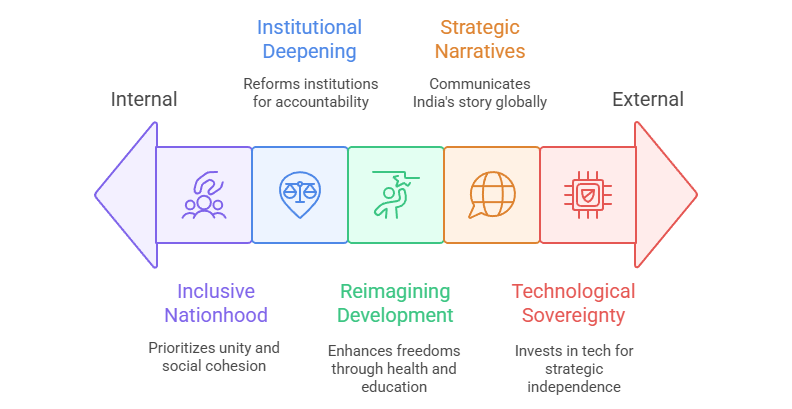
India must not merely grow, but grow equitably and sustainably. Amartya Sen’s capability approach provides a useful lens: development should enhance individual freedoms and agency, not just GDP. Health, education, and social protection must be prioritized.
Reforms in judiciary, policing, civil services, and local governance are needed to enhance state legitimacy and responsiveness. Institutions must align with democratic norms and public accountability.
India must communicate its story as a civilisational state, combining modernity with tradition, growth with equity, and sovereignty with cooperation. Narratives matter in global politics, as constructivist scholars argue.
India should invest in next-gen tech (AI, biotech, semiconductors) not just for economic gain but for strategic independence. This would reduce dependency and enhance global influence.
Social cohesion, respect for diversity, and safeguarding democratic institutions are critical. Only a unified and inclusive India can credibly aspire to global leadership. Conclusion: A Sociological Vision of India’s Global FutureIndia’s global power aspirations must be seen not just through military budgets or GDP rankings but through the sociological lens of internal cohesion, institutional robustness, and developmental equity. The journey from a post-colonial nation to a credible great power is not merely geopolitical—it is socio-political. India’s rise is possible, but it must be anchored in inclusive development, ethical governance, strategic clarity, and a civilisational ethos that speaks not only to its citizens but to the world. Sociology equips us to ask not just how fast India rises, but who rises with it—and what kind of power it ultimately becomes. |



To Read more topics, visit: www.triumphias.com/blogs
Read more Blogs:
Bringing Global Education Home: A Sociological Analysis of Foreign University Campuses in India
Nepal 2025 Gen Z Protests: When Digital Bans Spark a Societal Reckoning
2 comments