


India’s Clean Energy Transition
Balancing Growth and Sustainability
(Relevant to GS Paper-3. Renewable Energy)
India’s shift to clean energy is both an economic necessity and an environmental priority, ensuring widespread electricity access while mitigating climate risks. However, growing global resistance to climate action, coupled with rising costs and insurance challenges, poses hurdles to progress.
As climate impacts become more severe, it is essential to adopt solutions that balance sustainability with livelihood security. The key challenge lies in accelerating the transition while addressing economic vulnerabilities and ensuring equitable growth.
Why India’s Clean Energy Transition is Essential


Energy Security and Reduced Import Dependence
- India relies on imports for 85% of its crude oil and 50% of its natural gas, making it highly vulnerable to global price fluctuations and supply chain disruptions.
- Expanding domestic renewable energy can enhance energy independence and reduce the strain of a high import bill.
- According to the International Energy Agency (IEA), India was the world’s second-largest crude oil net importer in 2023, with the Russia-Ukraine war highlighting the risks of fossil fuel dependency.
- India’s commitment to achieving 500 GW of renewable capacity by 2030 under its COP26 pledge can help mitigate these risks.
Economic Growth and Job Creation
- Transitioning to clean energy can drive industrial growth, technological innovation, and job creation, particularly in solar, wind, and green hydrogen sectors.
- The Council on Energy, Environment, and Water (CEEW) estimates that India’s renewable sector could generate one million jobs by 2030.
- This shift will unlock opportunities in manufacturing and grid infrastructure, helping bridge economic disparities.
Climate Resilience and Pollution Control
- India is among the most climate-vulnerable nations, facing frequent heatwaves, floods, and rising sea levels.
- A transition to clean energy can significantly reduce carbon emissions and combat air pollution, which is responsible for millions of premature deaths annually.
In 2021, air pollution caused 8.1 million deaths worldwide, with China and India accounting for more than half. - For instance, in 2024, Delhi recorded its highest annual PM2.5 levels in three years, underscoring the urgent need for clean energy adoption.
Rural Electrification and Energy Access
- Decentralized renewable solutions like solar and wind can provide reliable power to remote areas, reducing energy poverty and improving education, healthcare, and economic opportunities.
- In 2024, India added 24.5 GW of solar installations, more than twice the capacity of 2023.
Utility-scale solar installations reached 18.5 GW, growing 2.8 times compared to the previous year.
Investment and Global Leadership in Green Energy
- India is emerging as a global leader in renewable energy, attracting foreign investments and strengthening diplomatic ties through clean energy initiatives.
- The sector witnessed a record investment of $14.5 billion in FY 2021-22, with initiatives like the Global Biofuels Alliance (GBA) and the International Solar Alliance (ISA) showcasing India’s role in climate diplomacy.
Green Hydrogen and Industrial Decarbonization
- India’s heavy industries—such as steel and cement—rely heavily on coal-based energy, but green hydrogen offers a sustainable alternative.
- Scaling up hydrogen production can position India as a global exporter while reducing industrial emissions.
- The National Green Hydrogen Mission, launched in 2023 with an allocation of ₹19,744 crore, aims to produce 5 MMT of green hydrogen annually by 2030.
Sustainable Urbanization and EV Transition
- India’s rapid urbanization calls for a clean energy-driven transport and infrastructure system.
- Expanding electric vehicle (EV) adoption and smart grids can reduce oil dependency while making cities more sustainable.
- The PM e-Drive Scheme, with an allocation of ₹10,900 crore for 2024-26, is set to boost EV adoption across the country.
International Climate Commitments and Carbon Markets
- India has pledged to achieve net-zero emissions by 2070, necessitating a major clean energy shift.
- Participating in carbon markets and emission reduction programs can provide financial incentives and enhance global credibility.
- The Carbon Credit Trading Scheme (2023)—under the Energy Conservation (Amendment) Act, 2022—enables industries to trade carbon credits, supporting India’s goal of a 45% emissions reduction by 2030 as per its updated Nationally Determined Contributions (NDCs).
Key Challenges Slowing India’s Clean Energy Transition

Weak Grid Infrastructure and Storage Constraints
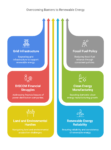
- India’s electricity grid is ill-equipped to manage the intermittency of renewable energy, leading to frequent power curtailments and inefficiencies.
- The absence of large-scale energy storage solutions makes it difficult to integrate solar and wind power, especially during peak demand periods.
- According to the National Electricity Plan-II (Central Electricity Authority – CEA), India will need an investment of over ₹1 lakh crore in transmission infrastructure to meet projected power demand by 2032.
Fossil Fuel Dominance and Policy Inconsistencies
- Coal currently accounts for 70% of India’s power generation, and the coal and oil industries continue to receive substantial subsidies and policy support, slowing the transition to clean energy.
- In FY 2023, subsidies for both renewables and fossil fuels increased by 40%, while the Ministry of Coal set a target to produce 1.3 billion tonnes of domestic coal by FY 2027.
- Millions of workers rely on coal mining and fossil fuel-based industries, and a rapid shift to renewables could lead to job losses and economic instability in these regions.
- A just transition strategy is needed to reskill workers and create alternative employment opportunities.
Financial Struggles of Power Distribution Companies (DISCOMs)
- India’s power distribution companies (DISCOMs) are burdened by massive debt, limiting their ability to invest in clean energy infrastructure.
- Issues such as high transmission losses, poor tariff collection, and subsidized fossil fuel-based power exacerbate financial distress.
- According to the RBI, state DISCOMs had accumulated losses of ₹6.5 lakh crore (2.4% of GDP) by 2022-23, making reforms essential.
Slow Growth of Domestic Clean Energy Manufacturing
- India remains heavily dependent on imported solar panels, wind turbines, and lithium-ion batteries, making its clean energy shift vulnerable to global supply chain disruptions.
- Despite government incentives, domestic production is still at a nascent stage.
- For instance, in 2023-24, India imported $7 billion worth of solar equipment, with China supplying 62.6%.
- The Production-Linked Incentive (PLI) scheme for solar PV manufacturing has a budget of ₹24,000 crore, but scaling up production will take time.
Land Acquisition and Environmental Hurdles
- Large-scale renewable projects require vast land areas, often leading to conflicts with farmers, displacement, and ecological concerns.
- For example, in Rajasthan’s Jaisalmer, villagers from Rewari have been protesting the state’s decision to allocate land to the Adani Group for a 450 MW solar plant.
- Delays in land approvals and concerns over biodiversity impact further hinder project implementation.
- For instance, the Great Indian Bustard conservation case led to Supreme Court restrictions on overhead power lines, though this ban was partially lifted recently.
Intermittency and Reliability of Renewable Energy
- Unlike coal and gas-based power, solar and wind energy are variable and require costly storage solutions for round-the-clock supply.
- This raises grid stability concerns and challenges in meeting peak-hour demand.
- In June 2024, India’s power demand peaked at 243.3 GW, but solar and wind energy contributions fell short, forcing the government to extend coal plant operations despite its clean energy targets.
Slow Adoption of Electric Vehicles (EVs) and Charging Infrastructure
- The EV transition is vital for reducing oil dependence, but limited charging infrastructure, high battery costs, and low consumer adoption remain barriers.
- The charging network outside metro cities is weak, restricting EV expansion.
- As of February 2024, India had only 12,146 public EV charging stations, while the estimated requirement was 3.9 million public and semi-public charging stations, maintaining a ratio of just 1 station per 20 vehicles.
Measures India Can Adopt to Accelerate Its Clean Energy Transition


Enhancing Grid Infrastructure and Energy Storage
- India needs to modernize its power grid to seamlessly integrate renewable energy while investing in large-scale battery storage solutions.
- Developing smart grids, pumped hydro storage, and hybrid renewable power projects can improve grid stability and reliability.
- Decentralized renewable energy solutions, such as rooftop solar and microgrids, should be promoted to minimize transmission losses.
- The Green Energy Corridor, combined with the Revamped Distribution Sector Scheme (RDSS), can ensure efficient power transmission and distribution.
Financial Reforms for DISCOMs and Renewable Investments
- Revitalizing power distribution companies (DISCOMs) by improving revenue collection, reducing losses, and ensuring timely payments to renewable energy producers is crucial.
- Encouraging innovative financing models, such as green bonds, viability gap funding, and concessional loans, can attract private sector investment.
- Expanding risk-sharing mechanisms for renewable energy projects will further boost investor confidence.
Strengthening Domestic Manufacturing and Supply Chain Resilience
- Reducing reliance on imported solar panels, wind turbines, and lithium-ion batteries by expanding domestic production is essential.
- Scaling up the Production-Linked Incentive (PLI) scheme for solar PV and battery storage will support local manufacturing.
- Establishing special renewable energy zones with tax benefits can draw global investors to India’s clean energy sector.
- Investing in research and development (R&D) for alternative battery technologies, such as sodium-ion and solid-state batteries, can enhance energy security and reduce dependence on lithium imports.
Streamlining Land Acquisition and Environmental Approvals
- Fast-tracking land acquisition while ensuring minimal ecological disruption is essential for speeding up renewable energy projects.
- Implementing digitized land records, a single-window clearance system, and community involvement can reduce conflicts and delays.
Renewable energy parks should be developed on degraded land and wastelands to avoid competition with agricultural land. - Accelerating approvals under the Environmental Impact Assessment (EIA) framework will enhance investor confidence and prevent project delays.
India’s transition to clean energy is vital for energy security, economic development, and environmental sustainability. Overcoming challenges such as grid limitations, financial constraints, and policy inconsistencies will accelerate this shift.
A balanced strategy that ensures both sustainability and livelihood security is essential for long-term success.
To Read more topics like Telecom Industry: Accessibility, Advancement, and Governance in India in Public Posts, visit: www.triumphias.com/blogs
Read more Blogs:
Cultural And Ethical Subjectivism | Ethics for UPSC Civil Services Examination | Triumph IAS