


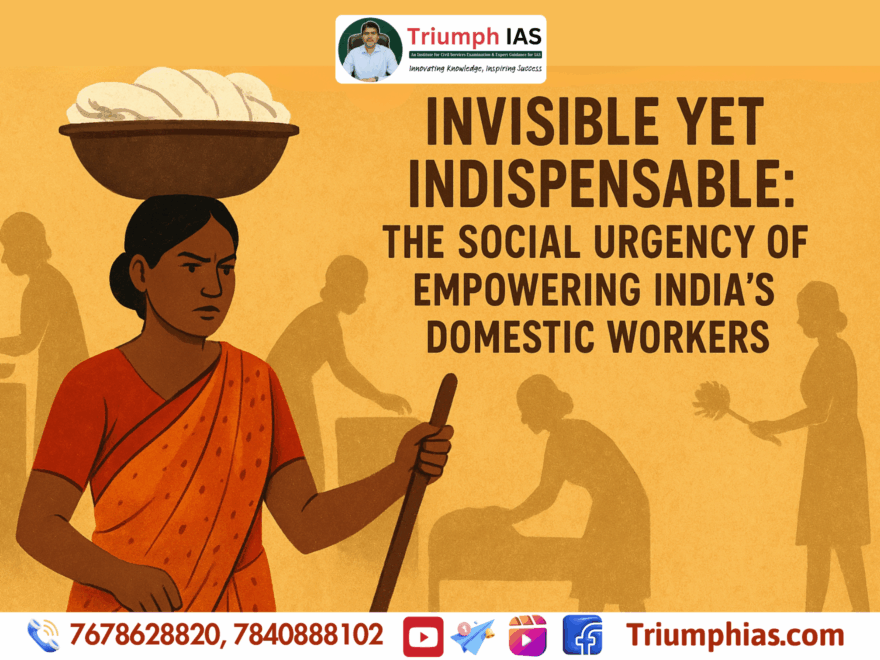
Invisible Yet Indispensable: The Social Urgency of Empowering India’s Domestic Workers
(Relevant for Sociology Paper 1: Stratification and Mobility, and Works and Economic life)
|
Every day, millions of women step quietly into homes that are not their own — cleaning, cooking, caring, and maintaining the rhythms of urban life. They hold up middle-class comfort, yet their labour remains undervalued, invisible, and unprotected. India’s domestic workers embody what sociologist Arlie Hochschild called “the global care chain” — where emotional and physical labour by poor women sustains the lives of others, often at the cost of their own dignity. A “national law to protect domestic workers” has again become the topic of discussion due to the Supreme Court’s appeal in the Ajay Malik (2025) case. The Court recognised domestic work as a crucial yet neglected form of employment, urging the State to fill legal gaps. This moment invites us to look at domestic work not merely as a welfare issue, but as a mirror of social inequality and moral neglect. Domestic Work in India: A Hidden WorkforceDomestic work in India straddles the blurred boundary between home and labour. According to the National Domestic Workers’ Movement (NDWM), estimates of domestic workers range from 4.2 million to 50 million — a massive variation that reveals the informal, invisible nature of this workforce. Over 2.8 crore domestic and household workers have registered on the e-SHRAM portal. Yet most still lack written contracts, regulated wages, or access to healthcare. Women, especially from Dalit, Adivasi, and migrant backgrounds, form the majority of this workforce — their marginalisation multiplied by gender, caste, and class. Sociologist Pierre Bourdieu’s concept of symbolic violence captures this condition well: exploitation is normalised because it hides behind cultural acceptance. In India, domestic work is often seen as “help,” not “employment.” This language itself erases labour and legitimises inequality. The Legal and Constitutional ContextIndia’s Constitution guarantees equality and dignity through Articles 14, 15, and 21, and the Directive Principles urge humane work conditions and living wages. Yet, domestic workers fall through the cracks of labour law. Though four labour codes — including the Code on Wages (2019) and the Social Security Code (2020) — nominally include domestic work, there is no dedicated legislation governing it. Enforcement is nearly non-existent. This legal ambiguity keeps domestic workers on the margins of recognition. As feminist legal scholars note, work done within private homes often escapes regulation because it challenges the public–private divide on which patriarchal society rests. What happens inside the home is deemed “personal,” even when it is commercial. The Sociology of ExploitationKarl Marx described domestic labour as part of the “reproductive economy” — work that sustains the workforce but is excluded from capitalist valuation. In India, this exclusion is sharpened by caste hierarchies. Many domestic workers come from Dalit or tribal communities historically associated with servitude. This continuity of caste-based labour in modern urban homes shows how traditional hierarchies adapt to new economies. Domestic workers may now earn wages, but the underlying social relations — dependence, subordination, and invisibility — often remain unchanged. Low and irregular wages persist because of power asymmetry. Workers rarely have contracts; employers dictate terms. Emerging digital platforms have worsened this imbalance — with gig-style “on-demand” apps paying as low as ₹49 per hour, undercutting even informal local norms. Gender, Stigma, and Emotional LabourDomestic work is gendered not just by who performs it, but by how it is valued. Women’s labour in homes — both their own and others’ — is considered an extension of their “natural” caregiving role. This feminisation of domestic work devalues it economically and symbolically. Arlie Hochschild’s idea of emotional labour — managing feelings as part of one’s job — fits perfectly here. Domestic workers must maintain politeness, patience, and obedience, even when facing abuse or humiliation. Many, like Smitha, a Dalit worker in Delhi who faced verbal and physical abuse, are trapped between economic dependence and social discrimination. Caste and gender intersect to produce what sociologists call triple oppression — exploitation through class (as workers), caste (as “servants”), and gender (as women). The Patchwork of Welfare and the Need for ReformSeveral states — Kerala, Tamil Nadu, Maharashtra, and Delhi among them — have set up Domestic Workers’ Welfare Boards, offering insurance, pension, and educational aid. Yet coverage remains minimal. The Draft National Policy on Domestic Workers, pending for years, promises registration, minimum wages, and social security, but without central legislation, it remains aspirational. Internationally, the ILO Convention No. 189 (2011) sets global standards for domestic work — fair wages, rest days, written contracts, and protection against abuse. India has not yet ratified it. In 2025, Karnataka’s Draft Domestic Workers (Social Security and Welfare) Bill proposed comprehensive protections, including welfare funds and grievance mechanisms. It could be a model for national reform — if backed by political will. Towards a Dignified Future: Measures That Matter
The Ethics of JusticeJohn Rawls’ Theory of Justice offers a moral compass for this issue. He argued that inequalities are only justifiable if they benefit the least advantaged. In India, domestic workers are among the least advantaged, yet the social order depends on their invisible labour. Justice demands not pity but redistribution of dignity and rights. Amartya Sen’s capability approach further deepens this insight: real development expands what people are free to do and be. Protecting domestic workers, therefore, is not charity — it is about expanding freedom, choice, and recognition for millions who sustain our daily lives. Conclusion: Making the Invisible VisibleThe story of India’s domestic workers is the story of its contradictions — rising middle-class affluence coexisting with hidden servitude. To ignore them is to accept a democracy divided by the walls of our own homes. Legal protection, social security, and cultural respect must converge to make domestic work dignified. As Marx would remind us, the true measure of a society lies in how it treats those whose labour is least visible yet most essential. Empowering domestic workers is not just about reforming labour law; it is about reshaping the moral imagination of a nation — one where every worker, in every home, can claim the dignity of being seen, valued, and protected. |
To Read more topics, visit: www.triumphias.com/blogs
Read more Blogs:
Poverty Beyond Numbers: A Sociological Reading of the Updated Rangarajan Poverty Line
The Six-Pocket Syndrome: When Love Turns into Overdose — Raising Generation Alpha in a Liquid World