(Relevant for Sociology Paper I: Politics and Society- Relationship between state and individual rights and Sociology Paper II: Challenges of Social Transformation)
The expansion of digital infrastructure in India has intensified debates on privacy rights, surveillance, and state control. With the Aadhaar biometric system, increasing deployment of CCTV cameras in public spaces, and the integration of Artificial Intelligence (AI) in law enforcement, the citizen-state relationship is undergoing a paradigmatic shift. While the state claims enhanced security and efficiency, sociologists and civil rights activists raise alarms over digital authoritarianism, erosion of individual freedoms, and data sovereignty.
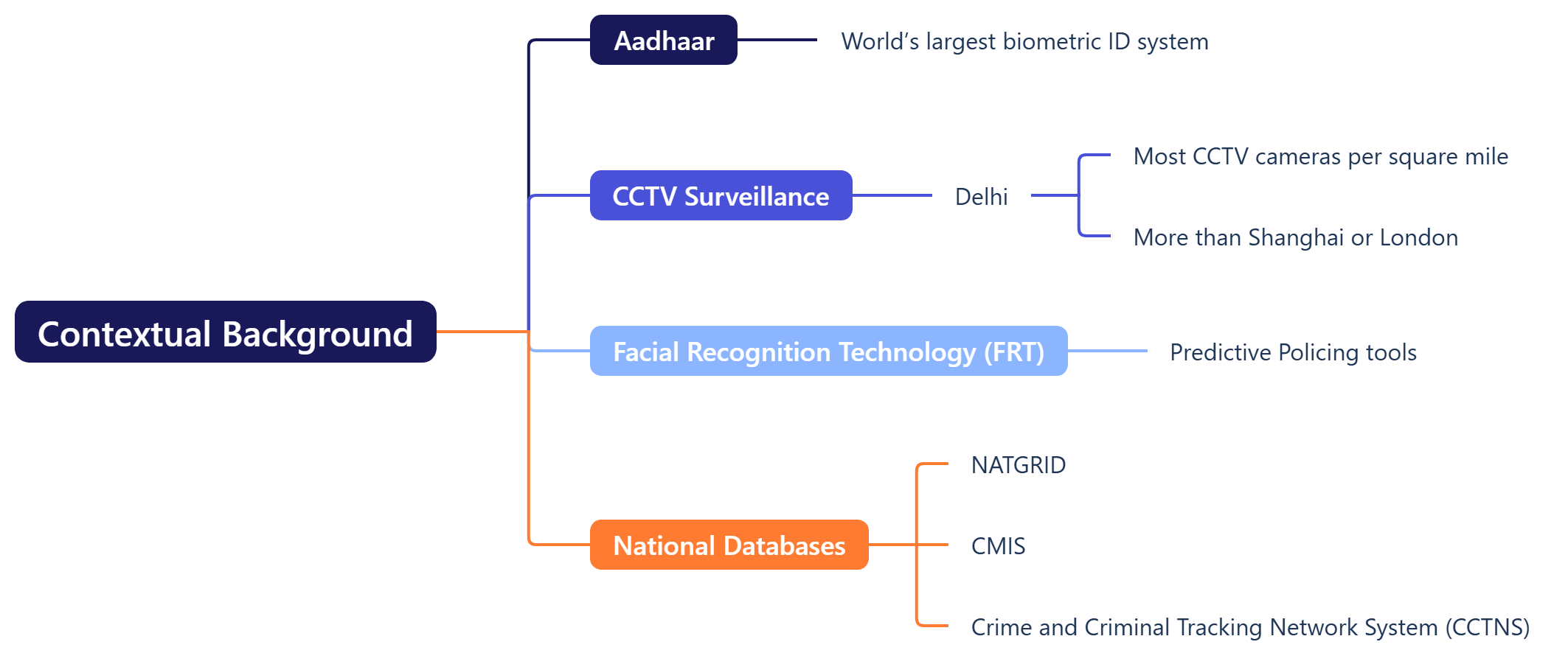
Contextual Background:
India’s transition to a digital welfare state has seen major initiatives such as:
Aadhaar: The world’s largest biometric ID system.
CCTV Surveillance: Delhi tops the global list for the most CCTV cameras per square mile (more than Shanghai or London).
Facial Recognition Technology (FRT) and Predictive Policing tools.
National databases like NATGRID, CMIS, and Crime and Criminal Tracking Network System (CCTNS).
These developments bring to light the classical tension between security and civil liberty, crucial for Sociology aspirants to analyze with sociological frameworks.
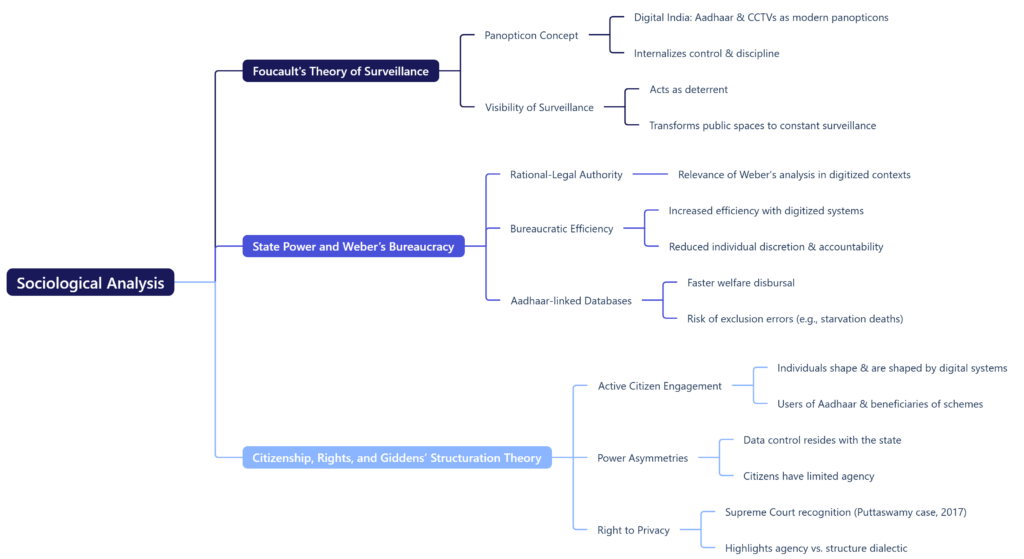
Sociological Analysis
Foucault’s Theory of Surveillance: Michel Foucault’s concept of the Panopticon (from his work Discipline and Punish) is central to understanding modern surveillance. In a digitally connected India:
Aadhaar and CCTVs serve as modern-day panopticons, internalizing control and discipline in the citizen.
The visibility of being watched acts as a deterrent but also transforms public spaces into sites of constant surveillance.
State Power and Weber’s Bureaucracy: Max Weber’s analysis of rational-legal authority finds new relevance:
Digitized bureaucracies increase efficiency but reduce the scope of individual discretion and accountability.
Aadhaar-linked databases enable faster welfare disbursal but may also lead to exclusion errors, as seen in multiple starvation deaths linked to failed biometric authentication.
Citizenship, Rights and Giddens’ Structuration Theory: Anthony Giddens’ theory helps us view individuals as both shaped by and shaping digital systems. Citizens are active users of Aadhaar and beneficiaries of digital schemes. However, power asymmetries persist, as data control lies with the state, not individuals. The Right to Privacy, upheld as a fundamental right by the Supreme Court in 2017 (Puttaswamy case), highlights the dialectic of agency and structure.
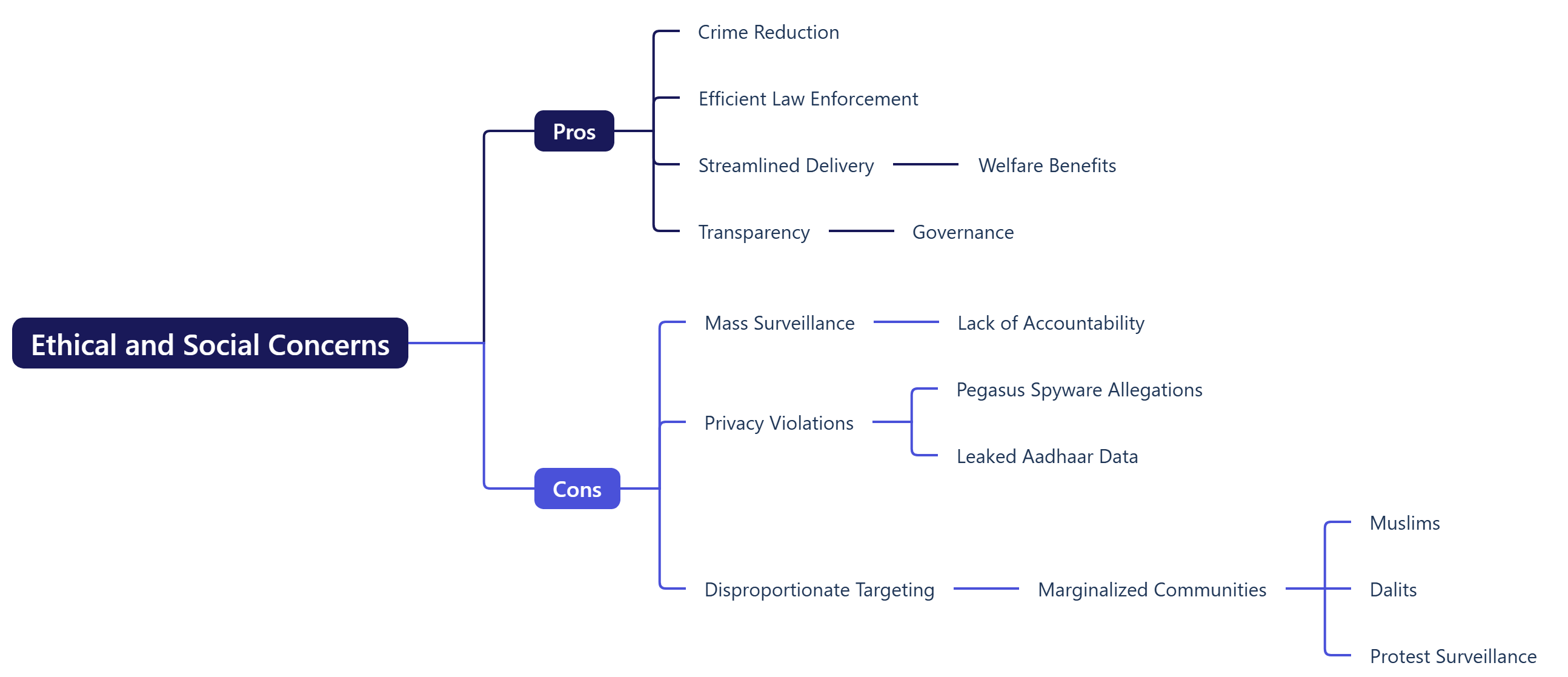
Disproportionate targeting of marginalized communities (Muslims, Dalits during protest surveillance).
Case Studies and Examples
Delhi CCTVs: Touted as a safety measure but used to track political protestors.
Jharkhand Starvation Deaths: Exclusion due to failed Aadhaar authentication.
Jamia Millia Surveillance: Facial recognition during anti-CAA protests.
Kolkata Police Drones: Used in slums for crowd control during COVID-19.
Conclusion
The debate on digital surveillance and privacy in India is not just technological—it is deeply sociological. It questions the social contract, redefines state-citizen dynamics, and demands a balance between security and civil liberties.
PYQs
Paper 1:
What is the relevance of the ‘disciplinary society’ in the digital age? Comment with reference to Foucault. (2023)
Discuss how Giddens’ theory of structuration explains the interaction between human agency and digital structures. (2022)
How do modern communication technologies affect personal identity and social relationships? (2021)
Discuss the significance of bureaucracy in the context of Max Weber’s theory and the challenges it faces in contemporary digital governance. (2019)
Analyze the process of rationalization and its consequences in the age of artificial intelligence and digital surveillance. (2018)
Discuss the impact of globalization and information technology on the concept of the modern state. (2017)
Explain how Weber’s notion of rational-legal authority is manifested in digital bureaucratic systems like Aadhaar. (2016)
Explain the concept of social control. How is it maintained in technologically advanced societies? (2015)
How does technology-driven surveillance impact social control and deviance in contemporary society? (2014)
Paper 2:
Evaluate the role of state surveillance mechanisms in managing dissent and protests in Indian democracy. (2023)
Examine the emerging forms of inequality in India due to digital capitalism and surveillance technologies. (2022)
Discuss how digitalization affects the lives of marginalized communities in India. (2021)
How has technology transformed the relationship between the state and the citizen in India? (2020)
Analyze the impact of digital governance in empowering rural India. (2019)
To what extent has e-governance enhanced transparency and accountability in India? Discuss. (2018)
Critically examine the impact of Aadhaar on welfare delivery and exclusion in India. (2017)
Discuss the implications of data privacy and surveillance for civil society and democratic rights in India. (2016)
How does the digital divide shape access to education, health, and governance in India? (2015)
Discuss the sociological implications of CCTV surveillance and biometric data collection in urban spaces. (2014)
To Read more topics like Digital Surveillance and Privacyin Public Posts, visit: www.triumphias.com/blogs









One comment