Universal Health Coverage (UHC) ensures that all individuals receive the health services they need without financial hardship. India, with its vast and diverse population, has been making significant strides toward achieving UHC, aiming for comprehensive health access by 2030. This blog delves into the current landscape, highlighting key initiatives, challenges, and future directions pertinent to India’s journey toward UHC
The Ayushman Bharat Initiative: A Cornerstone of UHC
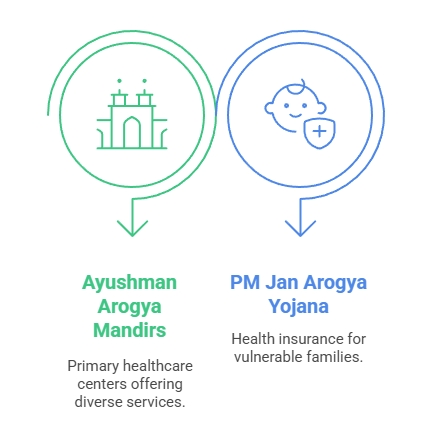
Launched in 2018, Ayushman Bharat stands as India’s flagship program to achieve UHC, comprising two main components:
Ayushman Arogya Mandirs (AAMs): Formerly known as Health and Wellness Centres, over 1.7 lakh AAMs have been operationalized by March 2024. These centers provide comprehensive primary healthcare services, including preventive, promotive, curative, rehabilitative, and palliative care.
Pradhan Mantri Jan Arogya Yojana (PM-JAY): This scheme offers health insurance coverage of ₹5 lakh per family per year for secondary and tertiary care hospitalization to over 10 crore vulnerable families.
Additionally, the Ayushman Bharat Digital Mission (ABDM) has been instrumental in creating a digital health ecosystem. As of April 2025, over 76 crore Ayushman Bharat Health Accounts (ABHA) have been created, linking more than 52 crore health records, thereby enhancing continuity of care and health data management.
Financial Commitments and Health Expenditure Trends
India’s health expenditure has seen a notable increase, doubling from ₹3.2 lakh crore in 2020-21 to ₹6.1 lakh crore in 2024-25, reflecting a compound annual growth rate of 18%. Despite this growth, health spending as a percentage of GDP remains at 1.84%, below the National Health Policy 2017 target of 2.5% by 2025.
Out-of-pocket expenditure (OOPE) has decreased from 60-70% to 39.4%, indicating progress in financial protection. However, disparities persist across states, with some regions still experiencing high OOPE, underscoring the need for equitable health financing mechanisms.
State-Level Innovations and Infrastructure Development
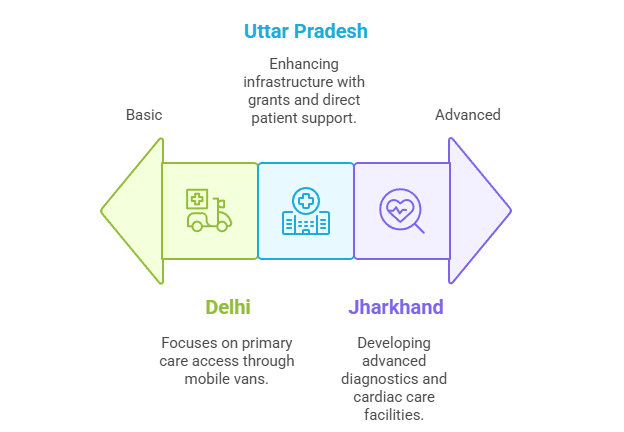
States have been proactive in implementing health initiatives aligned with UHC goals:
Uttar Pradesh: The state has intensified its fight against tuberculosis (TB), increasing testing sevenfold and disbursing ₹251.40 crore directly to patients under the Nikshay Poshan Yojana. Additionally, with a central grant of ₹4,892.53 crore, UP is enhancing its health infrastructure, including the establishment of critical care blocks and integrated public health labs.
Delhi: The government has launched mobile vans to enroll senior citizens in the Ayushman Bharat Vaya Vandana Yojana, providing ₹10 lakh health coverage. Furthermore, plans are underway to establish 1,139 Ayushman Arogya Mandirs across the city, enhancing primary healthcare access.
Jharkhand: Ranchi Sadar Hospital is set to commence CT scan services under a public-private partnership, ensuring free diagnostics for Ayushman Bharat beneficiaries. An MRI facility and a Cath Lab for cardiac care are also in development, aiming to reduce referrals to private hospitals.
Addressing Health Inequities and Data-Driven Interventions
The Indian Council of Medical Research’s Regional Medical Research Centre (ICMR-RMRC) in Bhubaneswar has joined the WHO’s Health Inequality Monitoring Network. This collaboration focuses on reducing health disparities by strengthening data systems and guiding evidence-based policies, particularly for tribal and underserved communities.
Challenges on the Path to UHC
Despite commendable progress, several challenges impede the realization of UHC in India:
Insurance Coverage Gaps: Approximately 400 million Indians remain uninsured, particularly for outpatient services, which constitute a significant portion of healthcare expenses.
Human Resource Shortages: India faces a deficit in healthcare professionals, with only 0.65 doctors, 1.3 nurses, and 1.3 hospital beds per 1,000 people, necessitating substantial investments in workforce development.
Fragmented Healthcare Delivery: The coexistence of multiple health systems within states leads to inconsistencies in service delivery and quality, complicating the implementation of a unified UHC strategy.
The Road Ahead: Strategic Priorities
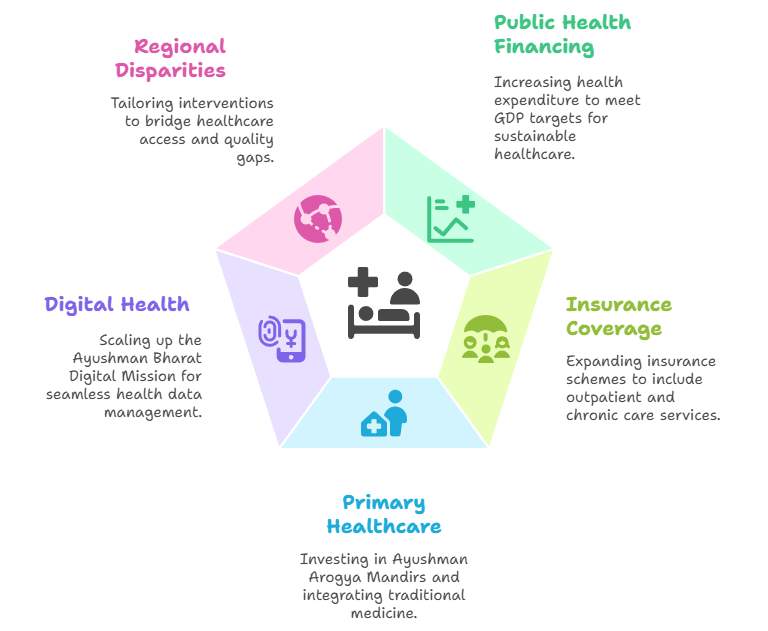
To accelerate progress toward UHC, India must focus on:
Enhancing Public Health Financing: Increasing health expenditure to meet the 2.5% GDP target is crucial for sustainable healthcare delivery.
Expanding Insurance Coverage: Broadening the scope of insurance schemes to include outpatient and chronic care services will provide comprehensive financial protection.
Strengthening Primary Healthcare: Investing in Ayushman Arogya Mandirs and integrating traditional medicine systems can enhance accessibility and holistic care.
Leveraging Digital Health: Scaling up the Ayushman Bharat Digital Mission will facilitate seamless health data management and service delivery.
Addressing Regional Disparities: Tailored interventions are needed to bridge the healthcare access and quality gaps across different states and populations.
Conclusion
India’s journey toward Universal Health Coverage is marked by significant achievements and persistent challenges. The Ayushman Bharat initiative, increased health financing, and state-level innovations underscore the nation’s commitment to health equity. However, addressing insurance coverage gaps, workforce shortages, and systemic inefficiencies remains imperative. A concerted effort involving policy reforms, infrastructure development, and community engagement is essential to realize the vision of health for all by 2030.
The blog does a great job highlighting Ayushman Bharat as a pivotal step toward UHC, but it’s also important to consider how uneven implementation across states could impact overall outcomes. I’d love to see more discussion on how data-driven monitoring could bridge these disparities and make the initiative more equitable at the grassroots level.











The blog does a great job highlighting Ayushman Bharat as a pivotal step toward UHC, but it’s also important to consider how uneven implementation across states could impact overall outcomes. I’d love to see more discussion on how data-driven monitoring could bridge these disparities and make the initiative more equitable at the grassroots level.