


Brewing Uncertainty: A Sociological Lens on Climate Change and India’s Tea Crisis
(Relevant for Sociology Paper 1 & 2: Social change in Modern Society and Rural and Agrarian Transformation in India and Challenges of Social Transformation)
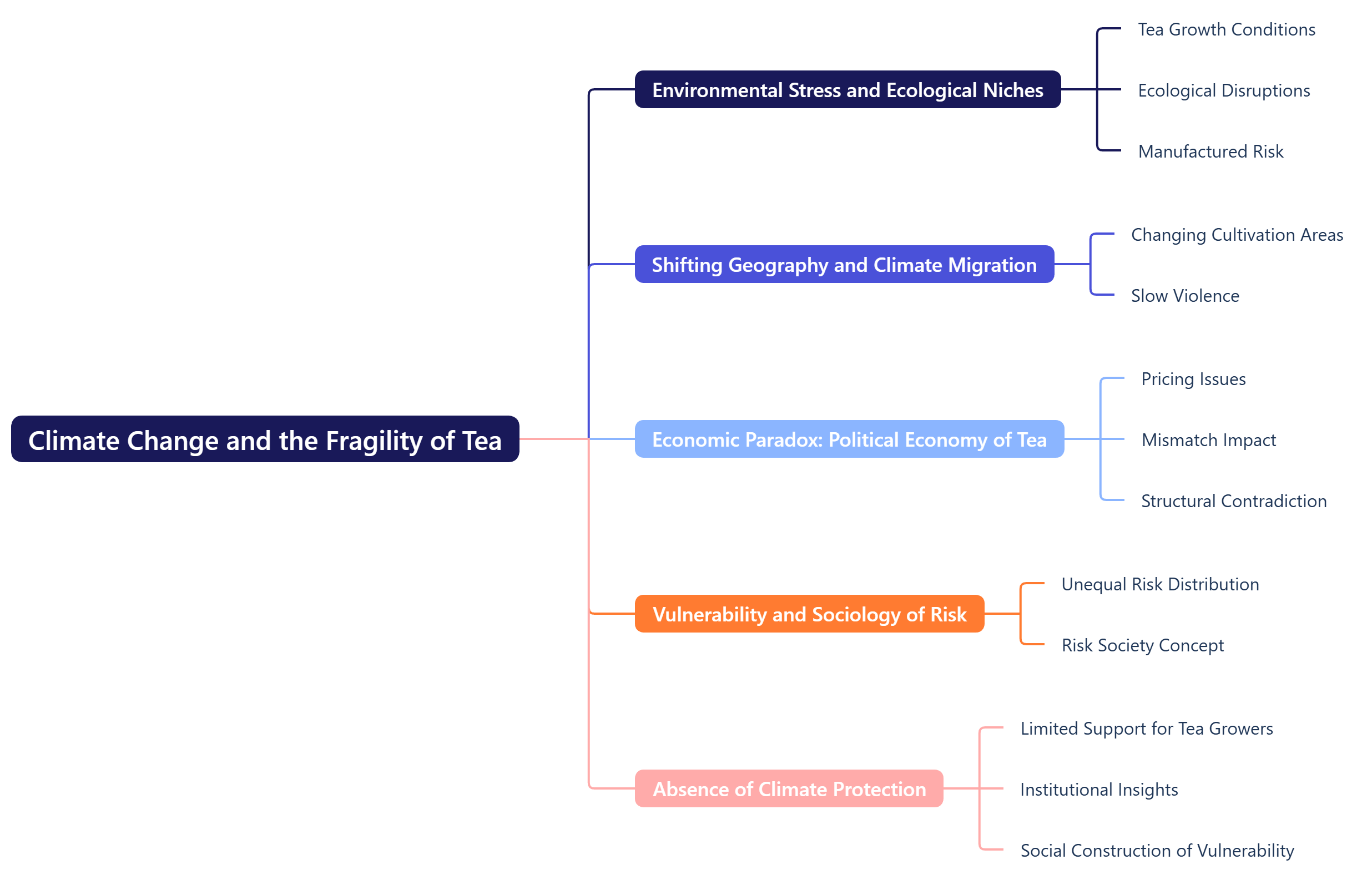
Introduction: Brewing Uncertainty: A Sociological Lens on Climate Change and India’s Tea CrisisClimate change is not just an environmental issue—it is a social disruption. Nowhere is this more visible than in the tea gardens of Assam, the heart of India’s tea economy. As prolonged heat, erratic rainfall, and unpredictable humidity plague the region even after October, the crisis extends far beyond agriculture. It threatens the livelihoods of nearly 12 lakh workers, restructures local economies, and reshapes global commodity chains. Understanding this crisis demands more than climatic data; it requires a sociological interpretation of power, inequality, labour, and structural vulnerability. Climate Change and the Fragility of Tea: A Sociological Breakdown
Tea—derived from Camellia sinensis—grows within a narrow ecological band (13°C–28°C, with optimum 23–25°C). Environmental sociology emphasises that agriculture is deeply embedded in ecosystems. As temperatures rise and rainfall becomes erratic, Assam’s ecological niche is destabilising:
In Anthony Giddens’ terms, this is an example of the “manufactured risk” of late modernity—harm generated by human activity, not natural cycles.
Changing rainfall and heat patterns are making traditional tea hubs (South Bank, Upper Assam) increasingly unsuitable. Cultivation is shifting toward higher altitudes like Karbi Anglong and Dima Hasao. Environmental sociologist Rob Nixon calls this “slow violence”—a gradual, invisible erosion of livelihoods that pushes communities into forced ecological migration.
For 30 years, tea prices have risen only 4.8% annually, compared to inflation and basic staples like wheat and rice (10%). Meanwhile, production costs—labour, fertiliser, irrigation—continue to rise. This mismatch is best explained through political economy:
The tea industry is locked in a price-cost squeeze—a structural contradiction that Marxist economists identify as characteristic of commodity-dependent economies.
Ulrich Beck argues that modern societies increasingly face risks that are unequally distributed. Climate change amplifies inequalities:
The tea industry’s risk exposure is a classic case of “risk society”, where hazards disproportionately impact those with the least power.
Tea growers receive limited support for droughts, heatwaves, or rainfall failures. Unlike staple crop farmers, they are excluded from robust crop insurance and climate-mitigation schemes. Institutional theorists would argue this reflects:
In other words, climate vulnerability is not natural—it is socially constructed. India’s Tea Landscape Through a Sociological Lens
India is the world’s 2nd largest producer and consumer, and 3rd largest exporter of tea. Yet value is unevenly distributed:
This mirrors Immanuel Wallerstein’s World Systems Theory, where peripheral economies produce raw materials while core countries extract value.
The tea industry’s 12 lakh workers—primarily indigenous Adivasi communities—experience:
Their work is essential yet undervalued, reinforcing Weber’s argument about class, status, and power operating simultaneously. Climate Resilience: Sociological Pathways Forward
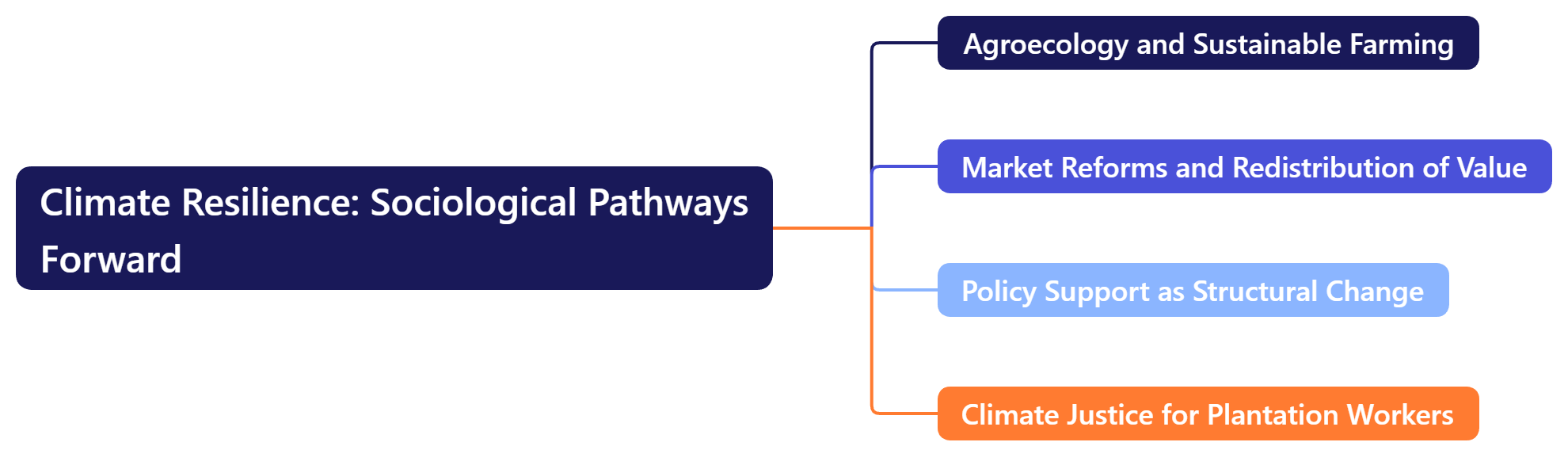
Promoting resilient tea varieties, mulching, micro-irrigation, cover crops, and rainwater harvesting aligns with agroecological principles that view farming as a socio-ecological system rather than a purely technical one. Agroforestry, with shade trees and companion crops, not only reduces heat stress but challenges the monoculture logic that makes plantations vulnerable.
Sociologically, sustainable certification systems like the trustea code do more than improve climate resilience—they alter power relations in the supply chain. This reflects new economic sociology, which emphasises relational, trust-based market structures.
Climate resilience requires:
Kenya’s Farmer Field Schools (under KTDA) demonstrate what Pierre Bourdieu calls “skill capital”—knowledge that increases resilience and bargaining power.
The communities most affected have the least voice. Climate justice requires:
This echoes Nancy Fraser’s call for redistribution + recognition—a dual approach to justice. Climate Change as a Cultural CrisisTea is more than an agricultural commodity—it is part of India’s cultural identity, daily life, and regional heritage.
Environmental sociologists argue that climate change erodes cultural ecosystems, not just physical ones. Conclusion: Brewing a Sustainable FutureAssam’s tea gardens stand at a crossroads. Climate change is reshaping temperatures, rainfall, labour dynamics, and global markets. But sociology teaches us that crises are not just ecological—they are structural, economic, and deeply social. To protect India’s $10-billion tea economy, resilience must be multidimensional:
Tea is more than a beverage—it is a livelihood, a heritage, and a social world. Ensuring its future means transforming the systems that have long undervalued both land and labour. Only then can the next generation inherit not just tea gardens—but a climate-resilient, socially just, and economically sustainable tea industry. |


To Read more topics, visit: www.triumphias.com/blogs
Read more Blogs:
Four Labour Codes and the Transformation of India’s World of Work: A Sociological Analysis
2 comments