


Reimagining Education in India: A Sociological Analysis of NEP 2020 and the Innovation-Driven School Transformation
(Relevant for Sociology Paper 2: Vision of Social Changes in India and Challenges of Social Transformation)
|
India’s education landscape is undergoing a profound transformation under the National Education Policy 2020 (NEP 2020). The conversation today is not just about new curricula or structural reforms; it is about redefining what schooling means in a rapidly changing society. Moving away from rote memorization toward experiential, inquiry-driven, and multidisciplinary learning, NEP 2020 aims to prepare students for a future where creativity, adaptability, and innovation will matter more than content recall. From a sociological standpoint, this transformation reflects a larger shift in India’s developmental trajectory—towards knowledge society formation, democratization of learning, and bridging structural inequalities. The policy marks a pivotal moment in India’s attempt to harmonize global educational trends with local socio-cultural realities. NEP 2020 and the Sociological Transformation of Schooling
NEP 2020 allows students to choose combinations like physics with music, art with mathematics, or coding with history. It introduces hands-on vocational training from Grade 6, alongside arts, technology, and skill-based education. Sociological Insight: John Dewey’s Experiential Learning Dewey argued that learning must arise from experience, inquiry, and interaction with the world. NEP’s integration of arts, vocational skills, and multidisciplinary choices echoes Dewey’s belief that education should prepare students for real-life problem-solving rather than narrow academic performance. Bourdieu and “Cultural Capital” Providing students from all socio-economic backgrounds access to music, arts, languages, vocational skills, and STEM can expand their cultural capital, reducing class-based educational disparity.
The policy replaces rote-based testing with competency-based assessments, captured through the 360° Holistic Progress Card, which evaluates cognitive, social, emotional, and ethical development. Board exams can be taken twice a year, reducing exam anxiety. Sociological Insight: Basil Bernstein’s Pedagogic Codes Bernstein argued that assessment systems shape what knowledge is considered legitimate. NEP’s shift redefines “legitimate knowledge” towards problem-solving, creativity, and application, rather than memorization—aligning school learning with societal needs.
Platforms like PM e-VIDYA, DIKSHA, virtual labs, and digital classrooms now benefit over 25 crore learners. Anthony Giddens’ Structuration Theory Digital integration shows how structures (technology platforms) and agency (students’ usage) shape each other. While enhancing access, the state must prevent digital systems from reproducing inequalities—what sociologists call the digital divide.
NEP 2020 emphasizes inclusivity through:
Paulo Freire’s Critical Pedagogy Freire insisted that education must liberate marginalized communities by enhancing critical consciousness. NEP’s equity-focused provisions attempt to ensure learning environments that are empowering and non-discriminatory—though their success depends on implementation quality. Structural Functionalism: Émile Durkheim Durkheim saw education as a mechanism to promote social solidarity. Inclusive policies strengthen collective belonging and national cohesion by ensuring that every social group participates in education. NEP 2020: Structure and Ambitions
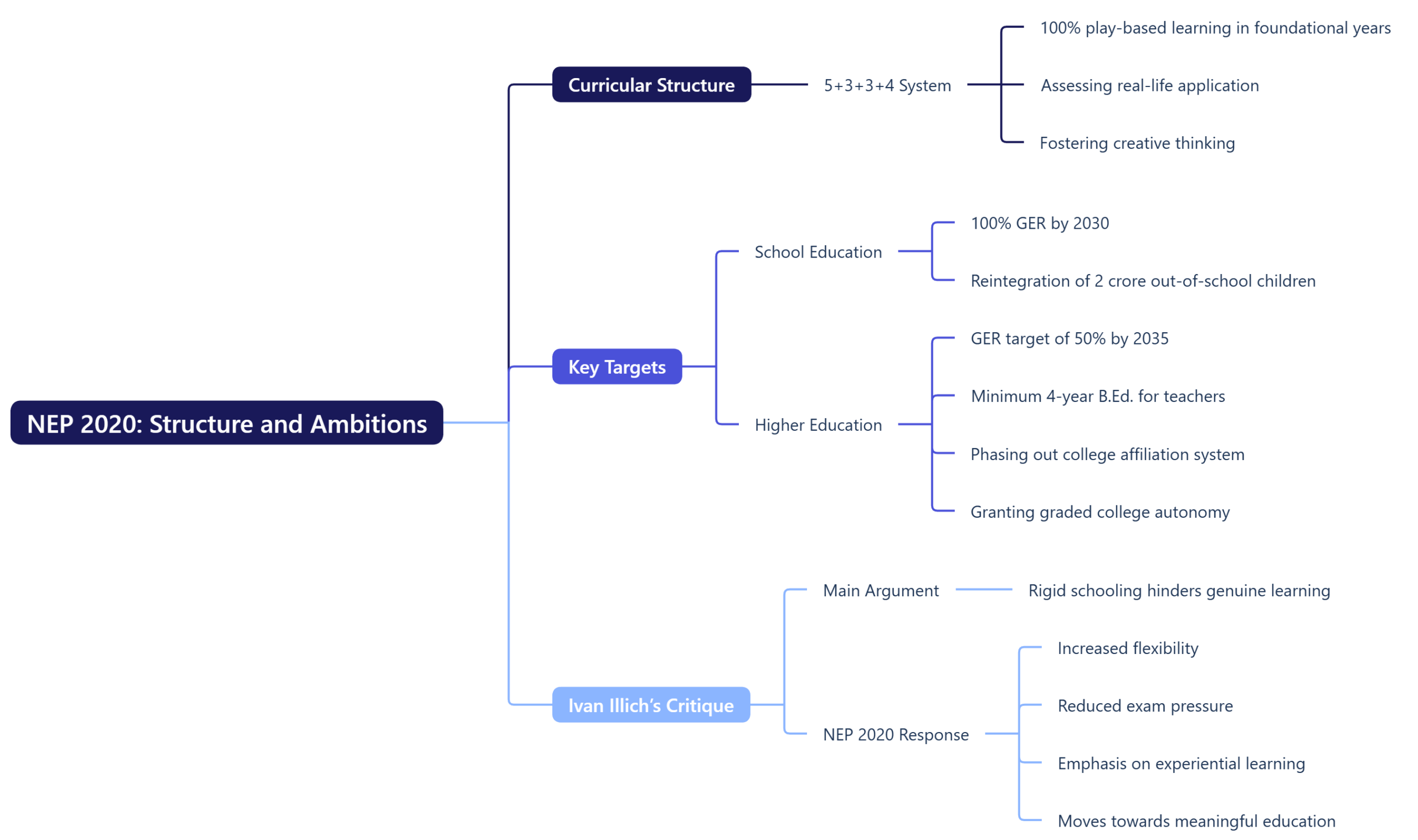
The 5+3+3+4 curricular structure begins with 100% play-based learning in foundational years. Every textbook, paper, and classroom activity will now assess real-life application and creative thinking. Key targets include:
Ivan Illich’s Critique of Schooling Illich argued that rigid schooling systems often hinder rather than help genuine learning. NEP 2020’s flexibility, reduction of exam pressure, and experiential learning represent a partial response to Illich’s critique, making education less bureaucratic and more meaningful. Innovation as a Pillar of Educational ChangeBeyond structural reforms, India is investing heavily in innovation ecosystems within schools.
AIM fosters innovation culture through:
Sociological Insight: Alvin Toffler’s “Future Shock” Toffler warned that societies must prepare individuals for rapid technological change. ATLs and AICs operationalize Toffler’s prescription, introducing children early to innovation and adaptability.
SICs cultivate creativity, leadership, and design thinking.
This addresses the sociological insight that teachers determine the hidden curriculum—the values, skills, and orientations students internalize.
Symbolic Interactionism (Mead & Blumer) These programs shape students’ identities as innovators through interaction, feedback, and real-world engagement. How Innovation is Reshaping the Meaning of Schooling
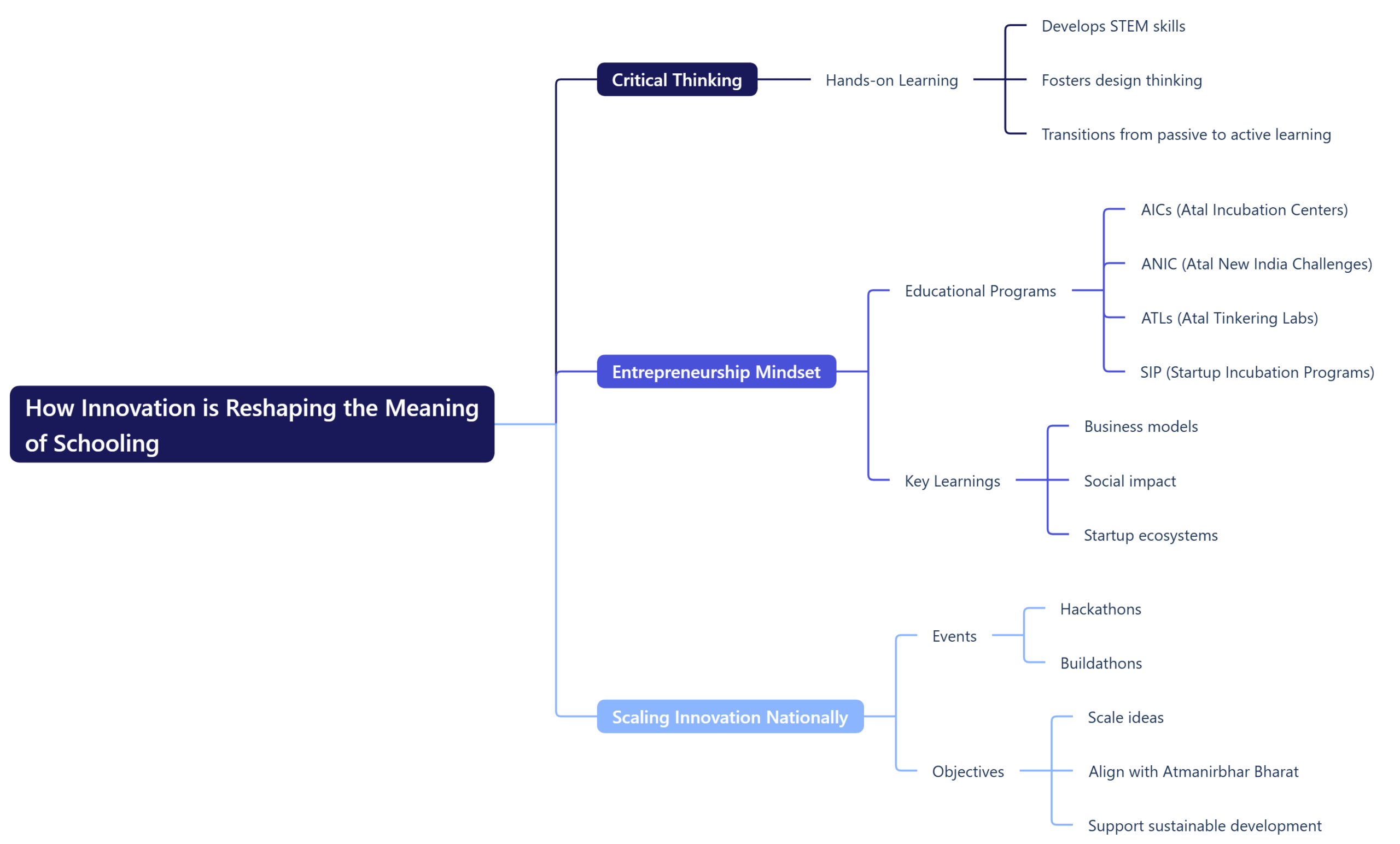
Hands-on learning develops STEM and design thinking abilities—shifting students from passive recipients to active creators.
Through AICs, ANIC, ATLs, and SIP programs, students understand business models, social impact, and startup ecosystems.
Hackathons and Buildathons allow school-level ideas to become scalable solutions aligned with Atmanirbhar Bharat and sustainable development. Modernization Theory: Parsons Parsons argued that modern societies require skills such as achievement, innovation, and adaptability. NEP 2020’s innovation ecosystem aligns schooling with India’s modernization goals. Conclusion: Towards a Sociologically Grounded Future of EducationNEP 2020 is more than an education policy—it’s an ambitious blueprint for reshaping India’s knowledge society. Through multidisciplinary learning, digital access, inclusive education, and national innovation ecosystems, India is moving away from memory-based schooling toward creativity, equity, and real-world skills. Sociological thinkers—from Dewey and Durkheim to Freire, Illich, Bourdieu, and Giddens—help us understand this transformation as a shift not only in pedagogy but in the social purpose of education. If implemented effectively, NEP 2020 could become one of the most significant social reforms in modern India, equipping students for the demands of a rapidly evolving world while reducing structural inequalities and fostering innovation at scale. |


To Read more topics, visit: www.triumphias.com/blogs