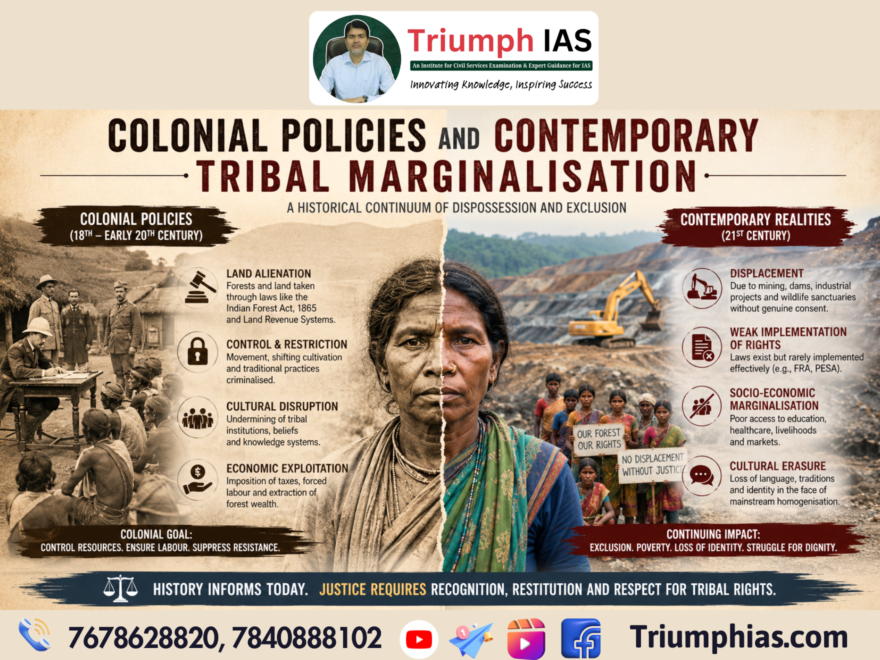
Colonial Policies and Contemporary Tribal Marginalisation

Colonial Policies and Contemporary Tribal Marginalisation

Relevant for Sociology Optional Paper 1, Paper 2, and GS Paper I (Indian Society)

Introduction

The marginalisation of tribal communities in India cannot be understood without tracing its historical roots in colonial governance. Colonial policies fundamentally restructured tribal life—economically, politically, and culturally—laying the foundation for their continued exclusion in postcolonial India. Despite constitutional safeguards and welfare measures, tribal communities remain disproportionately affected by poverty, displacement, and social exclusion.


Colonial Intervention and Disruption of Tribal Systems

Colonial rule introduced a series of administrative, legal, and economic interventions that disrupted the relatively autonomous tribal societies:

1. Land Alienation and Forest Laws
The introduction of laws such as the Indian Forest Acts (1865, 1878, 1927) transformed forests from community resources into state-controlled property. Tribal communities, who depended on forests for subsistence, were declared encroachers on their own land.

  • Customary rights were replaced by legal ownership
  • Shifting cultivation (jhum) was criminalised
  • Forest produce became a state monopoly

2. Revenue Settlements and Zamindari System
Colonial land revenue systems integrated tribal regions into the broader agrarian economy. This led to:

  • Entry of moneylenders and traders
  • Indebtedness and loss of land
  • Emergence of exploitative intermediaries

3. Criminalisation and Surveillance
Certain tribal groups were labelled under the Criminal Tribes Act (1871), reinforcing stigma and state surveillance. This institutionalised marginalisation and social exclusion.


Colonial Construction of ‘Tribe’

Colonial ethnography categorized tribes as “primitive”, “backward”, and isolated from mainstream society. This classification:

  • Created a rigid identity framework
  • Justified paternalistic governance
  • Ignored internal diversity and dynamic social structures

Scholars like Verrier Elwin initially advocated isolation, while others like G.S. Ghurye argued for assimilation—debates that continue to shape tribal policy.


Postcolonial Continuities: From Colonial Legacy to Contemporary Marginalisation

Despite independence, many colonial structures persisted in modified forms:

1. Development-Induced Displacement
Large-scale projects—dams, mining, industries—have disproportionately displaced tribal populations.

  • Lack of adequate rehabilitation
  • Loss of livelihood and cultural disintegration

2. Persistence of Forest Governance Issues
Even after the Forest Rights Act (2006), implementation gaps persist:

  • Bureaucratic resistance
  • Incomplete recognition of community forest rights

3. Socio-Economic Deprivation
Tribal communities lag behind in key indicators:

  • High poverty rates
  • Limited access to education and healthcare
  • Malnutrition and unemployment

4. Cultural Marginalisation
Dominant development narratives often disregard tribal knowledge systems, languages, and traditions, leading to cultural erosion.


Sociological Perspectives

1. Dependency Theory
Tribal regions have been integrated into the national economy in a subordinate manner, serving as resource peripheries.

2. Internal Colonialism
Scholars argue that postcolonial India continues a form of internal colonialism, where tribal areas are exploited for resources without equitable benefits.

3. Subaltern Perspective
Tribal voices remain underrepresented in policymaking, reinforcing their marginal status.


Way Forward

  • Effective Implementation of FRA and PESA
    Ensure genuine decentralisation and community control over resources
  • Participatory Development Models
    Involve tribal communities in decision-making processes
  • Cultural Sensitivity in Policy
    Recognise and integrate indigenous knowledge systems
  • Strengthening Livelihoods
    Promote sustainable forest-based economies and local entrepreneurship

Conclusion

Contemporary tribal marginalisation is not merely a developmental issue but a historical injustice rooted in colonial policies. Addressing it requires not just welfare measures but structural transformation that empowers tribal communities socially, economically, and politically.

UPSC Civil Services (Mains) Question

Q. “Colonial policies laid the foundation for the marginalisation of tribal communities in India, which continues in different forms today.” Critically examine.

To Read more topicsvisit: www.triumphias.com/blogs

Read more Blogs:

Tribal Communities, Development, and Displacement

The process of self-discovery has now been technologically outsourced – Triumph IAS & Vikash Ranjan Sir


“𝟑𝟎𝟗 𝐌𝐚𝐫𝐤𝐬 𝐢𝐧 𝐒𝐨𝐜𝐢𝐨𝐥𝐨𝐠𝐲 𝐎𝐩𝐭𝐢𝐨𝐧𝐚𝐥 𝐰𝐢𝐭𝐡 𝐣𝐮𝐬𝐭 𝐎𝐍𝐄 𝐬𝐨𝐮𝐫𝐜𝐞!”SANDESH JAIN [B.Tech] SOCIOLOGY STRATEGY #UPSC CSE 2025
Heartiest Congratulations to #Sandesh #Jain, #IPS. A student of the Sociology Foundation Course (Aug 2023 Batch) at #Triumph #IAS, Sandesh secured AIR 161 in UPSC CSE 2025 in his #First #Mains appearance.
𝐖𝐡𝐚𝐭 𝐦𝐚𝐤𝐞𝐬 𝐭𝐡𝐢𝐬 𝐚𝐜𝐡𝐢𝐞𝐯𝐞𝐦𝐞𝐧𝐭 𝐞𝐱𝐭𝐫𝐚𝐨𝐫𝐝𝐢𝐧𝐚𝐫𝐲 𝐢𝐬 𝐡𝐢𝐬 𝐒𝐨𝐜𝐢𝐨𝐥𝐨𝐠𝐲 𝐎𝐩𝐭𝐢𝐨𝐧𝐚𝐥 𝐬𝐜𝐨𝐫𝐞:
𝐓𝐎𝐓𝐀𝐋 𝐒𝐎𝐂𝐈𝐎𝐋𝐎𝐆𝐘 𝐌𝐀𝐑𝐊𝐒: 𝟑𝟎𝟗
𝐏𝐚𝐩𝐞𝐫 𝟏 – 173 Marks
𝐏𝐚𝐩𝐞𝐫 𝟐 – 136 Marks
𝐒𝐚𝐧𝐝𝐞𝐬𝐡 𝐟𝐨𝐥𝐥𝐨𝐰𝐞𝐝 𝐚 𝐬𝐢𝐦𝐩𝐥𝐞 𝐛𝐮𝐭 𝐩𝐨𝐰𝐞𝐫𝐟𝐮𝐥 𝐬𝐭𝐫𝐚𝐭𝐞𝐠𝐲:
Single Source Preparation- Only #Vikash #Ranjan Sir’s Sociology Foundation Class Notes, Discussions, Application Strategies & Answer Writing Practice.
No multiple books or Scattered Materials, No PDFs, No Free YouTube Time Wastes, No other Essentials.
He focused on developing Sociological Wisdom — the ability to apply concepts, thinkers, and examples in answers.
Because UPSC preparation is not just about knowledge. It is about developing Sociological Wisdom.
#New #Sociology #Optional – Foundation to Final Course
#Batch for UPSC CSE 2027 -2028 | #Admissions #Open
Available for:
Offline Classroom Program
Live Online Classes
Tablet Course (Learn Anytime)

2 comments

Leave a Reply

Your email address will not be published. Required fields are marked *