


Relevant for Sociology Optional Paper 1, Paper 2, and GS Paper I (Indian Society)
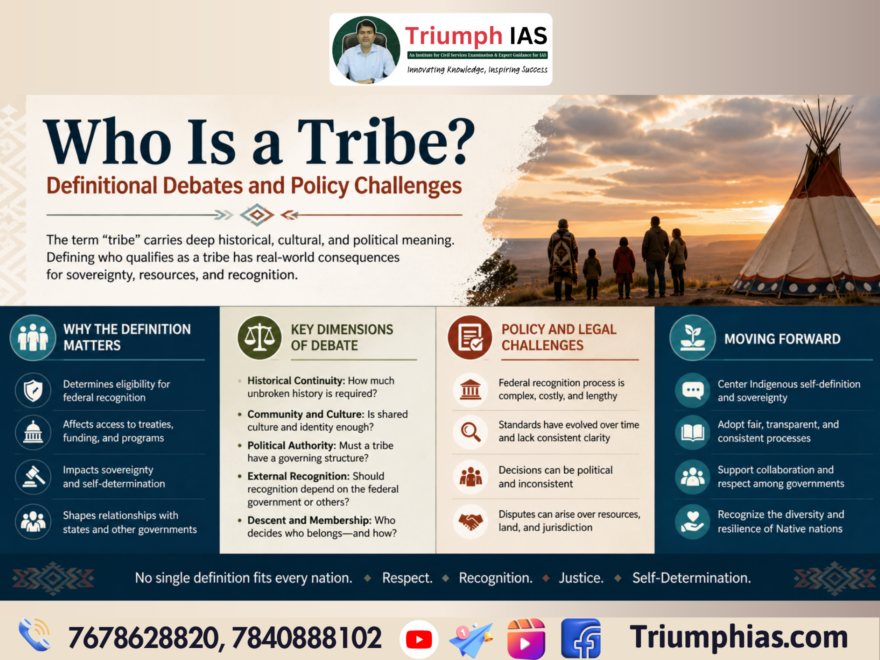
IntroductionThe concept of “tribe” occupies a central yet contested place in sociological and anthropological discourse. While it appears to denote a distinct social category, its meaning has evolved across colonial, academic, and policy frameworks. In India, the term is not merely analytical but carries significant administrative and political implications, particularly through the constitutional category of “Scheduled Tribes” (STs). The definitional ambiguity surrounding tribes raises critical questions about identity, inclusion, and governance. DimensionDefinitional Debates: From Anthropology to PolicyEarly anthropological literature, particularly during the colonial period, defined tribes as isolated, primitive, and homogeneous communities characterized by kinship-based organization, animistic beliefs, and subsistence economies. Scholars such as Verrier Elwin emphasized cultural distinctiveness and relative isolation, while others like G.S. Ghurye argued that tribes were “backward Hindus,” thereby challenging the rigid separation between tribes and castes. Post-independence, this binary view was increasingly questioned. Sociologists began to view tribes as dynamic social formations rather than static relics. The process of tribe-caste continuum, proposed by Ghurye, highlighted the fluid boundaries between tribal and non-tribal communities. Similarly, scholars like André Béteille emphasized the importance of understanding tribes within broader structures of inequality and stratification. In India’s policy framework, however, the definition of a tribe is less theoretical and more administrative. The Constitution does not provide a clear definition; instead, Article 342 empowers the President to notify certain communities as Scheduled Tribes based on criteria such as geographical isolation, distinctive culture, economic backwardness, and “shyness of contact.” These criteria, though practical, are inherently vague and subject to political negotiation. Changing Realities and Conceptual ChallengesThe traditional markers used to define tribes are increasingly inadequate in contemporary contexts. Processes such as urbanization, migration, market integration, and state intervention have transformed tribal societies. Many tribal communities are no longer geographically isolated, nor do they rely solely on subsistence economies. Education, political mobilization, and exposure to mainstream culture have further blurred the boundaries. This raises a fundamental sociological question: Can tribes still be defined by isolation and primitiveness, or should identity be understood in terms of historical marginalization and cultural distinctiveness? Moreover, the term “tribe” itself has been critiqued for its colonial origins and implicit hierarchy. Many prefer the term “indigenous peoples,” which emphasizes rights, autonomy, and historical continuity rather than backwardness. However, in India, the term “Scheduled Tribe” remains deeply embedded in legal and policy structures. Policy Challenges in the Indian ContextThe definitional ambiguity of tribes has direct implications for policy-making:
Towards a Nuanced UnderstandingA more nuanced approach to defining tribes must move beyond static and essentialist criteria. It should incorporate historical disadvantage, socio-economic conditions, cultural practices, and self-identification. Importantly, policy frameworks must be flexible enough to adapt to changing realities while ensuring that benefits reach those who need them most. From a sociological perspective, tribes should be understood not as isolated entities but as communities negotiating their place within broader structures of power, economy, and culture. This shift in understanding is crucial for designing inclusive and effective policies. |
UPSC Civil Services (Mains) Question
Q. “The concept of ‘tribe’ in India is both a sociological category and an administrative construct.” Critically examine in the context of definitional debates and policy challenges.
To Read more topics, visit: www.triumphias.com/blogs
Read more Blogs:
What is research, but a blind date with knowledge! – Triumph IAS & Vikash Ranjan Sir


4 comments