


Relevant for Sociology Optional Paper 1, Paper 2, and GS Paper I (Indian Society)
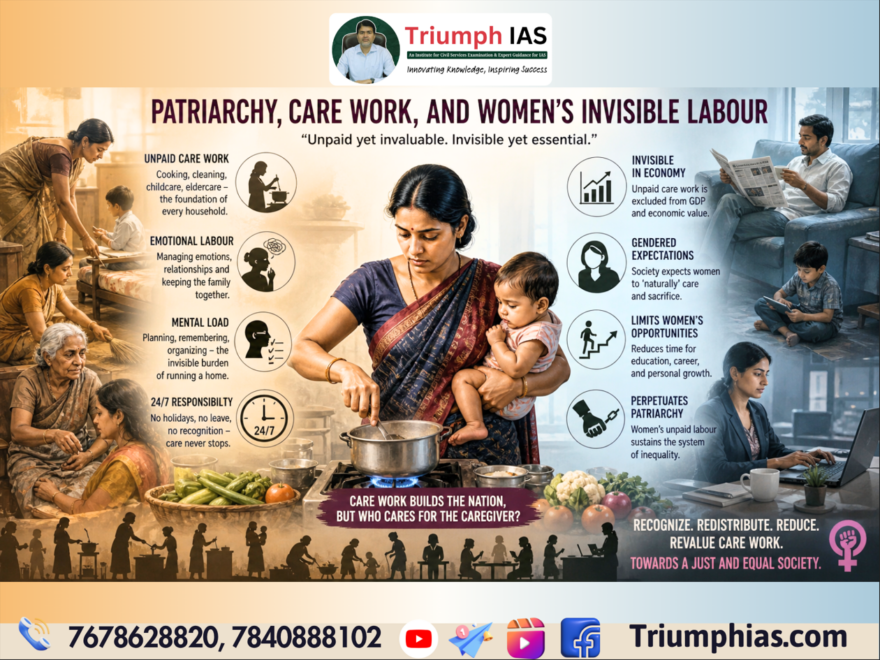
IntroductionPatriarchy, as a structural and ideological system, organizes social relations in ways that privilege men and subordinate women. One of its most enduring manifestations is the systematic invisibilization of women’s labour, particularly in the domain of care work. Care work—encompassing child-rearing, elder care, domestic chores, and emotional support—forms the backbone of social reproduction, yet remains undervalued, unpaid, and largely unrecognized in formal economic frameworks. From a sociological perspective, the persistence of invisible labour can be understood through the intersection of gender norms, economic structures, and cultural ideologies. Feminist scholars have long argued that the public-private dichotomy is central to this invisibility. While the “public” sphere of paid work is associated with productivity and economic value, the “private” sphere of the household is feminized and perceived as natural or instinctive, rather than as labour requiring skill, time, and effort. DimensionThis normalization of unpaid care work is deeply embedded in patriarchal ideology. Women are socialized into roles that prioritize caregiving as a moral duty rather than an economic contribution. As a result, their labour is not only unpaid but also excluded from national income accounting systems like GDP. This exclusion has profound implications: it renders women’s work statistically invisible, reinforces gender inequality, and perpetuates economic dependency. The concept of “social reproduction,” articulated by Marxist and feminist theorists, provides a critical lens to understand this phenomenon. Social reproduction refers to the array of activities and attitudes that sustain and reproduce the labour force. Without the daily and generational reproduction of human beings—through food preparation, caregiving, and emotional nurturing—the capitalist economy itself would collapse. Yet, paradoxically, this foundational labour is not remunerated. Time-use surveys in India reveal the stark gender disparity in unpaid work. Women spend significantly more hours than men in domestic and caregiving activities. This “time poverty” restricts their participation in paid employment, education, and political engagement, thereby reinforcing structural inequalities. It also leads to the “double burden” or “second shift,” where women engaged in paid work continue to shoulder the majority of household responsibilities. Intersectionality further complicates this issue. Not all women experience care work in the same way. Class, caste, and rural-urban divides shape the distribution and experience of labour. For instance, middle-class women may outsource domestic work to poorer women, often from marginalized castes, creating a hierarchy within gendered labour. Thus, while patriarchy oppresses women as a group, it also produces differentiated experiences among them. Policy interventions have attempted to address these disparities, but with limited success. Schemes promoting women’s employment often fail to account for their unpaid workload. There is growing advocacy for recognizing, reducing, and redistributing care work—the “3R framework.” Measures such as paid parental leave, public childcare facilities, and social security for caregivers are essential steps in this direction. Additionally, integrating unpaid work into satellite national accounts can provide visibility and inform policy-making. However, structural transformation requires more than policy adjustments; it necessitates a cultural shift. Challenging deeply entrenched gender norms is critical. Encouraging men’s participation in domestic work, redefining masculinity, and promoting gender-sensitive education are vital for achieving substantive equality. ConclusionIn conclusion, women’s invisible labour is not merely a private issue but a public concern with significant socio-economic implications. Recognizing and valifying care work is essential for building an equitable society. Sociology, with its critical tools and perspectives, plays a crucial role in uncovering these hidden dimensions and advocating for transformative change. |
UPSC Civil Services (Mains) Question
Q.“Care work remains one of the most undervalued forms of labour in patriarchal societies.” Critically examine the socio-economic implications of women’s unpaid care work in India.
To Read more topics, visit: www.triumphias.com/blogs
Read more Blogs:
What is research, but a blind date with knowledge! – Triumph IAS & Vikash Ranjan Sir



3 comments