


Relevant for Sociology Optional Paper 1, Paper 2, and GS Paper I (Indian Society)
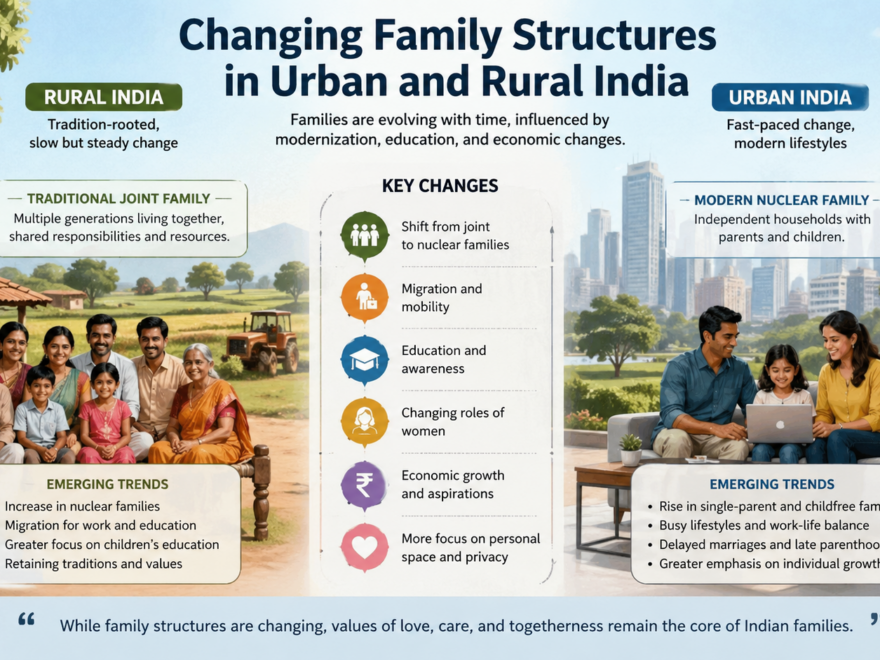
IntroductionFamily, as a fundamental social institution, has undergone significant transformation in India over the past few decades. These changes are closely linked with processes such as industrialization, urbanization, education, migration, and economic restructuring. While both urban and rural areas reflect these shifts, the nature, pace, and extent of change differ considerably. DimensionTraditional Family Structure in IndiaTraditionally, Indian society was characterized by the joint family system, especially in rural areas. This structure was marked by:
In contrast, urban areas historically showed relatively more flexibility, though joint families were still prevalent. Changing Trends in Urban IndiaUrban India has witnessed rapid transformation in family structures due to modernization and globalization. Key trends include: 1. Rise of Nuclear FamiliesThe most visible change is the shift from joint to nuclear families, consisting of parents and children. Factors contributing to this include:
2. Increasing IndividualismUrban families increasingly emphasize personal autonomy and self-fulfillment, leading to:
3. Changing Gender RolesWith more women entering the workforce:
4. Decline of Kinship ControlUrban families experience weaker kinship ties, reducing social control and increasing privacy. Changing Trends in Rural IndiaThough rural India is often seen as traditional, it is also undergoing gradual but significant changes: 1. Fragmentation of Joint FamiliesEconomic pressures, land fragmentation, and migration have led to:
2. Impact of MigrationMale migration to urban areas has resulted in:
3. Influence of Education and MediaIncreased access to education and mass media has:
4. Persistence of TraditionDespite changes, rural families still retain:
Comparative Perspective: Urban vs Rural
Sociological InterpretationFrom a sociological perspective:
Thus, family transformation is not merely structural but deeply interconnected with broader social change. ConclusionThe Indian family is not disintegrating but transforming and adapting. While urban families reflect rapid shifts toward nuclearization and individualism, rural families show a hybrid pattern, blending tradition with modernity. Understanding these changes is crucial for policymaking, especially in areas like gender justice, social security, and welfare. |
UPSC Civil Services (Mains) Question
Q. “Discuss the changing nature of family structures in India in the context of urbanization and modernization. How do these changes differ between rural and urban areas?” (250 words)
To Read more topics, visit: www.triumphias.com/blogs
Read more Blogs:
Caste Census, Reservation, and the Politics of Social Justice



2 comments