


Relevant for Sociology Optional Paper 1, Paper 2, and GS Paper I (Indian Society)
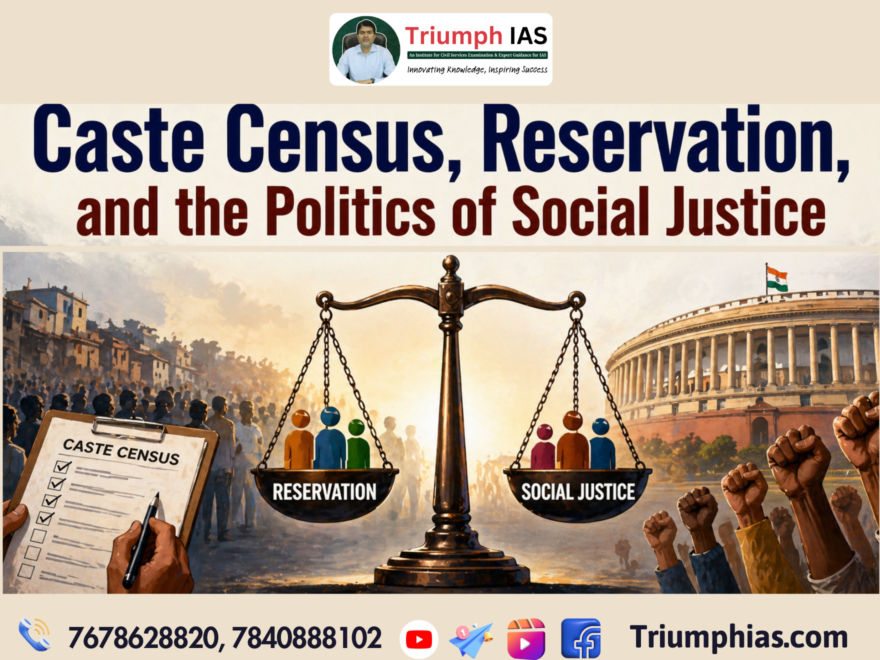
IntroductionThe debate surrounding caste census and reservation policies in India lies at the intersection of empirical governance and normative ideals of social justice. Within sociology, these issues are not merely administrative concerns but reflect deeper structural inequalities embedded in the social system. They raise fundamental questions about representation, redistribution, and recognition in a stratified society. DimensionUnderstanding Caste Census: Data as PowerA caste census refers to the systematic enumeration of caste identities within a population. While caste was last comprehensively recorded in the 1931 Census, post-independence India has largely avoided collecting detailed caste data, except for Scheduled Castes (SCs) and Scheduled Tribes (STs). However, the growing demand for a caste census reflects a shift toward evidence-based policymaking. From a sociological perspective, caste is a form of ascribed status that continues to influence life chances, access to resources, and social mobility. Without updated data, policies aimed at social justice risk being based on outdated or incomplete assumptions. A caste census, therefore, is seen as a tool for quantifying inequality, making visible the extent of deprivation among Other Backward Classes (OBCs) and other marginalized groups. Reservation: Instrument of Social JusticeReservation policies in India are rooted in the principle of compensatory discrimination or affirmative action. They aim to correct historical injustices by ensuring representation of marginalized groups in education, employment, and political institutions. Sociologically, reservation can be analyzed through the lens of structural inequality and social exclusion. Thinkers like B.R. Ambedkar argued that caste-based discrimination is systemic, not individual, requiring institutional remedies. Reservation thus serves as a mechanism of redistributive justice, attempting to level the playing field. However, reservation also generates debates around meritocracy, efficiency, and the emergence of a “creamy layer” within backward classes. Critics argue that it may reinforce caste identities rather than dissolve them, while supporters contend that caste remains a lived reality and cannot be wished away without structural interventions. Politics of Social Justice: Mobilization and ContestationThe politics of caste census and reservation cannot be understood without examining electoral dynamics. Political parties often mobilize caste identities to build vote banks, making caste both a social reality and a political resource. The demand for a caste census has gained momentum in recent years, particularly from regional parties representing OBC interests. It is framed as a step toward inclusive governance and equitable distribution of state resources. At the same time, it raises concerns about the potential intensification of identity politics. From a sociological standpoint, this reflects the transition from traditional caste hierarchies to modern political identities. Caste is no longer confined to ritual status but has become a basis for political assertion and negotiation. This aligns with M.N. Srinivas’s idea of “dominant caste” and the role of caste in democratic politics. Balancing Justice and UnityThe central challenge lies in balancing the goals of social justice with the need for social cohesion. A caste census can provide the empirical foundation for more targeted policies, but it must be accompanied by a broader vision of equality that transcends narrow identity politics. Reservation, similarly, needs periodic review to ensure that benefits reach the most disadvantaged sections. The debate should move beyond binaries of “pro” vs “anti” reservation toward a nuanced understanding of equity vs equality. ConclusionCaste census and reservation policies are integral to India’s ongoing project of social transformation. They reflect the state’s attempt to address deeply entrenched inequalities while navigating the complexities of a diverse society. For sociology, they offer a rich site to examine how structures of power, identity, and justice interact in shaping contemporary India. |
UPSC Civil Services (Mains) Question
Q. “Discuss the relevance of caste census in contemporary India. How does it impact the discourse on reservation and social justice?” (250 words)
To Read more topics, visit: www.triumphias.com/blogs
Read more Blogs:
Untouchability in the 21st Century: New Forms, Old Structures
Best for an individual is not necessarily best for the society – Triumph IAS & Vikash Ranjan Sir


One comment