


Relevant for Sociology Optional Paper 1, Paper 2, and GS Paper I (Indian Society)
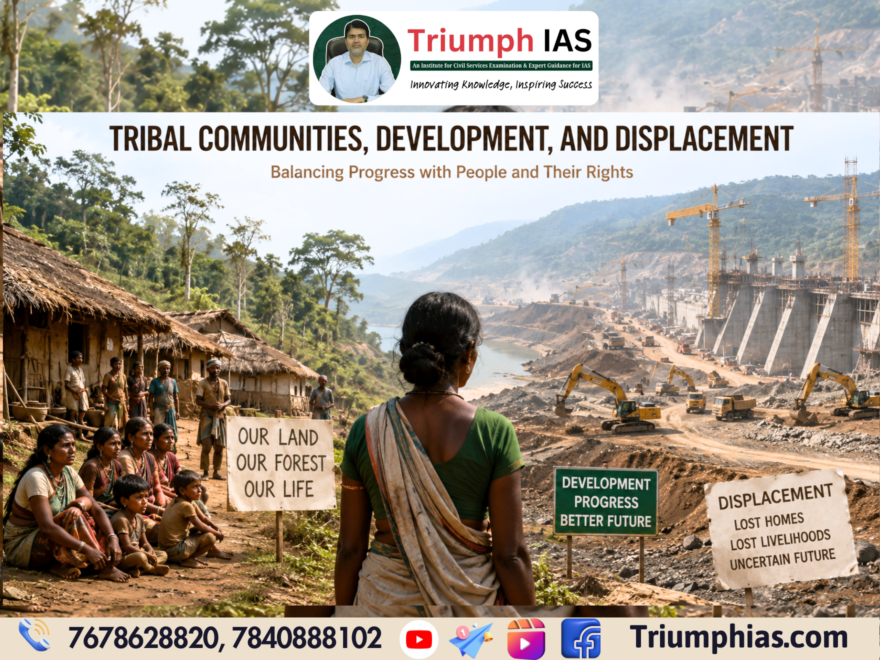
IntroductionThe trajectory of development in India has often unfolded as a paradox—while it promises growth and modernization, it simultaneously marginalizes some of the most vulnerable populations, particularly tribal communities. These communities, constitutionally recognized as Scheduled Tribes, have historically maintained a symbiotic relationship with forests, land, and natural resources. However, state-led development initiatives such as dams, mining, industrial corridors, and conservation projects have frequently resulted in their displacement, raising critical sociological questions about equity, justice, and sustainability. DimensionFrom a sociological standpoint, development-induced displacement is not merely a physical relocation but a profound disruption of social structure, cultural identity, and economic systems. Tribal societies are characterized by strong kinship ties, community ownership of resources, and a subsistence-based economy. When displacement occurs, these foundational elements are dismantled, leading to what sociologists term “cultural disintegration.” The concept of development itself has been critiqued by scholars like Amartya Sen, who emphasized that true development must enhance human capabilities rather than merely increase economic output. In the case of tribal communities, displacement often results in loss of livelihood, food insecurity, and social alienation—clearly contradicting Sen’s capability approach. Similarly, Walter Fernandes has extensively documented that a disproportionate number of displaced people in India are tribals, despite them constituting a small percentage of the population. This reflects a structural bias in development policies, where marginalized groups bear the cost of national progress without equitable compensation or rehabilitation. One of the key issues is the inadequacy of rehabilitation and resettlement (R&R) policies. Although legal frameworks like the Right to Fair Compensation and Transparency in Land Acquisition Act, 2013 exist, their implementation remains inconsistent. Compensation is often monetary and fails to account for non-material losses such as cultural heritage, community cohesion, and traditional knowledge systems. Moreover, displacement leads to what Marginalization and social exclusion. Tribals, once self-reliant within their ecosystems, are pushed into urban peripheries or unfamiliar rural settings where they lack skills to compete in market economies. This results in increased poverty, unemployment, and vulnerability to exploitation. Another dimension is the ecological contradiction. Tribal communities have traditionally practiced sustainable living, preserving biodiversity and ecological balance. Ironically, development projects that displace them often lead to environmental degradation. This raises questions about the dominant model of development and its long-term viability. The role of the state is also contentious. While it acts as a facilitator of development, it often overlooks participatory governance. The Panchayats (Extension to Scheduled Areas) Act (PESA), 1996 and the Forest Rights Act (FRA), 2006 were enacted to empower tribal communities and recognize their rights over land and resources. However, their potential remains underutilized due to bureaucratic inertia and political-economic interests. In recent years, there has been growing advocacy for an inclusive and participatory model of development. Concepts like “development with consent” and “bottom-up planning” emphasize the need to involve tribal communities in decision-making processes. Sociologically, this aligns with the principles of democratic decentralization and social justice. ConclusionIn conclusion, the issue of tribal displacement underscores a fundamental tension between growth and equity. A reimagining of development is imperative—one that integrates economic progress with social inclusion, cultural preservation, and environmental sustainability. Without this, development risks becoming a source of dispossession rather than empowerment. |
UPSC Civil Services (Mains) Question
Q. “Development-induced displacement has disproportionately affected tribal communities in India.” Critically examine the sociological dimensions of this issue.
To Read more topics, visit: www.triumphias.com/blogs
Read more Blogs:
There are better practices to “best practices” – Triumph IAS & Vikash Ranjan Sir



2 comments