


𝐑𝐞𝐥𝐞𝐯𝐚𝐧𝐭 𝐟𝐨𝐫: Essay for IAS
INTRODUCTIONLife, in its bare biological sense, begins with birth and ends with death; however, in its deeper moral and philosophical sense, it unfolds as a continuous journey of becoming. The statement “Life is long journey between human being and being humane” captures this profound distinction between mere existence and meaningful living. While a human being denotes a biological entity endowed with intelligence and agency, being humane signifies the ethical refinement of that entity through compassion, empathy, responsibility, and moral consciousness. Thus, life is not merely about survival, accumulation, or achievement, but about an inner evolution where instinct is tempered by conscience and power is guided by compassion. This journey is neither automatic nor linear; rather, it is shaped by socialization, culture, institutions, choices, and crises. In this sense, life becomes a moral pilgrimage in which individuals, societies, and civilizations are continuously tested on the scale of humanity. MAIN BODY:To begin with, every individual is born a human being by virtue of biology, but no one is born humane. The newborn carries immense potential, yet this potential must be nurtured through social interactions and moral learning. Philosophers like Aristotle emphasized that humans are zoon politikon—social animals whose virtues develop within the polis. Likewise, sociologists such as Durkheim viewed morality as a social fact, external to the individual yet internalized through education and collective life. Therefore, the journey towards being humane begins with socialization, where family, school, and community inculcate values such as sharing, empathy, and respect for others. However, while society provides the moral framework, the individual must consciously internalize it. At this stage, the tension between self-interest and social good becomes apparent. A human being driven purely by instinct may seek pleasure, dominance, or material gain, but a humane individual learns to restrain impulses for the sake of others. Hence, the early phase of life represents the foundational step in the journey—moving from biological impulse to moral awareness. As life progresses, rationality and emotion jointly shape human conduct. Reason gives humans the capacity to calculate consequences, while emotions such as compassion and guilt humanize decisions. Thinkers like Immanuel Kant argued that morality arises from rational duty, whereas Indian philosophical traditions emphasized karuna (compassion) and dharma (righteous conduct). The synthesis of these traditions suggests that being humane requires both rational judgment and emotional sensitivity. Nevertheless, modern life often prioritizes instrumental rationality—efficiency, productivity, and success—over moral considerations. Consequently, individuals may excel as professionals or citizens while failing as humane beings. The corporate executive maximizing profits at the cost of environmental destruction or the bureaucrat adhering rigidly to rules while ignoring human suffering exemplifies this moral disjunction. Thus, the journey between being human and being humane is marked by constant ethical choices, where convenience and conscience frequently collide. While individual choice is central, social structures significantly influence the capacity for humaneness. Capitalism, bureaucracy, and technological rationality, as Max Weber warned, can lead to an “iron cage” where efficiency eclipses empathy. Urbanization and modernization, though liberating in many ways, often weaken traditional bonds of community and solidarity. As relationships become transactional, individuals risk becoming isolated and indifferent to collective suffering. Moreover, social inequalities based on class, caste, gender, and ethnicity test the moral fabric of society. A society that tolerates hunger amidst abundance or discrimination amidst constitutional equality reflects a failure to translate human existence into humane governance. In this context, being humane is not merely a personal virtue but a structural imperative. Policies, institutions, and laws must embody compassion to ensure dignity for all. Therefore, the journey towards humaneness must be undertaken not only by individuals but also by societies as collective moral agents. History repeatedly demonstrates that human intelligence without humaneness can be disastrous. Wars, genocides, and ecological destruction are outcomes of human capability divorced from moral restraint. The twentieth century, despite unprecedented scientific progress, witnessed extreme brutality, prompting thinkers like Hannah Arendt to reflect on the “banality of evil”—the idea that ordinary individuals, by suspending moral judgment, can perpetrate extraordinary cruelty. In contemporary times, terrorism, communal violence, and authoritarianism further illustrate how fear and ideology can eclipse empathy. Here, the journey from being human to being humane is violently interrupted, as the “other” is dehumanized. Once empathy is withdrawn, cruelty becomes normalized. Thus, sustaining humaneness requires vigilance, moral courage, and the willingness to recognize shared humanity even amid conflict. Technological advancement has dramatically reshaped human life, enhancing comfort, connectivity, and control over nature. Yet, ethical progress has not always kept pace with technological growth. Artificial intelligence, social media, and surveillance technologies raise critical questions about privacy, autonomy, and dignity. A technologically empowered human being may become less humane if empathy is replaced by algorithms and relationships are reduced to data points. Furthermore, digital spaces often amplify hate, misinformation, and polarization, eroding civil discourse. While technology can be a tool for humanitarian action, its moral orientation depends on human intent. Hence, the journey towards being humane in the digital age requires ethical literacy alongside technical proficiency. Without this balance, progress risks becoming hollow and destructive. Education occupies a pivotal role in transforming human beings into humane citizens. Beyond literacy and skills, education must cultivate critical thinking, ethical reasoning, and emotional intelligence. Rabindranath Tagore envisioned education as a process of harmonizing intellect with empathy, while Mahatma Gandhi emphasized nai talim—education for character and service. However, contemporary education systems often prioritize competition and credentials over values. This creates individuals who are competent but indifferent. Reorienting education towards humanistic values can therefore accelerate the journey towards humaneness. Service learning, ethical debates, and exposure to diverse social realities can nurture compassion and civic responsibility. Thus, education becomes not merely preparation for livelihood but preparation for life itself. Paradoxically, suffering often acts as a catalyst in the journey towards being humane. Personal loss, failure, or exposure to injustice can deepen empathy and moral maturity. Philosophical traditions across cultures recognize suffering as a teacher—Buddhism views it as central to enlightenment, while existentialists see it as a condition that forces authentic choice. Yet, suffering can also breed resentment and cruelty if not accompanied by reflection. Therefore, the humane individual is one who transforms suffering into solidarity rather than bitterness. This transformative capacity distinguishes moral growth from mere endurance. In this sense, life’s adversities are not deviations from the journey but integral milestones shaping humane consciousness. In public life, the distinction between being human and being humane acquires heightened significance. Leaders wield power that can alleviate or exacerbate suffering. Humane leadership is characterized by empathy, accountability, and inclusiveness, while inhumane leadership thrives on exclusion and fear. Democratic governance, at its best, institutionalizes compassion through welfare policies, social justice, and participatory decision-making. Civil servants, in particular, are custodians of humane governance. Their role extends beyond rule enforcement to empathetic problem-solving. As the famous dictum goes, “Rules are made for humans, not humans for rules.” Thus, the moral journey of individuals finds its ultimate test in public responsibility, where private values translate into collective outcomes. India’s civilizational ethos offers rich insights into the idea of humaneness. Concepts such as Vasudhaiva Kutumbakam (the world is one family) and Ahimsa (non-violence) emphasize universal compassion. Yet, the coexistence of deep spirituality with persistent social inequalities reveals the unfinished nature of this journey. Constitutional ideals of justice, liberty, equality, and fraternity represent an attempt to institutionalize humaneness in a diverse society. The challenge lies in bridging the gap between ethical ideals and social realities. Movements for social reform, from anti-caste struggles to gender justice, represent collective efforts to move closer to being humane. Thus, India’s experience underscores that the journey is continuous and requires sustained moral commitment. CONCLUSION:In conclusion, life is not merely a passage of time but a moral voyage from biological existence to ethical fulfillment. Being human is a given; being humane is an achievement. This journey is shaped by individual choices, social structures, education, suffering, and public responsibility. In an age marked by rapid change and profound contradictions, the need to reaffirm humaneness has become more urgent than ever. Progress devoid of compassion is hollow, and power without empathy is perilous. Ultimately, the true measure of a life well lived lies not in what one acquires or achieves, but in how one treats others and responds to shared vulnerability. Thus, the long journey between human being and being humane is the essence of civilization itself—a journey that defines not only individuals but the destiny of humanity as a whole. |
Read more blog:
Best Essay Writing Course for UPSC CSE
If you’re preparing for the UPSC Civil Services Examination (CSE), one paper that can unlock exceptional scores and a top rank is the Essay Paper. While General Studies and Optional Subjects are structured and syllabus-driven, the Essay writing segment is where individuality, critical thinking, and articulation truly shine.
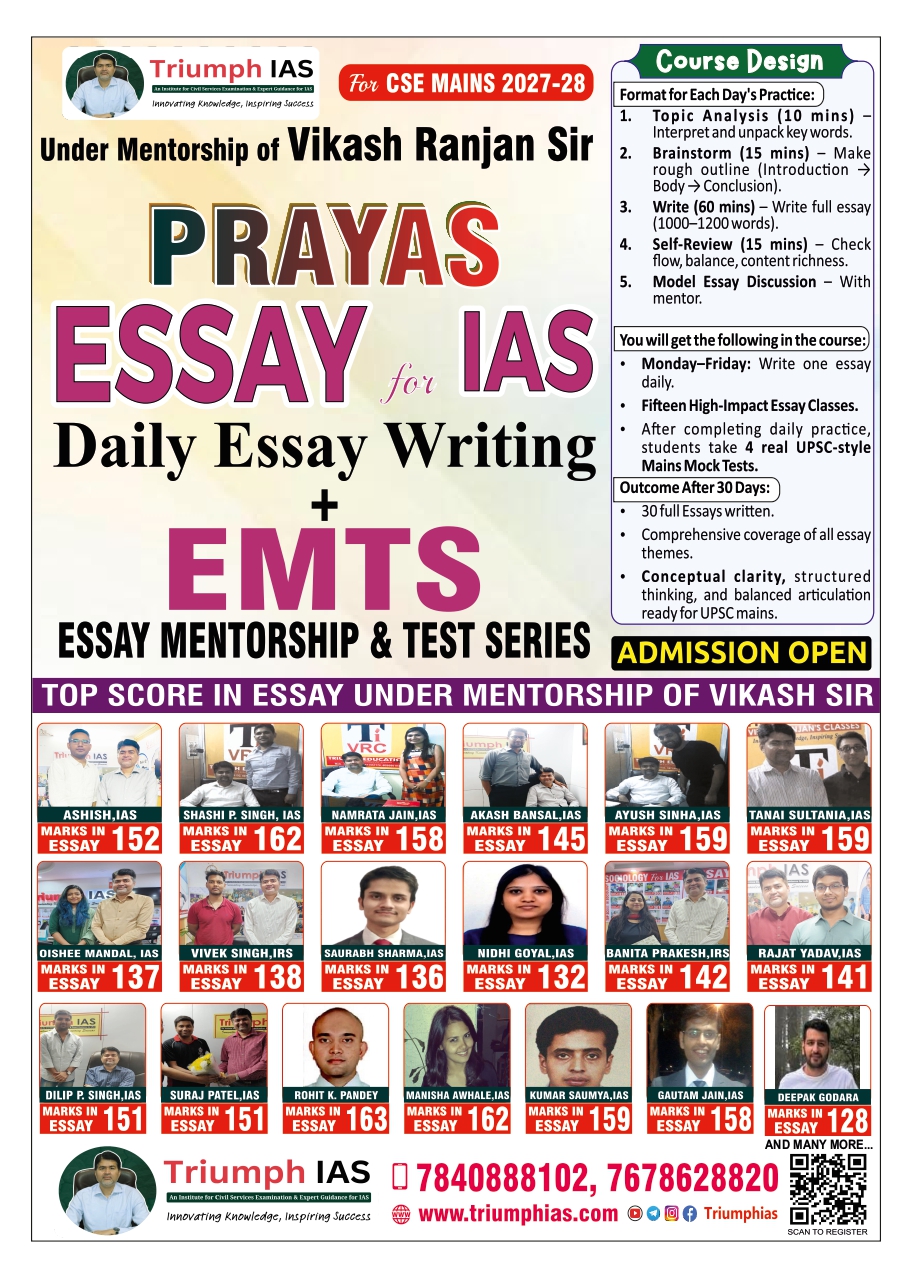
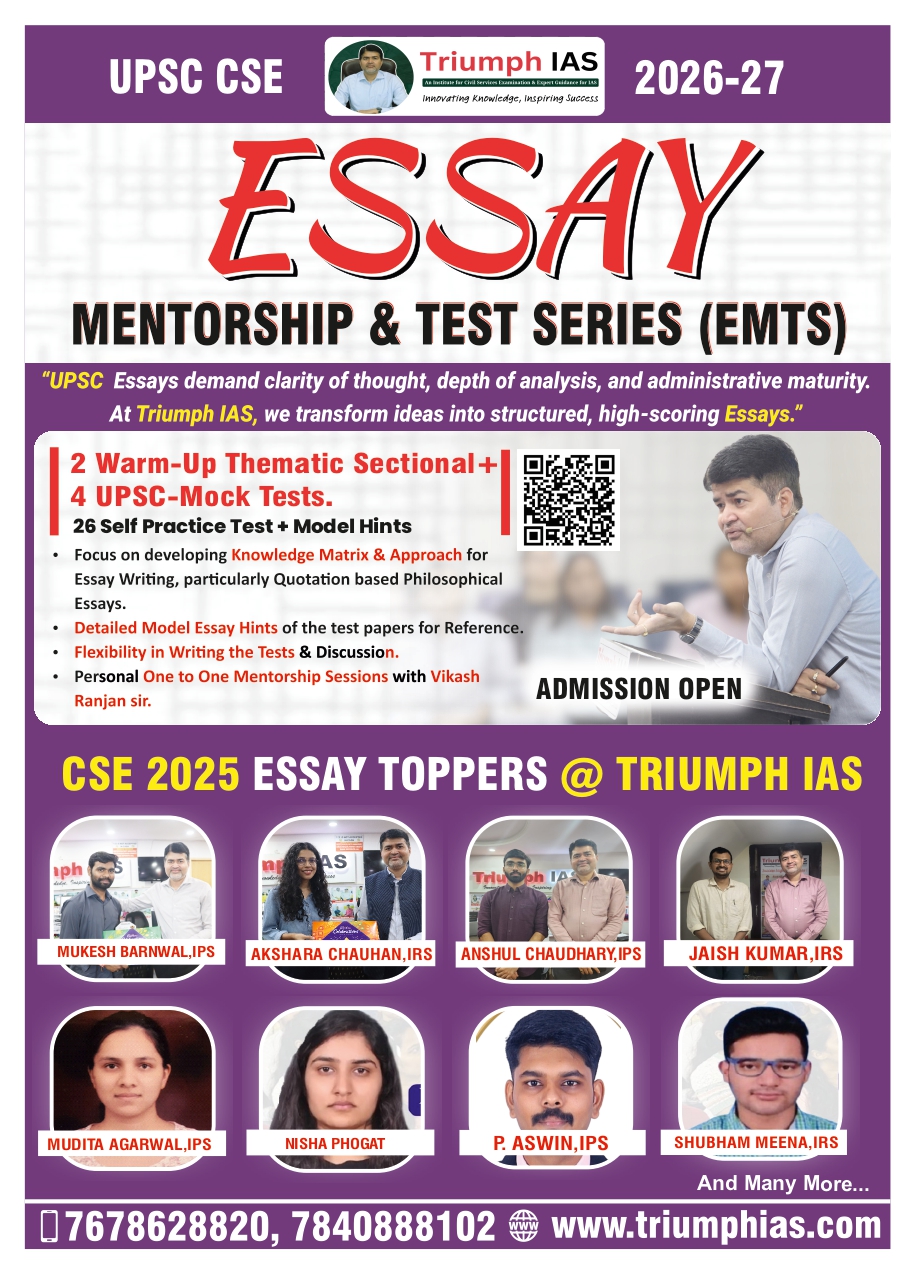
Among various Essay programs available across India, Triumph IAS, under the expert mentorship of Vikash Ranjan Sir, offers the Best Essay writing Course for UPSC CSE. This comprehensive guide explores what makes this program unparalleled and why it should be part of every serious aspirant’s preparation strategy.


2 comments