Secularisation vs Religious Revivalism in Sociology | UPSC Sociology Optional

Secularisation vs Religious Revivalism

Relevant for Sociology Optional Paper 1, Paper 2, and GS Paper I (Indian Society)

Introduction

Secularisation vs Religious Revivalism

Modern societies are often characterized by rapid industrialization, urbanization, scientific advancement, and globalization. These processes were expected to reduce the influence of religion in public life, giving rise to the concept of secularisation. However, contrary to earlier sociological predictions, the contemporary world is witnessing a simultaneous resurgence of religion in politics, culture, and identity formation. This phenomenon is popularly described as religious revivalism. The tension between secularisation and religious revivalism has therefore emerged as one of the most significant debates in Sociology.

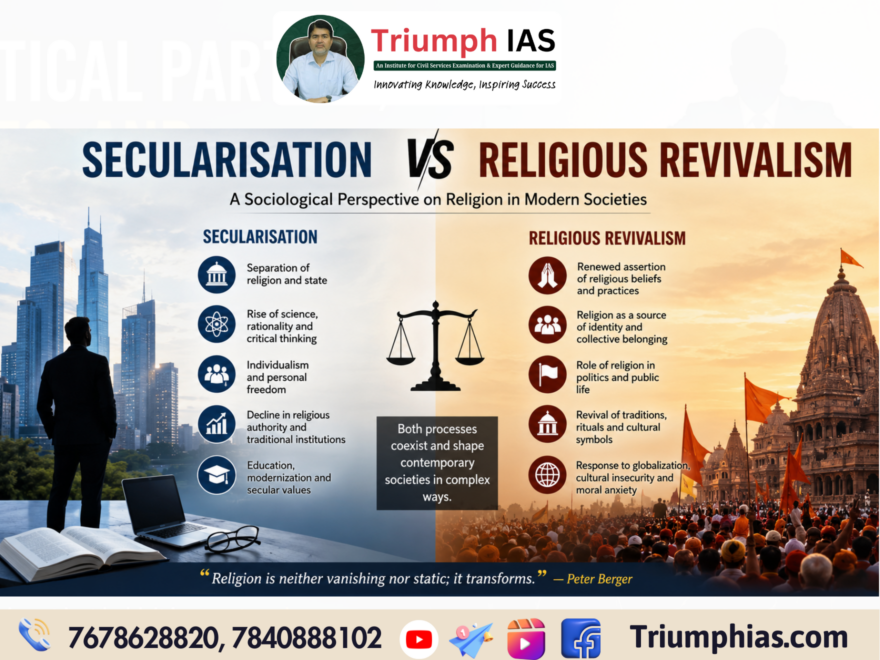
Secularisation refers to the declining influence of religion over social institutions, individual behavior, and collective consciousness. Classical sociologists such as Max Weber, Émile Durkheim, and Karl Marx believed that modernization would gradually reduce the authority of religion. Weber associated secularisation with rationalization and the “disenchantment of the world,” where scientific reasoning replaces mystical explanations. Durkheim argued that religion would lose its traditional control but continue to provide social solidarity in modified forms.

In Western societies, secularisation became visible through declining church attendance, separation of religion from the state, and increasing emphasis on scientific temper and individualism. Education, technology, and democratic institutions further strengthened secular values. In India, secularism acquired a distinct meaning. Unlike the Western model of strict separation between religion and state, Indian secularism emphasizes equal respect for all religions. The Indian Constitution guarantees freedom of religion while maintaining state neutrality in religious matters.

However, the expectation that modernization would inevitably weaken religion has not been fully realized. The late twentieth and early twenty-first centuries have witnessed strong forms of religious revivalism across the world. Religious revivalism refers to the renewed assertion of religious beliefs, practices, and identities in social and political life. It is often seen as a response to cultural insecurity, globalization, moral anxiety, and identity crises.

Examples of revivalism can be observed in the rise of political Islam in West Asia, evangelical movements in the United States, Buddhist nationalism in parts of Asia, and growing religious mobilization in India. Sociologists argue that religion continues to provide emotional security, collective identity, and moral legitimacy in an increasingly fragmented world.

In India, religious revivalism is visible in the increasing role of religion in electoral politics, public discourse, and cultural symbolism. While some view this as cultural resurgence and civilizational confidence, others fear that excessive politicization of religion may weaken constitutional secularism and social harmony. The debate becomes particularly relevant in a diverse society marked by caste, ethnicity, language, and regional identities.

Contemporary sociologists therefore reject the simplistic assumption that secularisation and modernization always go together. Instead, they argue that modernization may transform religion rather than eliminate it. Religion adapts itself through media, digital platforms, and new forms of spiritual consumption. Thus, secularisation and religious revivalism often coexist simultaneously.

The sociological significance of this debate lies in understanding how societies negotiate tradition and modernity. Secularisation promotes rationality, tolerance, and institutional differentiation, whereas religious revivalism reflects the continuing relevance of faith, identity, and cultural belonging. A balanced democratic society requires maintaining harmony between constitutional secularism and freedom of religious expression.

Ultimately, the debate between secularisation and religious revivalism demonstrates that religion remains a dynamic and evolving social force rather than a disappearing institution.

UPSC Civil Services (Mains) Question

Q. “Modernization does not necessarily lead to the decline of religion; rather, it often transforms its form and functions.” Critically examine in the context of secularisation and religious revivalism. (250 words)

To Read more topicsvisit: www.triumphias.com/blogs

Read more Blogs:

Regionalism, Federalism, and Decentralisation


South Asian Societies are woven not around the state, but around their plural cultures and plural identities – Triumph IAS & Vikash Ranjan Sir

🔥 YOUR FINAL UPSC RANK CAN BE DECIDED BY JUST TWO PAPERS — ESSAY & OPTIONAL!

Most aspirants study hard.
But very few know how to convert knowledge into MARKS.

That’s where **Triumph IAS** creates the difference. 🚀

✍️ EMTS – Essay Mentorship & Test Series (CSE Mains 2026–27)

Under the mentorship of **Vikash Ranjan Sir**, master the art of writing structured, philosophical, multidimensional, and topper-level essays.

Scientific Essay Writing Approach
Knowledge Matrix Framework
5 Exclusive Essay Approach Classes
2 Thematic Tests + 4 UPSC Mock Tests
Detailed Model Essay Hints
Flexible Writing & Discussion Sessions
Personal 1-to-1 Mentorship

🏆 Trusted by UPSC Essay Toppers
━━━━━━━━━━━━━━━━━━

📚 SMTS – Sociology Mentorship & Test Series + Quick Revision Session (QRS)

🎯 SCORE 300+ MARKS IN SOCIOLOGY OPTIONAL

A structured, analytical, and result-oriented mentorship program designed to maximize your Sociology score under the guidance of **Vikash Ranjan Sir**.

Program Highlights:

26 Full-Length Tests with Detailed Evaluation
PYQ–NYQ Trend Analysis
Quick Revision Sessions on Unconventional Questions
Brainstorming & Concept Enrichment Sessions
1-to-1 Personal Mentorship Discussions
Topic-wise Answer Writing Practice
Current Social Issues Compilation
Home-based Practice Tests with Model Hints
Thinkers Integration & Value Addition Notes
Essay & GS Enrichment through Sociology

  • 🏆 Legacy of High Scores Continues:
  • 🌟 G.R. Raghavendra, IPS – 318
  • 🌟 Medha Anand, IAS – 310
  • 🌟 Sandesh Jain, IPS – 309
  • 🌟 Gauravjeet Singh, IPS – 309
  • 🌟 Deepanshu Khurana, IFS – 303
  • 🌟 Pradeep Singh, IAS – 302
  • 🌟 Swati Sharma, IAS – 296
  • 🌟 Gunjita Agarwal, IAS – 295

…and many more successful aspirants.

━━━━━━━━━━━━━━━━━

  • *Batch Starts: 01 June*
  • 📍 Available in OFFLINE & ONLINE Mode
  • 📞 Call/WhatsApp: 7678628820 | 7840888102
  • 🌐 triumphias.com
  • 📍 Triumph IAS
  • 23-B, 3rd Floor, Pusa Road
  • Near Karol Bagh Metro Pillar No. 114, New Delhi
Leave a Reply

Your email address will not be published. Required fields are marked *