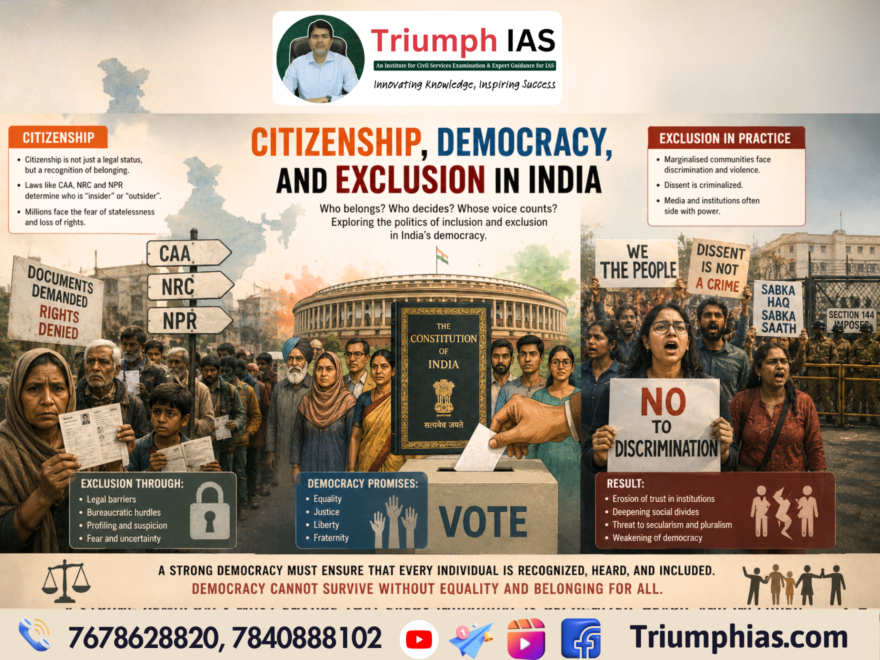
India is often celebrated as the world’s largest democracy, where citizenship guarantees equality, liberty, and participation in public life. The Constitution of India envisions citizenship not merely as a legal identity but as a framework for dignity, justice, and inclusion. However, sociological realities reveal that citizenship in India remains deeply unequal due to caste, class, gender, religion, region, and ethnicity. The relationship between democracy and exclusion therefore becomes a critical area of sociological inquiry.
Citizenship refers to the formal membership of individuals within a nation-state, granting them rights as well as responsibilities. Sociologist T. H. Marshall conceptualized citizenship in terms of civil, political, and social rights. In the Indian context, while constitutional citizenship provides universal adult franchise and legal equality, substantive citizenship often differs across social groups. The gap between constitutional ideals and lived realities exposes patterns of exclusion embedded within society.
Indian democracy has undoubtedly expanded political participation. Marginalized communities, women, Dalits, tribal groups, and backward classes increasingly participate in electoral politics and social movements. Democratic institutions such as Panchayati Raj, reservations, and welfare schemes have attempted to democratize access to power and resources. The rise of social justice politics after the Mandal Commission reflected how democracy can become a tool for historically oppressed communities to claim recognition and representation.
Yet, exclusion continues to shape the experience of citizenship. Sociologically, exclusion refers to processes through which certain groups are denied equal access to resources, opportunities, and participation. In India, caste remains one of the strongest determinants of exclusion. Despite constitutional safeguards, Dalits continue to face discrimination, social segregation, and violence in many parts of the country. Untouchability may be legally abolished, but it persists in subtle and overt forms within everyday social interactions.
Religious minorities also experience forms of exclusion linked to identity and representation. Debates surrounding nationalism, citizenship laws, and communal polarization have intensified concerns regarding equal citizenship. Similarly, tribal communities are often displaced in the name of development projects, reflecting how economic growth can marginalize vulnerable populations. Urban exclusion is visible in the growth of slums, informal labour, and unequal access to education, healthcare, and digital infrastructure.
Gender inequality further complicates democratic citizenship. Women in India formally possess equal political rights, yet patriarchal norms restrict their participation in public spaces and decision-making. Issues such as gender violence, wage inequality, and underrepresentation demonstrate that democratic rights alone do not guarantee substantive equality.
Globalization and neoliberal reforms have also transformed citizenship. Economic liberalization created new opportunities for the middle class but widened inequalities between regions and social groups. The informal sector, migrant labourers, and rural populations often remain excluded from social security and welfare protections. The COVID-19 pandemic highlighted these inequalities when millions of migrant workers struggled for survival despite being citizens of the same democratic nation.
From a sociological perspective, democracy is not limited to elections; it also requires social inclusion and participatory justice. Thinkers like B. R. Ambedkar emphasized that political democracy cannot survive without social and economic democracy. If social hierarchies continue to dominate society, democratic institutions alone cannot ensure equality.
Therefore, strengthening citizenship in India requires moving beyond formal rights toward inclusive development, social justice, and participatory governance. Education, affirmative action, welfare policies, and protection of minority rights are essential to deepening democracy. Civil society movements, digital activism, and grassroots mobilization also play an important role in expanding democratic spaces for marginalized groups.
Conclusion
In conclusion, the sociology of citizenship in India reveals a paradox: democracy has empowered millions, yet exclusion persists through enduring social inequalities. The challenge before Indian democracy is not merely to preserve electoral institutions but to ensure that every citizen experiences dignity, equality, and meaningful participation in social life. Only then can citizenship become truly democratic and inclusive.





3 comments