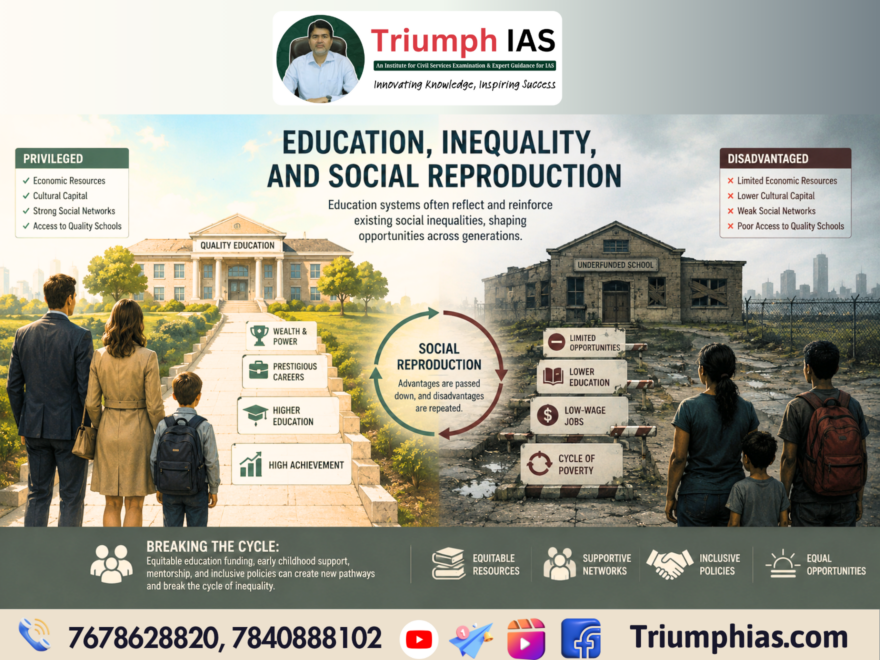
Education is often described as the “great equalizer” because it promises opportunities for upward social mobility. Modern democratic societies consider education essential for individual growth, economic development, and social integration. However, Sociology reveals a more complex reality: education not only reduces inequalities in some cases but also reproduces existing social hierarchies based on class, caste, gender, ethnicity, and region. This process is known as social reproduction.
The concept of social reproduction explains how inequalities persist across generations through social institutions, especially the education system. Sociologists such as Pierre Bourdieu, Louis Althusser, and Bowles and Gintis argued that schools often function in ways that maintain the dominance of privileged groups rather than creating genuine equality.
According to Pierre Bourdieu, education reproduces inequality through the transmission of cultural capital. Children from affluent and educated families inherit language skills, confidence, social etiquette, and cultural exposure that align with the expectations of schools. These advantages help them perform better academically. In contrast, students from marginalized backgrounds may possess talent and intelligence but lack the cultural resources valued by educational institutions. As a result, the education system rewards the already privileged.
Similarly, the correspondence principle developed by Samuel Bowles and Herbert Gintis suggests that schools mirror the inequalities of the capitalist workplace. Elite schools prepare students for leadership roles, while underfunded institutions often train poorer students for subordinate positions. Thus, education becomes a mechanism for maintaining class structure rather than dismantling it.
In the Indian context, educational inequality is shaped by caste, class, gender, language, and rural-urban disparities. Despite constitutional commitments to equality and schemes such as the Right to Education Act, access to quality education remains uneven. Students from privileged urban backgrounds often benefit from private schools, coaching institutes, digital resources, and English-medium education. Meanwhile, many rural and marginalized communities struggle with poor infrastructure, teacher shortages, digital exclusion, and financial constraints.
Caste-based inequalities continue to influence educational outcomes. Historically disadvantaged communities such as Scheduled Castes and Scheduled Tribes have faced social exclusion, discrimination, and lower access to educational opportunities. Reservation policies and welfare schemes have improved representation, yet structural inequalities persist in subtle forms, including social stigma and unequal classroom experiences.
Gender inequality also affects educational attainment. Although female literacy and enrollment have improved significantly, many girls still face barriers such as early marriage, domestic responsibilities, lack of sanitation facilities, and patriarchal attitudes. Sociologists argue that education often reproduces gender roles through textbooks, hidden curriculum, and societal expectations.
At the same time, education can also serve as an instrument of social transformation. Reformers such as B. R. Ambedkar viewed education as a tool for empowerment and liberation from caste oppression. Public education, affirmative action, scholarships, and inclusive policies have enabled many individuals from marginalized groups to achieve upward mobility. Digital education platforms and expanding higher education opportunities are also opening new possibilities for social inclusion.
However, the commercialization and privatization of education raise serious concerns. The growing dominance of expensive private institutions and coaching culture may deepen inequalities by making quality education dependent on economic capacity. This creates a situation where merit itself becomes socially conditioned rather than purely individual.
Therefore, Sociology emphasizes that education cannot be understood merely as a neutral institution. It reflects broader power relations within society. For education to become genuinely transformative, policies must focus not only on enrollment but also on equitable access, quality, inclusivity, and social justice. Equal educational opportunity requires addressing structural inequalities rooted in society itself.
In conclusion, education occupies a paradoxical position in society. It has the potential to empower individuals and reduce social inequality, yet it can also reproduce existing hierarchies across generations. Understanding this dual role is essential for building a more equitable and democratic society.






2 comments