


𝐑𝐞𝐥𝐞𝐯𝐚𝐧𝐭 𝐟𝐨𝐫: Essay for IAS
INTRODUCTIONSuccess, whether personal or collective, is rarely the product of chance alone. It emerges from a complex interplay of effort, learning, resilience, and ethical clarity. Among the many attributes associated with success, two stand out as foundational: the courage to accept reality and the dedication to improve it. Acceptance without effort breeds complacency, while effort without acceptance leads to denial and frustration. Together, however, acceptance and improvement form a dynamic process through which individuals and societies learn, adapt, and progress. Thus, the proposition that courage to accept and dedication to improve are two keys to success captures a timeless truth about human development. It emphasizes that success is not merely about ambition or talent, but about honest self-assessment coupled with sustained commitment to growth. MAIN BODY:At the outset, acceptance must be clearly distinguished from resignation. Acceptance does not imply passivity or surrender; rather, it is an act of clarity. To accept is to acknowledge facts as they are—one’s limitations, failures, circumstances, and constraints—without distortion or denial. This act often requires courage, because truth is frequently uncomfortable. Psychologically, denial offers temporary relief, but it obstructs learning. Individuals who refuse to accept failure externalize blame and repeat mistakes. In contrast, acceptance opens the door to reflection. Philosophically, Stoic thinkers such as Epictetus emphasized acceptance of what lies beyond one’s control as the first step toward inner freedom. Thus, courage to accept reality is not weakness; it is the foundation of rational action Success presupposes an accurate understanding of one’s starting point. Whether in academics, governance, leadership, or personal life, progress begins with honest diagnosis. A student who accepts gaps in preparation can improve strategically. An administrator who acknowledges systemic flaws can initiate reform. A society that recognizes inequality can strive toward justice. History reinforces this insight. Nations that acknowledged institutional weaknesses—be it in education, economy, or public health—have been better positioned to reform. Conversely, societies trapped in denial often stagnate. Therefore, acceptance is not the end of effort; it is the necessary beginning. Acceptance is not merely cognitive; it is ethical and emotional. It demands courage because it confronts ego, pride, and fear. Admitting error challenges self-image. Accepting responsibility may invite criticism or accountability. Consequently, many resist acceptance and seek comfort in justification. However, courage in acceptance reflects maturity. Mahatma Gandhi’s emphasis on self-purification before social reform illustrates this principle. Only those willing to accept personal and collective shortcomings can legitimately aspire to transformation. Hence, courage to accept is a moral virtue that precedes effective action. While acceptance provides clarity, dedication to improve provides momentum. Improvement requires sustained effort, discipline, and perseverance over time. Unlike sudden inspiration, dedication is quiet and continuous. It involves learning from mistakes, refining methods, and remaining committed despite slow or uncertain results. Aristotle described excellence as a habit rather than an act. Similarly, modern theories of growth mindset emphasize that abilities can be developed through effort and learning. Thus, dedication transforms potential into achievement. Without dedication, acceptance remains sterile; with it, acceptance becomes transformative. Improvement is rarely linear. It involves setbacks, reassessment, and recalibration. Dedication, therefore, must be resilient rather than rigid. Those committed to improvement view failure not as a verdict, but as feedback. Scientific progress exemplifies this principle. Experiments fail, hypotheses are revised, and theories evolve. Yet, dedication to inquiry sustains advancement. In the same way, personal and institutional success depends not on flawless execution, but on persistence in improvement. Consequently, dedication must be long-term and adaptive. Acceptance and improvement are not sequential stages but interdependent processes. Acceptance without improvement leads to fatalism, while improvement without acceptance leads to misdirected effort. For instance, policy reforms that ignore ground realities often fail, just as recognition of problems without action leads to inertia. This interdependence reflects a dialectical relationship. Acceptance grounds improvement in reality, while improvement validates acceptance by converting awareness into action. Together, they create a virtuous cycle of learning and growth. At the individual level, this dual principle shapes character and competence. Successful individuals are not those who never fail, but those who confront failure honestly and work consistently to overcome it. Athletes analyze losses to refine technique. Professionals seek feedback to enhance skills. Leaders acknowledge errors to regain trust. Moreover, emotional resilience depends on this balance. Acceptance prevents self-deception, while dedication sustains hope. Thus, success becomes not a destination but a continuous process of self-betterment. Organizations, too, succeed when they institutionalize acceptance and improvement. Transparent evaluation, audits, and feedback mechanisms reflect acceptance of imperfections. Continuous training, innovation, and reform reflect dedication to improvement. Corporate failures often stem from denial of risks, while enduring institutions adapt through learning. Similarly, public institutions that acknowledge policy shortcomings and refine implementation are more effective than those driven by image management. Hence, the two keys operate not only at personal but also at systemic levels. In governance, the relevance of this principle is profound. Democracies depend on acceptance of dissent, criticism, and accountability. Governments that accept socio-economic challenges honestly can design realistic policies. Dedication to improve ensures that governance remains responsive rather than complacent. Public administration reforms, social welfare expansion, and technological modernization all require candid assessment of gaps and sustained commitment to improvement. Without acceptance, populism thrives; without dedication, reforms remain symbolic. Therefore, success in public life depends on integrating both virtues. Philosophically, courage to accept reflects humility, while dedication to improve reflects hope. Humility acknowledges human limitation; hope affirms human potential. Together, they define ethical realism—a worldview that neither despairs over imperfection nor indulges in illusion. Existential thinkers emphasized responsibility arising from awareness. Once reality is accepted, individuals are morally obligated to act. Thus, dedication to improve is not optional; it is an ethical response to accepted truth. Success, in this sense, is moral as much as material. Despite its clarity, practicing acceptance and improvement is difficult. Social pressures reward appearance over honesty. Short-term incentives discourage sustained effort. Fear of failure inhibits acceptance, while impatience undermines dedication. However, overcoming these challenges is itself part of success. Education, ethical leadership, and supportive institutions can cultivate cultures where acceptance is valued and improvement rewarded. In such environments, success becomes inclusive and sustainable. In a rapidly changing world marked by uncertainty, this principle acquires renewed relevance. Global challenges—climate change, inequality, technological disruption—require honest acceptance of limits and unwavering dedication to improvement. Denial delays action; despair paralyzes effort. Thus, whether addressing personal goals or collective crises, humanity must embrace reality with courage and pursue progress with dedication. Only then can success be meaningful and enduring. CONCLUSION:In conclusion, courage to accept and dedication to improve are indeed two keys to success. Acceptance provides clarity, honesty, and grounding in reality, while dedication ensures continuity, resilience, and growth. Separated, each is incomplete; together, they transform failure into learning and limitation into opportunity. Success, therefore, is not the absence of flaws, but the presence of courage and commitment. Individuals, institutions, and societies that accept their realities without fear and strive persistently to improve them embody the true spirit of success. In this balanced integration of humility and perseverance lies the sustainable path to achievement and excellence. |
Read more blog:
Best Essay Writing Course for UPSC CSE
If you’re preparing for the UPSC Civil Services Examination (CSE), one paper that can unlock exceptional scores and a top rank is the Essay Paper. While General Studies and Optional Subjects are structured and syllabus-driven, the Essay writing segment is where individuality, critical thinking, and articulation truly shine.
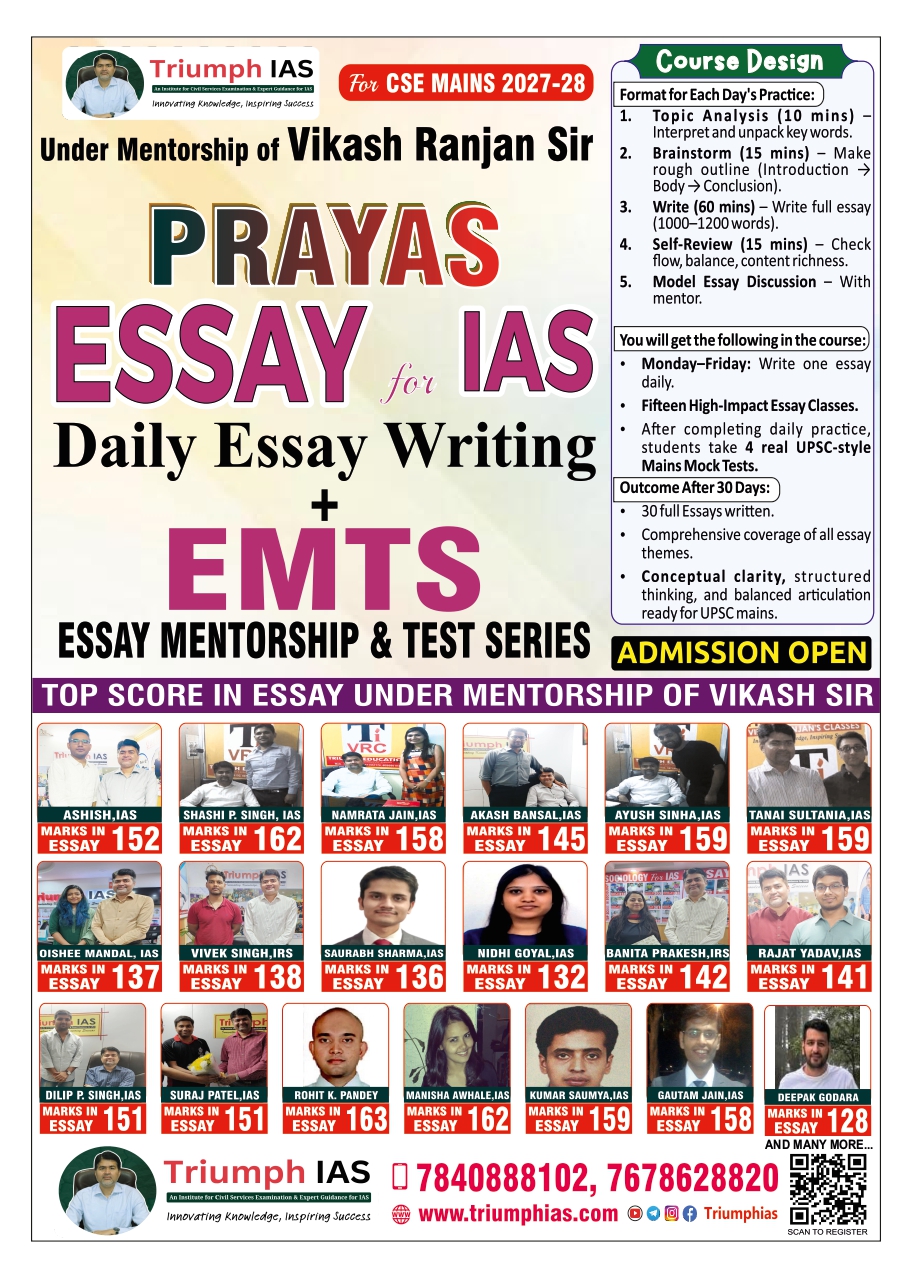
Among various Essay programs available across India, Triumph IAS, under the expert mentorship of Vikash Ranjan Sir, offers the Best Essay writing Course for UPSC CSE. This comprehensive guide explores what makes this program unparalleled and why it should be part of every serious aspirant’s preparation strategy.




2 comments