
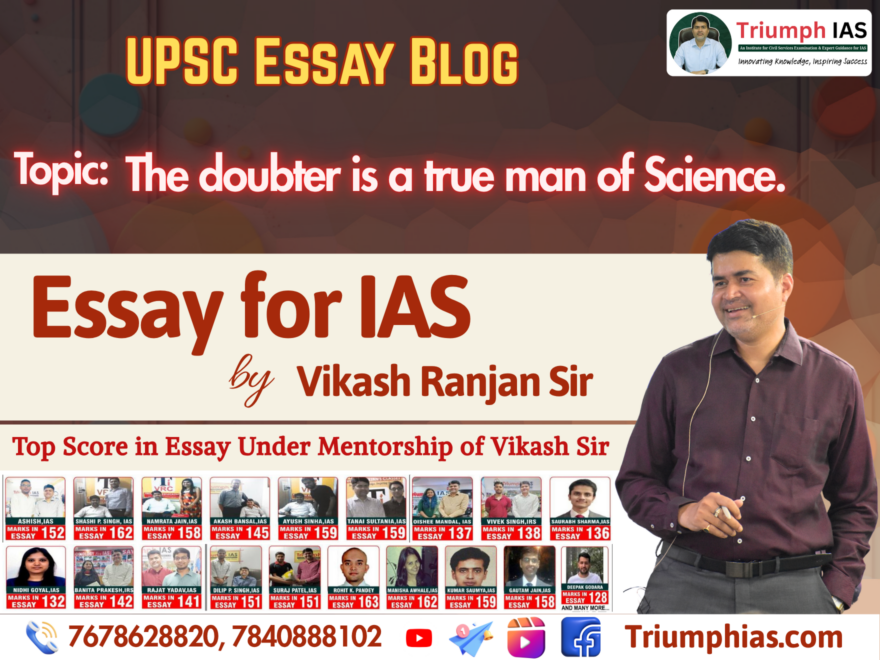
𝐑𝐞𝐥𝐞𝐯𝐚𝐧𝐭 𝐟𝐨𝐫: Essay for IAS
INTRODUCTION:At the heart of scientific inquiry lies a deceptively simple yet profoundly transformative attitude: doubt. The assertion that “the doubter is a true man of science” captures the essence of the scientific spirit more accurately than any celebration of certainty or authority. Science does not advance through unquestioned acceptance but through systematic skepticism, critical examination, and the willingness to revise even the most cherished beliefs. From the overthrow of geocentric cosmology to the ongoing re-evaluation of physical laws and biological theories, scientific progress has been propelled by those who dared to doubt the obvious, the traditional, and the authoritative. In this sense, doubt is not a sign of intellectual weakness but of epistemic humility. A true man of science, therefore, is not one who claims final answers, but one who continuously interrogates assumptions in pursuit of a more accurate understanding of reality. MAIN BODY:The scientific method itself is institutionalized doubt. Observation, hypothesis, experimentation, and falsification are all mechanisms designed to test claims rather than accept them at face value. Karl Popper famously argued that scientific theories are distinguished not by their verifiability but by their falsifiability. A theory remains scientific only insofar as it can be challenged and potentially disproven. Thus, the doubter embodies the methodological core of science. By questioning existing explanations and subjecting them to empirical scrutiny, the scientist ensures that knowledge remains provisional and corrigible. Without doubt, hypotheses would harden into dogma, and science would lose its dynamic character. Therefore, skepticism is not an obstacle to knowledge; it is its primary engine. History provides abundant evidence that doubt has been the catalyst for scientific revolutions. Copernicus doubted the geocentric model endorsed by centuries of religious and philosophical authority. Galileo doubted Aristotelian physics and insisted on observation over inherited doctrine. Darwin doubted static conceptions of species, proposing instead a dynamic process of evolution through natural selection. In each case, doubt confronted entrenched belief systems and provoked resistance. Yet, these doubts ultimately expanded human understanding and reshaped worldviews. As Thomas Kuhn observed, scientific progress often occurs through paradigm shifts initiated by anomalies that existing theories cannot explain. Doubt, therefore, functions as the bridge between anomaly and innovation. Beyond methodology, doubt reflects a moral and intellectual virtue: humility. The doubter acknowledges the limitations of human knowledge and resists the temptation of certainty. This humility safeguards science against arrogance and authoritarianism. In contrast, unquestioned certainty often characterizes pseudoscience and dogmatism. Claims immune to criticism, whether religious, ideological, or scientific, undermine the ethos of inquiry. The true man of science remains open to revision, recognizing that knowledge evolves with new evidence and better methods. Such openness preserves intellectual integrity and fosters a culture of continuous learning. Paradoxically, doubt is also a source of creativity. Questioning established frameworks creates intellectual space for new ideas. Scientific imagination thrives when familiar explanations are unsettled. Albert Einstein’s revolutionary theories emerged from his willingness to doubt Newtonian absolutes of space and time. Thus, doubt does not paralyze inquiry; it liberates it. By destabilizing the known, doubt invites exploration of the unknown. In this sense, the doubter embodies both critical rigor and creative vision, demonstrating that skepticism and imagination are complementary rather than contradictory. While doubt is central to science, it must be distinguished from cynicism or relativism. Scientific doubt is disciplined and constructive, guided by evidence and rational argument. Cynicism, by contrast, dismisses the possibility of knowledge altogether, eroding trust in reason. A true man of science doubts in order to understand, not to negate meaning. He subjects claims to scrutiny but accepts conclusions provisionally when supported by robust evidence. This balance between skepticism and commitment prevents science from descending into nihilism. Thus, doubt in science is purposeful, not corrosive. In the contemporary world, where scientific knowledge influences public policy, healthcare, and technology, the role of doubt acquires renewed significance. Rapid scientific advancements, particularly in fields such as artificial intelligence, biotechnology, and climate science, raise complex ethical and social questions. Doubt here functions as a safeguard against uncritical technological enthusiasm. Moreover, in an era of misinformation and ideological polarization, scientific doubt helps distinguish credible knowledge from speculation. Peer review, replication, and transparency institutionalize skepticism, maintaining public trust in science. Therefore, the doubter is not only central to scientific progress but also to democratic discourse. Philosophically, doubt has long been recognized as a pathway to knowledge. René Descartes employed methodological doubt to arrive at foundational certainty, illustrating how skepticism can clarify rather than obscure truth. Similarly, Socratic inquiry relied on questioning assumptions to reveal deeper understanding. In science, however, certainty is never final. Truth is approached asymptotically, refined through successive approximations. The doubter accepts this provisionality, embracing uncertainty as an integral aspect of knowledge. This epistemic stance aligns with the scientific temper, which values inquiry over closure. The ethical dimension of doubt cannot be overlooked. Scientific discoveries carry profound consequences for humanity and the environment. Doubt encourages reflection on unintended effects, ethical implications, and long-term risks. For example, questioning the unrestrained use of nuclear energy or genetic engineering reflects responsible scientific skepticism. Thus, the doubter serves as a moral conscience within science, ensuring that innovation remains aligned with human values. In this way, doubt transcends epistemology and enters the realm of ethical responsibility. CONCLUSION:The statement that “the doubter is a true man of science” encapsulates a fundamental truth about the nature of scientific inquiry. Doubt is the engine that drives discovery, the virtue that preserves humility, and the discipline that safeguards integrity. Far from undermining knowledge, doubt sustains its vitality and relevance. In a world increasingly shaped by scientific and technological power, the need for thoughtful skepticism has never been greater. The true man of science does not claim absolute certainty; instead, he embraces uncertainty as an invitation to deeper understanding. By doubting wisely and constructively, science continues its quest—not for final answers, but for ever more reliable ways of knowing the world and our place within it. |
Read more blog:
The Empires of the future will be the empires of the mind – Triumph IAS & Vikash Ranjan Sir
Best Essay Writing Course for UPSC CSE
If you’re preparing for the UPSC Civil Services Examination (CSE), one paper that can unlock exceptional scores and a top rank is the Essay Paper. While General Studies and Optional Subjects are structured and syllabus-driven, the Essay writing segment is where individuality, critical thinking, and articulation truly shine.
Among various Essay programs available across India, Triumph IAS, under the expert mentorship of Vikash Ranjan Sir, offers the Best Essay writing Course for UPSC CSE. This comprehensive guide explores what makes this program unparalleled and why it should be part of every serious aspirant’s preparation strategy.


3 comments